Wednesday, May 5, 2021

'No more' PILs from Traffic Ramaswamy at Madras High Court


'No more' PILs from Traffic Ramaswamy at Madras High Court

Traffic Ramaswamy was a familiar figure at the Madras High Court, often spotted clad in his trademark white shirt and khaki trousers, darting between courts, his Personal Security Officer in tow.

Published: 05th May 2021 12:02 AM 


Traffic Ramaswamy (Photo | EPS)


Express News Service

CHENNAI: Prakasam Salai road in the buzzling Parry's locality that housed the office cum residence of Traffic Ramaswamy will no longer be the same after the passing of the social activist at age 87. The High Court premises neighbouring his office was a frequent visiting point for Ramaswamy.

Traffic Ramaswamy was a familiar figure at the Madras High Court, often spotted clad in his trademark white shirt and khaki trousers, darting between courts, his Personal Security Officer in tow.

S Ganesan, a long time associate and advocate for the hundreds of Public Interest Litigation petitions filed by the crusader since the early 2000s, recalled the 2002 incident that spurred Ramaswamy to regularly file cases of public interest.

"He had filed a PIL to regulate fish carts and a section of fish cart owners beat him up and left him bleeding on the road. The then Chief Justice of the Madras High Court Subhashan Reddy in 2003 provided him with a personal security officer," he emphasised.

Since then there has been no turning back for the activist who took up several cases of public interest in Chennai.

Ganesan recalls that there was an instance where Ramaswamy attended the wedding of a close friend's son, however, the moment he saw posters outside on the road leading towards the marriage hall, he left the place without attending the function. He later called up his friend and informed him that the posters were erected illegally and that it was a violation.

"Nothing bogged down the activist, even the several contempt charges he had faced in court," says Ganesan.

In 2014, Ramaswamy was imposed with a Rs 25,000 fine by a division bench of the Madras High Court for filing a vague PIL stating that party functionaries who swore allegiance to criminals cannot form the government.

On most of the occasions, Ramaswamy's PILs were dismissed by the court which found them vague.

However, the octogenarian kept filing them, with the most recent one being a PIL filed against the use of unregistered battery-run cars by the Chennai corporation for collecting garbage.

Following the court direction, all the vehicles were then registered and brought under the Regional Transport Authority for compliance.

Just in the last week of April, the Madras High Court ordered the Chennai corporation to file a report on GNT road encroachments after a PIL by Ramaswamy. Unfortunately the activist will no longer be a witness to its proceedings.

ICMR: Do away with must RT-PCR test for inter-state travel


ICMR: Do away with must RT-PCR test for inter-state travel

TIMES NEWS NETWORK

New Delhi:05.05.2021 

The Indian Council for Medical Research in its advisory for Covid-19 testing during the second wave of the pandemic has recommended that the need for RT-PCR test in healthy individuals undertaking inter-state domestic travel may be completely removed to reduce the load on laboratories. As part of the measures to optimise RT-PCR testing, ICMR advisory makes it clear that the test must not be repeated in any individual who has tested positive once either by RAT or RT-PCR. Also no testing is required for Covid-19 recovered individuals at the time of hospital discharge in accordance with the discharge policy of the ministry of health and family welfare.

The advisory emphasises that non-essential travel and interstate travel of symptomatic individuals (Covid-19 or flu like symptoms) should be essentially avoided to reduce the risk of infection and all asymptomatic individuals undertaking essential travel must follow Covid appropriate behaviour.

It pointed out that mobile testing laboratories are now available on GeM portal and states must augment RT-PCR testing through mobile systems. “To meet the overwhelming testing demand, it will be prudent to upscale testing using Rapid Antigen Tests,” the advisory recommends.

Explaining the need for a detailed advisory on testing for Covid-19, ICMR cites the “unprecedented upsurge of Covid-19 cases and deaths currently being witnessed across India”. The overall nationwide test positivity rate is above 20%. In this backdrop testing-tracking-tracing, isolation and home-based treatment of positive patients is the key measure to curb transmission of SARSCoV-2. As of today, India has a total of 2,506 molecular testing laboratories including RTPCR, True-Nat, CBNAAT and other platforms. The total daily national testing capacity is close to15 lakh tests considering a three- shift operationalisation of the existing laboratory network.

As US travel ban kicks in, families are sundered and study plans disrupted


As US travel ban kicks in, families are sundered and study plans disrupted

Those Stranded Sign Petition Seeking Exemption For Non-Immigrants

Chidanand.Rajghatta@timesgroup.com

Washington:  05.05.2021 

Pankaj Patil lost his father, a retired government official in Nashik, to Covid-19 on April 2. He rushed home from US, where he works as an IT professional on an H-1B visa, to be with his mother. With his wife Kavita expecting their second child at their home in Connecticut, Pankaj, with all his work and travel papers in order, hoped to take his mother back with him to help navigate what doctors have said would a high-risk pregnancy because of high sugar and thyroid fluctuation. On April 30, just before Pankaj was to travel back to his wife and sixyear old daughter Aarushi, the Biden administration announced restrictions on travel from India to contain Covid-19 variants from entering the US.

As the travel ban kicked in at midnight on May 4, the family and professional life of thousands like Pankaj Patil have been sundered and disrupted. Husbands and wives, mothers and fathers separated from each other and from their children; jobs, careers, and mortgages jeopardised, and schooling thrown out of whack. “Many of us travelled to India for family emergencies in light of the pandemic, some to say their final goodbyes to parents, grandparents, and loved ones. Our visa appointments got cancelled without much notice, some even on the day off with no support or preference on rescheduling of those appointments. We are now stuck in India indefinitely, separated from spouses, children, families and community,” they pleaded in a petition to President Biden, signed by Patil and more than 4,000 affected people, seeking a travel ban exemption for non-immigrant (H-1B/H4/L1/L2) visa holders, with similar provisions that have been extended to international students, Green Card holders, and US citizens travelling from India: a negative RTPCR test, 14-day quarantine, and vaccination proof.

Indeed, many immigration advocates and lawyers back their pleas, pointing out the fallacy of banning non-immigrant professionals from India who may be vaccinated and have tested negative for the virus while allowing students, green card holders and citizens from across the world who could be carrying the virus. “Isn’t it better to ensure that travellers to US are vaccinated and/or test negative and quarantine?” asks New York-based immigration attorney Cyrus Mehta, adding the ban is disproportionately affecting professionals from India and the “virus does not know the difference” between citizens and non-immigrants.

Payal Raj and her daughter came to India from Tennessee on April 6 to see their family, hoping also to revalidate their visas during their stay after her husband joined them on April 16. Two days after Payal landed in Patna, her parents, brother, and sister developed Covid symptoms, forcing her to check into a hotel with her daughter. Already vaccinated in the US, the family flew to Delhi for a scheduled Dropbox appointment at the US embassy on April 20, armed with negative Covid results. The visa officer accepted the passport of her husband (on a H-1B visa) and her daughter, but Payal, who is on an H4 dependent visa, was left behind. “I wake up in the middle of the night in sweats thinking when and if ever I will be able to go back,” says Payal, adding that her husband is having to give melatonin to their anxious nineyear old daughter so she can get some sleep.

The travel restriction has also disrupted the plans of many senior citizens. Mumbai’s Prakash Nanavati and his wife had planned to celebrate their 50th wedding anniversary with their son in the Bay Area, while also attending their grand daughter’s graduation ceremony. Vaccinated and armed with negative test results, and with a 10-year visa on hand, they had booked their tickets for May16, but the travel ban has scuppered their plans.

Also on tenterhooks are thousands of students from India. While the US embassy in New Delhi reiterated on Tuesday that student visa holders would be able to enter the US if their classes start on or after August 1, 2021, it urged those whose start date is before August 1, some of whom have graduated and have lined up internships, to “contact your respective educational institutions to discuss options.” “I am a part of critical infrastructure sector (pharmaceuticals) which is eligible for NIE (National Interest Exemption) as per presidential proclamation. I am working and assisting directly in development & manufacturing of oncology & neuroscience drugs. My NIE was refused because I am on F1 visa, stem OPT,” wrote back one student. Scores of professionals, students, and interns are writing to the US missions urging travel exemptions for those who are vaccinated. Their pleas are lost in the din of a greater tragedy unfolding across India.

Many immigration advocates and lawyers back the pleas of those stranded, pointing out the fallacy of banning non-immigrant professionals from India who may be vaccinated and have tested negative for the virus while allowing students, green card holders and citizens from across the world who could be carrying the virus

Oz says chance of jail remote for India travel ban offenders

Australian PM Scott Morrison, under pressure to overturn rules barring travel from -ravaged India, said on Tuesday it was “highly unlikely” travellers would face maximum penalties of five years jail and a A$66,000 ($51,000) fine. Australia last week banned all travellers from India, including its own citizens, from entering the country until May 15. The temporary restrictions have been excoriated by lawmakers, expatriates and the Indian diaspora. “I don’t think it would be fair to suggest these penalties in their most extreme forms are likely to be placed anywhere, but this is a way to ensure we can prevent the virus coming back,” Morrison told local broadcaster Channel Nine. The rules would be used “responsibly and proportionately” but were needed.

Former Australia cricket player Michael Slater, who was working in India as a commentator for the Indian Premier League, lambasted the Australian government for the travel ban. “Blood on your hands PM. How dare you treat us like this. How about you sort out quarantine system,” Slater said in a tweet. Morrison dismissed Slater’s comments as “absurd”. Repatriation flights from India may resume as planned by May 15, the PM said, as the government looks to more than double the capacity in a quarantine facility in the Northern Territory by the middle of this month. REUTERS

Two Positives Can Still Make A Negative


THE SPEAKING TREE A SHOT OF HOPE

Two Positives Can Still Make A Negative

Ramesh Bijlani

05.05.2021 

To be found Covid-positive spells fear, panic, isolation and depression – everything negative. A positive attracting something negative is not inevitable. But before that, let us see what being Covid-positive means.

Suppose we devise a test that detects the presence of food in the mouth. The sensitivity of the test is such that the result is positive in anybody who has had a meal within the last one hour. Since we have three meals a day, in tests done at random throughout the day, about one-third of the population will test positive. It does not mean that the two-third who test negative do not eat. It only means they probably took a meal more than an hour ago. Our test is not sensitive enough to pick them up. Further, some ‘sensible’ people would have rinsed the mouth immediately after the meal. They will test negative even ten minutes after a meal – these will be our false negatives. On the other hand, some people who have taken only a sugary drink will test positive, although they have not taken a meal – these will be our false positives.

In the current context, we are all breathing air which has some coronavirus. The only way to breathe air which has no coronavirus at all is to stop breathing! Therefore, to test positive is no surprise. Up to a point, the body’s in-built mechanisms can deal with the virus, and we will not get sick. The crucial point is that these defence mechanisms are weakened by fear and depression; conversely, they are strengthened by peace and hope.

Hence, there is a place for relaxation techniques. The techniques only create the right atmosphere for a process.

The process facilitated by relaxation techniques consists of developing a new perspective, creating the foundation for unshakable peace, and thereby letting prana, the life-force, do its job.

The new perspective is that ‘all stress’, including Covid-positivity, is sent to us by a Higher Force to guide us towards greater harmony with our surroundings based on love and oneness. This higher, wider and deeper perspective suspends questions such as ‘Why me? Will I die? What will happen to my near and dear ones?’ These questions, which create noise in the mind without solving any issue, get terminated temporarily by relaxation techniques, thereby creating a small window of silence for the new perspective to start taking shape.

The new perspective leads to peaceful acceptance of all eventualities. Since the peace is based on a high, wide and deep foundation, it is unshakable. Unshakable peace lets the life-force deal with the infection to the best of its ability. But even its best may not be good enough to always save us from death. However, as Sri Aurobindo told us, the skills of the Divine exceed those of a million doctors. Thus, being Covidpositive can initiate a positive process, which in turn can negate all fear, including the fear of death.

The writer, once a professor at AIIMS, New Delhi, is now a spiritual seeker at Sri Aurobindo Ashram – Delhi branch.

For hope in the time of Covid-19, send your questions to spiritual masters, scan the QR Code or visit https://bit.ly/3eGSfvo

கரோனா சிகிச்சை; சேலம் அரசு மருத்துவமனையில் உடனுக்குடன் படுக்கை கிடைக்காத நிலை

கரோனா சிகிச்சை; சேலம் அரசு மருத்துவமனையில் உடனுக்குடன் படுக்கை கிடைக்காத நிலை

Published : 04 May 2021 21:02 pm

Updated : 04 May 2021 21:02 pm


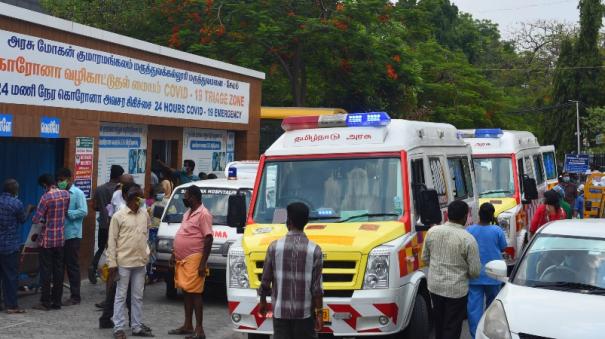
சேலம் அரசு மோகன் குமாரமங்கலம் மருத்துவக் கல்லூரி மருத்துவமனையில் உள்ள கரோனா அவசர சிகிச்சைப் பிரிவு முன்பு அணிவகுத்து நின்ற ஆம்புலன்ஸ்கள்.


கரோனா தொற்றினால் பாதிக்கப்பட்டு, சேலம் அரசு மருத்துவமனைக்கு சிகிச்சைக்காக வருபவர்களின் எண்ணிக்கை அதிகரித்துள்ளதால், நோயாளிகளுக்கு உடனுக்குடன் மருத்துவமனையில் படுக்கை வசதி கிடைக்காத நிலை ஏற்பட்டுள்ளது.

தமிழகத்தில் கரோனா தொற்றின் 2-ம் அலை வேகமாகப் பரவி வருகிறது. இதன் காரணமாக, சேலம் மாவட்டத்திலும் கரோனா தொற்றினால் தினமும் 500க்கும் மேற்பட்டவர்கள் பாதிக்கப்பட்டு வருகின்றனர். மேலும், தொற்றினால் பாதிக்கப்பட்டு உயிரிழப்பு எண்ணிக்கையும் தற்போது அதிகரித்துள்ளது.

இந்நிலையில், சேலம் அரசு மருத்துவக் கல்லூரி மருத்துவமனை, மேட்டூர் மாவட்ட அரசு தலைமை மருத்துவமனை, ஆத்தூர், பெத்தநாயக்கன் பாளையம், ஓமலூர் உள்ளிட்ட அரசு மருத்துவமனைகள், தனியார் மருத்துவமனைகள் ஆகியவற்றில் கரோனா வார்டுகளில் தொற்றினால் பாதிக்கப்பட்டோர் சிகிச்சைக்காக சேருவது அதிகரித்துவிட்டது.

குறிப்பாக, கரோனா தொற்றினால் பாதிக்கப்பட்டு சேலம் அரசு மருத்துவமனைக்கு சிகிச்சைக்காக வருபவர்களுக்கு, உடனுக்குடன் படுக்கை வசதி கிடைப்பதில்லை. இதனால், ஆம்புலன்ஸில் வரும் கரோனா நோயாளிகள், ஆம்புலன்ஸிலேயே காத்திருக்க வேண்டிய நிலை ஏற்பட்டுள்ளது.

இதுகுறித்து மருத்துவமனை அதிகாரிகள் கூறுகையில், "சேலம் அரசு மருத்துவமனையில் உள்ள 800 படுக்கைகளும் நிரம்பியதன் காரணமாக, புதிதாக வருபவர்களுக்கு உடனுக்குடன் படுக்கை வசதி அளிக்க முடிவதில்லை. சிகிச்சையில் குணமடைந்து நோயாளிகள் வெளியேறிய பின்னரே, புதிய நோயாளிகள் அனுமதிக்கப்பட்டு வருகின்றனர்" என்றனர்.

The traffic-stopper is dead. No hoarding for him, please


The traffic-stopper is dead. No hoarding for him, please

Octogenarian Activist Traffic K R Ramaswamy Held Officials, Citizens Accountable For Their Actions

A.Subramani@timesgroup.com

05.05.2021

Dictionaries and thesauruses say the English word ‘traffic’ can be both noun and verb. In Tamil Nadu, particularly in judicial and activist circles, however, it is a proper noun referring to a man — Traffic K R Ramaswamy, aged 87.

It started as a hobby more than 30 years ago. Ramaswamy, then a mill worker, used to stand for hours at the Broadway signal in Chennai regulating traffic. He preened when motorists called him Traffic Ramaswamy. As the years went by, the moniker was shortened to Traffic.

In his trademark white shirt, with two pockets bulging with petitions, and khakhi trousers, clutching a case bundle in one hand and two mobiles in the other, Traffic was a permanent fixture at the Madras high court.

In 2018, a biopic titled ‘Traffic Ramaswamy’ was made with S A Chandrasekaran as the protagonist. When SAC met Traffic for permission to make the biopic, he set a price — ₹200. Traffic called it ‘seed money’.

Traffic’s activism focused on three problems — violation of road rules, encroachment of pavements and roads, and hoardings. You would never know which traffic signal he would take over or which encroachment he would pull down or which hoarding he would knife to tatters. If such direct action did not work, he would call the police — from the local sub-inspector to the commissioner of police, everyone would get SMSs or calls in a span of five minutes. If even that did not work, he would turn up at the Madras high court and file a plea. He’s filed at least 200 such PILs Traffic realised the power of the courts when he successfully challenged the Chennai police’s decision to convert the wide NSC Bose around the high court premises as a one-way. He accused police of settling for the easier option instead of regulating traffic. The other case which got him a lot of goodwill as well as threats was the fish-cart abolition case. Fish-carts, rickety, improvised goods-carriers powered by motorbike engines (most of them sourced from the local stolen goods market), were notorious for causing deadly accidents.

Traffic got them banned because they were never recognised as roadworthy vehicles in the law and, hence, accident victims never got any compensation. His battle against share-autorickshaws, also on the same legal premise, remains inconclusive.

Ramaswamy took on political bigwigs such as M Karunanidhi and J Jayalalithaa too, tearing down their posters and banners right outside their party offices and homes. To his credit, he got away with it.

He was a nightmare for encroachers — big and small — and owners of illegal buildings. His PIL on unauthorised buildings in T Nagar led to a series of judgments on enforcement of development control rules. Though the menace still exists, giant showrooms in Chennai’s shopping hub of T Nagar had to spend crores modifying buildings and introducing fire safety features.

In the Madras high court, Traffic commanded respect matched only by a few designated senior advocates. There was no bench that would not hear him. Of course, sometimes he would get a rap for either taking the law into his own hands or bringing up a political issue for which he is not known. He would trudge quietly out of the court hall on such occasions, only to waltz back in with a PIL on his pet topics the next day.

Hated by vendors occupying pavements, threatened by fishcart owners and physically intimidated by many lawyers, Traffic risked life and limb for the public cause. No wonder, then, he got an armed police security guard tailing him 24X7 for more than two decades.

A small-built man weighing about 40kg, Traffic got thinner and thinner over the last two decades. Hardly surprising as he never had a proper meal. “I enjoy these biscuits and tea more than unlimited full meals,” he would say, settling for snacks even during lunch. Curds, buttermilk, fruit juices, puffed rice, biscuits and tea were his diet. And, through all his field and court visits, he would uncomplainingly trudge around with a urine bag strapped to his body, necessitated by an ailment.

On Traffic’s unfinished agenda is removal of all places of worship encroaching public spaces and pavements. May be someone else will step forward to continue the fight. For Traffic used to often say: “How long can I alone run to every trouble spot, like a fire engine? Everyone coming across road violations and encroachments should take it up in their own way.”

Email your feedback with name and address to southpole.toi @timesgroup.com

Govt doctor arrested for selling Remdesivir in the black market

AT ₹20,000 A VIAL

Govt doctor arrested for selling Remdesivir in the black market

Ram.Sundaram@timesgroup.com

Chennai:05.05.2021 

A government hospital doctor in Chennai and a pharmacist were arrested on Tuesday by Tamil Nadu civil supplies crime investigation department (CID) for selling Remdesivir in black market.

The duo was arrested during a routine vehicle inspection at Guindy. P Ramasundaram, 25, working with the governmentrun health centre King's Institute of Preventive Medicine and Hospital in Guindy, was found illegally carrying 12 vials of Remdesivir, which was meant for treatment of Covid-19 patients at the health centre.

His aide N Karthick, 27, who works as a pharmacist at Guindy hospital, confessed to the police that they sneaked the drug and sold it at ₹20,000 per vial to patients, who were in dire need at private hospitals, an official release from police stated. Karthick was in possession of another 12 vials at the time of arrest. Police seized all the 24 vials.

They were remanded in judicial custody, the release added. This was the first time government healthcare workers were booked for black marketing of Remdesivir. Last week, three private hospital doctors and pharma vendors were arrested in Chennai for similar crime.

All the accused have been booked under Essential Commodities Act, 1955 and various other sections of IPC.

There have been complaints about people buying Remdesivir from government counters at Kilpauk Medical College (KMC) Hospital for ₹1,568 per vial and later selling them in black.

Meanwhile, the queue at KMC Remdesivir counters is getting longer. Relatives of Covid-19 patients, who have travelled to Chennai from other districts, have been seen waiting for 8 to12 hours to get the drug.

Tamil Nadu health authorities said that they were selling roughly 1,500 to 2,000 vials per day .

கார்த்திகையில் அணைந்த தீபம்!

கார்த்திகையில் அணைந்த தீபம்!  பிறருக்கு சிறு நஷ்டம்கூட ஏற்படக் கூடாது என்று மின் விளக்கை அணைக்கச் சொன்ன பெரியவரின் புதல்வர் சரவணன் என்கிற வி...