
Wednesday, September 13, 2017


Nannaya varsity secures 12-B status
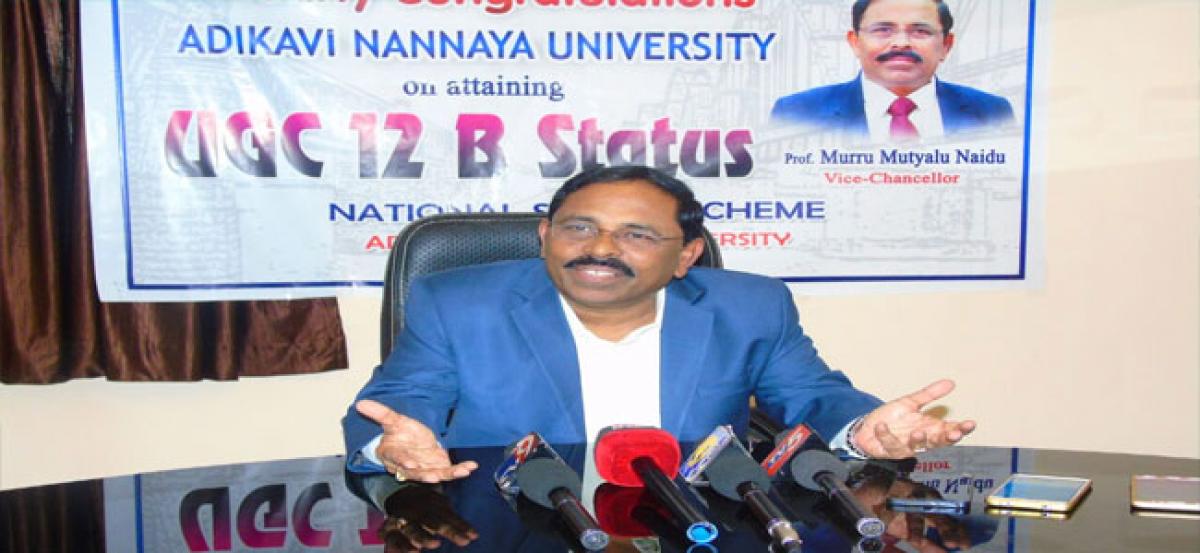
Nannaya Universirty VC M Mutyala Naidu addressing a press conference in Rajamahendravaram on Tuesday
Rajamahendravaram: University Grants Commission (UGC) has accorded '12-B' status to Nannaya University. 12-B status will help the varsity to strengthen its financial position which will in turn aid its overall development.
In the year 2006, the then Congress government established eight varsities in the state, of them now Nannaya university obtained 12-B status. Nannaya university is one of the biggest institutions with 460 colleges and 1.50 lakh students in East and West Godavari districts.
The university is offering as many as 32 post-graduate courses and manning one engineering college. B.ED college, arts and commerce college and science and technology college.
Addressing a press conference at his office vice-chancellor Prof. Murru Mutyala Naidu has said that it was a milestone in the history of the varsity. “There will be abundant opportunities to develop the university,” he added.
UGC sanction funds for research programmes, seminars, study tours, foreign trips relating to research programmes etc. UGC sanctions an amount of Rs 5 lakh to Rs 5 crore for research programmes.
“Now our endeavour is to get NAAC recognition as we secured 12-B status. We have initiated steps to get one research programme to each faculty, which also enhances their knowledge,” the V-C informed.
Now sky is the limit for the development of the university and hostel buildings, college buildings, stadium etc also be constructed with the funds.
Rajamahendravaram: University Grants Commission (UGC) has accorded '12-B' status to Nannaya University. 12-B status will help the varsity to strengthen its financial position which will in turn aid its overall development.
In the year 2006, the then Congress government established eight varsities in the state, of them now Nannaya university obtained 12-B status. Nannaya university is one of the biggest institutions with 460 colleges and 1.50 lakh students in East and West Godavari districts.
The university is offering as many as 32 post-graduate courses and manning one engineering college. B.ED college, arts and commerce college and science and technology college.
Addressing a press conference at his office vice-chancellor Prof. Murru Mutyala Naidu has said that it was a milestone in the history of the varsity. “There will be abundant opportunities to develop the university,” he added.
UGC sanction funds for research programmes, seminars, study tours, foreign trips relating to research programmes etc. UGC sanctions an amount of Rs 5 lakh to Rs 5 crore for research programmes.
“Now our endeavour is to get NAAC recognition as we secured 12-B status. We have initiated steps to get one research programme to each faculty, which also enhances their knowledge,” the V-C informed.
Now sky is the limit for the development of the university and hostel buildings, college buildings, stadium etc also be constructed with the funds.
‘Courts not barred from staying probe in corruption cases’
Neither law nor interpretations of the Prevention of Corruption (PC) Act, 1988, by the Supreme Court have imposed any bar on courts from staying investigation in corruption cases, it was contended before the High Court of Karnataka on behalf of former Chief Minister B.S. Yeddyurappa.
The court, on Tuesday, heard the petitions filed by Mr. Yeddyurappa questioning registration of two cases against him for alleged corruption in exclusion of around 207 acres of land notified for acquisition.
Senior Counsel C.V. Nagesh, appearing for Mr. Yeddyurappa, contended that Section 19(3) (c) of the Act “only bars courts from staying proceedings initiated under the PC Act” and proceedings under the Act commence only after designated courts either take cognisance of an offence in warrant cases or frame charges after submission of charge sheet by the investigating agency. He also pointed out that the investigation of corruption cases is conducted as per the procedure under the Code of Criminal Procedure (Cr.PC) like in any other criminal cases as the PC Act does not prescribe any procedure for investigation.
Since the “process of investigation” does not fall under the ambit of the PC Act, Mr. Nagesh contended that courts are not barred from staying investigation, which is covered under the Cr.PC and not the PC Act.
Citing verdicts of the Supreme Court that ordered expediting of trials in corruption cases, Mr. Nagesh said that the apex court had repeatedly reiterated the bar imposed on courts from staying the trials of corruption cases and has not restrained any court from staying the investigation.
How NEET nixed their chances
Caught unawares:Confusion over whether NEET would be held in Tamil Nadu was another reason for the poor show.File photo
Students from four districts fared badly in the exam
Over the last decade or so, four districts emerged as the top educational districts of the State, if the measure of success was entry of students into professional courses. The four districts in the western region — Namakkal, Dharmapuri, Krishnagiri, and Erode — renowned for their extra-rigorous coaching techniques have been attracting students in large numbers.
Also, over the years, these districts seem to have accounted for most number of students who secured MBBS and BDS seats in various government colleges across the State. This year, however, when the criteria for admission was NEET, the number of students who secured MBBS/BDS seats in these districts fell rather dramatically — to 373 from 1,750 in 2016.
“Though these districts are sometimes called backward, it certainly is not the case when it comes to education. These schools work on a blueprint geared towards propelling a student towards a seat in an engineering or medical college, and have even found great success with this technique,” says a Health Department official.
The blueprint includes ignoring the Class XI syllabus and vaulting straight into Class XII, with a particular approach to cracking the board exam. With Tamil Nadu admitting students to professional engineering and medical colleges based on these marks, the entire system was geared towards producing successful candidates in this very task.
Namakkal, for instance, in 2016, had the highest number of students who had got admission into MBBS/BDS at 957. It also has 13 schools that send more than 20 students to do medicine every year. This year, that number has dropped to 109, and the number of schools that have sent over 20 students is at three. The other three districts send only a fraction of Namakkal's 957 students, but their numbers are in several 100s too.
An education department official in Krishnagiri makes no bones about it: “NEET is the reason.” Students were either unprepared or, under prepared to ace the entrance exam this year, he added.
K. Murugan, who runs a coaching centre for Plus Two students at Mohanur, zeroed in on the nub of the issue: a majority of private schools skipped Class IX and Class XI syllabi regularly. With the NEET question paper containing questions from Class IX to XII, the students were naturally caught unawares, leading to their poor performance, he rationalised.
He reckoned it would take another couple of years to enable the students of Namakkal schools to gain their supremacy by performing well in the NEET.
Education Department officials in Erode agreed that there had been a decline in the number of students from the district being admitted to the MBBS course this year. They agreed that the root cause was the fact that class XI portions were ignored in these schools. Adding to this was the confusion over whether NEET would indeed be implemented in Tamil Nadu, one official said.
Even in instances where students from these districts did take up coaching for NEET, leaving out the class XI portions completely made the gulf too wide to bridge, educationists pointed out. Besides, as the issue continues to gain political and community level traction in Tamil Nadu, they urged that no confusion should prevail about the manner of admission into MBBS courses.
S. Palaniandi, chairman of the Subramanian Arts and Science College, Mohanur, Salem, also a retired teacher, called for employing teaching methods that would help students understand the subject, rather than promote rote learning, which cannot help a student tackle a competitive exam such as NEET. But he added, the government would do well to start NEET coaching centres across the State, so that the next batch of students is well equipped.
(With inputs from Syed Muthahar in Salem, P.V. Srividya in Dharmapuri and S.P. Saravanan in Erode)
AIADMK meet removes Sasikala as general secretary
Coordinator, co-coordinator to run party; TTV’s appointments invalidPowers to run party vested with coordinator, co-coordinatorDhinakaran’s appointmentsto party posts invalid
Nearly nine months after V.K. Sasikala was unanimously appointed interim general secretary of the AIADMK following then Chief Minister Jayalalithaa’s death, she was unseated from the post on Tuesday.
The general council of the AIADMK (Amma, PTA) convened under the joint leadership of Chief Minister Edappadi K. Palaniswami and his deputy O. Panneerselvam adopted a resolution nullifying all decisions taken by Sasikala from December 30, 2016 to February 15, 2017.
“Following an atmosphere of shock after Amma’s (Jayalalithaa’s) untimely death and concern, V.K. Sasikala was appointed as interim general secretary to attend to routine party work.
“This general council unanimously resolves to cancel her [Sasikala’s] appointment made on December 29, 2016. (It also) resolves that all those appointments and removals made by her between December 30, 2016 and February 15, 2017 are not valid,” the council resolution said.
Not expelled
The resolution, which did not assign any reason for ousting Sasikala from the top post, however, did not expel her from the party. She is currently serving a four-year prison term in Bengaluru following her conviction in a disproportionate assets case.
The general council, held at a marriage hall in Vanagaram on the outskirts of Chennai, also unanimously decided to abolish the post of general secretary of the party. All the powers enjoyed by the general secretary have been vested with the party coordinator and co-coordinator, two newly created posts.
Adopting a resolution, the ‘general council’ reasoned that nobody else could fill the post once held by “two great leaders” — MGR and Jayalalithaa. And hence the post of general secretary was done away with and Rule 43 of the party’s by-laws amended to this effect.
New chapter for party
Originally, this rule had mentioned that though the general council would have powers to frame, amend or delete any rule of the party constitution, the stipulation that the general secretary should be elected only by all the primary members of the party “cannot be changed or amended” since it formed the basic structure of the party.
The change heralds a new chapter in the history of the 45-year-old AIADMK, which has functioned as per the diktats of a single leader, be it founder M.G. Ramachandran or his successor Jayalalithaa.
A resolution was adopted ratifying the decision taken a few weeks ago to make Deputy Chief Minister O. Panneerselvam and Chief Minister Edappadi K. Palaniswami coordinator and co-coordinator of the unified party respectively. The coordinator and co-coordinator would be joint signatories of authorisation forms to be submitted to the Election Commission. Sasikala’s decision to anoint her nephew T.T.V. Dhinakaran as deputy general secretary of the party before she went to jail also stood invalidated.
Mr. Dhinakaran’s appointments to party positions and removing existing office bearers were declared “invalid” and “not in consonance with the party’s by-laws.”
Dhinakaran’s caveat
However, Mr. Dhinakaran told journalists in Madurai that the Madras High Court had made it clear on Monday that all decisions taken at the general council meeting would be subject to the final outcome of a petition challenging the validity of the meeting itself.
The meeting was attended by all important leaders of the two factions and the entire proceedings were concluded in three hours.
Out of nearly 2,300 members of the general council, 90% took part in the meeting, sources in the party claimed.
The appointment of former Ministers K.P. Munusamy and R. Vaithilingam as deputy coordinators was also approved by the general council.
Nearly nine months after V.K. Sasikala was unanimously appointed interim general secretary of the AIADMK following then Chief Minister Jayalalithaa’s death, she was unseated from the post on Tuesday.
The general council of the AIADMK (Amma, PTA) convened under the joint leadership of Chief Minister Edappadi K. Palaniswami and his deputy O. Panneerselvam adopted a resolution nullifying all decisions taken by Sasikala from December 30, 2016 to February 15, 2017.
“Following an atmosphere of shock after Amma’s (Jayalalithaa’s) untimely death and concern, V.K. Sasikala was appointed as interim general secretary to attend to routine party work.
“This general council unanimously resolves to cancel her [Sasikala’s] appointment made on December 29, 2016. (It also) resolves that all those appointments and removals made by her between December 30, 2016 and February 15, 2017 are not valid,” the council resolution said.
Not expelled
The resolution, which did not assign any reason for ousting Sasikala from the top post, however, did not expel her from the party. She is currently serving a four-year prison term in Bengaluru following her conviction in a disproportionate assets case.
The general council, held at a marriage hall in Vanagaram on the outskirts of Chennai, also unanimously decided to abolish the post of general secretary of the party. All the powers enjoyed by the general secretary have been vested with the party coordinator and co-coordinator, two newly created posts.
Adopting a resolution, the ‘general council’ reasoned that nobody else could fill the post once held by “two great leaders” — MGR and Jayalalithaa. And hence the post of general secretary was done away with and Rule 43 of the party’s by-laws amended to this effect.
New chapter for party
Originally, this rule had mentioned that though the general council would have powers to frame, amend or delete any rule of the party constitution, the stipulation that the general secretary should be elected only by all the primary members of the party “cannot be changed or amended” since it formed the basic structure of the party.
The change heralds a new chapter in the history of the 45-year-old AIADMK, which has functioned as per the diktats of a single leader, be it founder M.G. Ramachandran or his successor Jayalalithaa.
A resolution was adopted ratifying the decision taken a few weeks ago to make Deputy Chief Minister O. Panneerselvam and Chief Minister Edappadi K. Palaniswami coordinator and co-coordinator of the unified party respectively. The coordinator and co-coordinator would be joint signatories of authorisation forms to be submitted to the Election Commission. Sasikala’s decision to anoint her nephew T.T.V. Dhinakaran as deputy general secretary of the party before she went to jail also stood invalidated.
Mr. Dhinakaran’s appointments to party positions and removing existing office bearers were declared “invalid” and “not in consonance with the party’s by-laws.”
Dhinakaran’s caveat
However, Mr. Dhinakaran told journalists in Madurai that the Madras High Court had made it clear on Monday that all decisions taken at the general council meeting would be subject to the final outcome of a petition challenging the validity of the meeting itself.
The meeting was attended by all important leaders of the two factions and the entire proceedings were concluded in three hours.
Out of nearly 2,300 members of the general council, 90% took part in the meeting, sources in the party claimed.
The appointment of former Ministers K.P. Munusamy and R. Vaithilingam as deputy coordinators was also approved by the general council.
Subscribe to:
Posts (Atom)

-
 Madras varsity panel against budget cuts Ragu.Raman@timesofindia.com 22.04.2025 Chennai : The state govt's move to cut the budget for t...
 -
கணவன் முதல் நாள் இரவில் தான் கண்ட கனவைப் பற்றி மறுநாள் காலையில் தன் மனைவியிடம் விளக்கிக் கொண்டிருந்தார். “அடியேய்... நானும், நீயும் அமொர...
