Monday, November 13, 2017

Lack of seats continues to worry NEET aspirants of Tamil Nadu

Several students have chosen examination centres in other States

Lack of adequate seats at examination centres for those wanting to appear for NEET — post graduate courses in Tamil Nadu continues to worry aspirants in the State.
Though an additional 1,000 seats were shown for the six examination centres in Tamil Nadu a few days ago, they were opted by candidates in a day.
A day after the online application process began on October 31, applicants were shocked to find no seats available at the examination centres in Tamil Nadu - Chennai, Coimbatore, Madurai, Salem, Tiruchi and Tirunelveli.
Several students hence chose examination centres in other States when National Board of Examination (NBE) website showed unavailability of seats in centres within Tamil Nadu.
“There are more than 10,000 aspirants who wish to write NEET-PG in January 2018. Either the number of seats in the centres should be increased or the number of centres in the State to accommodate more students from Tamil Nadu,” said N. Ravisankar, State secretary of Tamil Nadu Government Doctors Association (TNGDA).
With seats allotted to centres in Tamil Nadu being nil after two days, TNGDA had appealed to the NBE and Central Government to increase seats in all centres in order to accommodate applicants in their native State. Lack of seats was also coupled with technical glitches on the NBE website following which e-filing of a single application at times took more than six hours.
Mr. Ravisankar said that the Government and NBE should make arrangements for candidates to change their centres to their native States depending on the availability of seats.
“Some of the candidates had chosen centres in other States due lack of seats here. They should be given a chance to change centres. As the fee of the test itself is Rs. 3,750, candidates should not be put in a difficult situation to spend more for travel and accommodation. Around 4,000 doctors who are currently practising at Government and private hospitals in the State will also appear for the test,” Mr. Ravisankar said.

‘Children born to Muslim couple before marriage not legal heirs’

But High Court gives one-third share of father’s property to such a son, citing law

The Madras High Court has held that a child born to a Muslim couple before their marriage cannot be considered as a legal heir and consequently not entitled to a share in the biological father’s property.
However, the court permitted one such descendant to walk away with a lion’s share of his father’s property on the ground that the latter was entitled to bequeath one-third of his property to strangers as per Muslim law.
Justices R. Subbiah and P. Velmurugan passed the ruling while disposing of an appeal suit preferred by the second wife of Mohammed Ansar, a former employee of Southern Railways.
The appellant was aggrieved against an order passed by a lower court in favour of two daughters born to her husband through his first wife though he had left behind a will bequeathing his properties only to the second wife and her three children.
Will made in 1978
Resolving the dispute between the parties, the judges noted that Mr. Ansar had married his first wife in 1946 and gave birth to two girls who were married in 1962 and 1967 respectively. Subsequently, his first wife died and he married another woman in July 1969.
The couple begot a son three months before their marriage and gave birth to another son and a daughter after their marriage, in 1972 and 1974 respectively. The former railway employee executed a will in February 1978 bequeathing all his properties to his second wife and her three children and died in October 1981.
Pointing out that Muslim law states that an “illegitimate child is considered to be the child of its mother alone and as such it inherits from the mother alone,” the judges held that the first son born through the second wife of the deceased was not entitled to inherit his father’s property.
However, writing the judgement for the Bench, Mr. Justice Velmurugan pointed out that the same Muslim law permits a Muslim to bequeath one-third of his property to strangers.
Therefore, the judges ordered that the “illegitimate son” in the present case would be entitled to 20 out of 60 portions of his father’s properties since the genuineness of the registered will had not been disputed by the daughters born through the first wife of the deceased.
Shares to all
Observing that a Muslim could execute a will only with respect to one-third of his property and bequeathing more than that would require the legal heirs’ prior consent, which had not been obtained in the present case, the judges held that each of the two daughters born to Mr. Ansar through his first wife would be entitled to 6.5 out of the 60 portions of their father’s property.
This was in accordance with the apportionment permitted under Muslim law.
Since the law states that legitimate sons were entitled to inherit double the property than those to which legitimate daughters were entitled to, the Division Bench ordered that the second son born through the second wife would be entitled to 13 out of 60 portions.
Finally, it was held that the remaining 7.5 out of 60 shares would go to the second wife since she had a right over one-eighth of the property owned by her husband during his lifetime.

Doctor suspended for dengue post on FB

The West Bengal government has suspended a doctor of a public hospital for alleging in a social media post that the State government was suppressing data regarding the dengue outbreak. The doctor, Arunachal Dutta Choudhury, worked as a medical officer at the Barasat District Hospital in North 24 Parganas district, which according to the government, is the worst affected by dengue.


Relief at last for victims of Moulivakkam collapse


By Express News Service  |   Published: 11th November 2017 02:49 AM  |  

A boy explaining to his friend how was demolished at Moulivakkam in Chennai on Thursday.(Sunish P Surendran | EPS)
CHENNAI: Deputy Commissioner of Labour II court awarded compensation to the kin of Moulivakkam building collapse victims on Friday.
As per the order, `6.82-lakh compensation was awarded to V Nanda Gopal, son of Vasu, who died in the disaster.
Likewise, Deputy Commissioner of Labour II court awarded `8.36 lakh to Baby Saroja, wife of Arumugam, `6.03 lakh to Shanti, wife of Karuppaiah and `8.52 lakh to Vellikannan and Kalyani, parents of Thiruvenkadam. The compensation was awarded by the builders and the insurance company.
As many as 61 workers died after one of the under-construction twin residential towers came crashing down on a rainy day in Moulivakkam on June 28, 2014.
An 11-storey apartment complex was being constructed by Prime Sristi Housing Private Limited. Another block at the same site was ordered to be demolished by the Supreme Court after a committee submitted its report to the apex court. The building was demolished on November 2, 2016. The state government had awarded a compensation of `7 lakh each to the relatives of victims.

Judges bribery case: Three-judge Supreme Court bench likely to hear plea tomorrow


By PTI  |   Published: 12th November 2017 05:31 PM  |  

Supreme Court of India | PTI
NEW DELHI: A three-judge bench of the Supreme Court is likely to hear tomorrow a plea claiming that alleged bribes were taken using the names of apex court judges promising to secure favourable settlement of a case.
A bench of justices J Chelameswar and S Abdul Nazeer had ordered on November 9 that the plea be heard by a five-judge Constitution bench of the senior-most judges of the apex court.
However, on November 10, in an unprecedented hearing, a five-judge constitution bench headed by CJI Dipak Misra had ruled that "no judge can take up a matter on his own, unless allocated by the chief justice of India, as he is the master of the roster".
It had over-ruled the order of Justice Chelameswar directing a Constitution bench hearing, saying, "If any such order has been passed by any bench, that cannot hold the field as that will be running counter to the order passed by the Constitution bench." The plea filed by advocate Kamini Jaiswal is now listed for hearing before a bench of justices R K Agrawal, Arun Mishra and A M Khanwilkar at 3.30 pm tomorrow.
The hearing on November 10 had brought the tussle within top judiciary to the fore with the Constitution bench overturning the order of a two-judge bench to set up a larger bench to hear the graft case allegedly involving judges.
The showdown over the issue of supremacy of constituting a bench in which the authority of CJI, was allegedly undermined by a bench headed by Justice Chelameswar.
Justice Chelameswar, who is the senior-most judge after the CJI, had termed as "disturbing" the allegations levelled in a CBI FIR and had ordered setting up a bench of five top judges of the court as a petition by Jaiswal had claimed there were allegations against Justice Misra.
The CBI, in its FIR, lodged on September 19, has named several persons, including former Orissa High Court judge Ishrat Masroor Quddusi, as accused in an alleged corruption case.
Quddusi, who had also served as a judge in the Chhattisgarh High Court, was arrested along with Lucknow-based Prasad Institute of Medical Sciences' chairman B P Yadav, his son Palash Yadav and three others, for allegedly trying to settle a matter relating to a medical college barred from admitting new students.

After Supreme Court order, UGC to have power to close down institutes

KRITIKA SHARMA | Updated: Nov 7, 2017, 08:05 AM IST, DNA

At present, education regulators—UGC and AICTE, can only send notices and cancel affiliation for limited period

After a Supreme Court order recently banned technical education through distance mode and cancelled degrees of hundreds of students who passed out between 2001 and 2005, the central government is now working on the idea of strengthening the powers of its regulators.

Regulators for higher education — University Grants Commission (UGC) and All India Council for Technical Education (AICTE) — currently do not have the power to permanently close down an institution that isn't abiding by its norms. They can only send them notices and cancel their affiliation over non-adherence to norms, for a limited period, after which the institute will have to acquire a fresh affiliation.

The Supreme Court had on Friday suspended engineering degrees granted between 2001 and 2005 to all graduates through distance learning by JRN Rajasthan Vidyapeeth, Rajasthan, Institute of Advanced Studies in Education, Rajasthan (IASE), Allahabad Agricultural Institute, Allahabad, and Vinayak Mission Research Foundation (VMRF), Tamil Nadu, for want of adherence to statutory guidelines/policies. With this, the court also ruled that no institution will be allowed to run technical courses through distance mode.

"Our regulators do not have enough power. Had that been the case, a situation like this would not have arised where the court would have to cancel degrees of students. The UGC had sent notices to these institutes, asking them to stop technical education courses through distance mode; but, they did not adhere to the orders and continued offering the courses," said a senior Human Resource Development Ministry official.

"When we talk about a improving our regulatory authorities, we ought to give them more power, including that of deciding on closing down institutions when necessary," the official said.

The Supreme Court judgment had mentioned that the government should form a committee to look into regulatory mechanism in the field of higher education.

"The Union of India may constitute a three-member committee comprising eminent persons who have held high positions in the fields of education, investigation, administration, or law at national level within one month. The committee may examine the issues indicated above and suggest a road map for strengthening and setting up of oversight and regulatory mechanism in the relevant field of higher education and allied issues within six months," the court mentioned in its order.

UGC asks universities to setup chair in name of Dayanand Saraswati

UGC asks universities to setup chair in name of Dayanand Saraswati (DNA)

DNA CORRESPONDANT | Updated: Nov 10, 2017, 12:05 PM IST

The University Grants Commission (UGC) has asked universities to set up a chair in the name of renowned thinker Swami Dayanand Saraswati under category of Social Reformer.

The commission has set up a scheme to establish chairs under various renowned personalities and scholars across various universities.

Students are taught about life and times of these personalities under the programme. As an extension to this, the commission has now asked for establishing a chair in the name of Dayanand Saraswati.

The notice sent to all universities on Thursday read, "The universities desirous of setting up a chair in the name of Swami Dayanand Saraswati may sent their proposals and budget details to Secretary UGC within 15 days of publishing of this notice."

Dayanand Saraswati was a Hindu religious leader and founder of the Arya Samaj, a Hindu reform movements of the Vedic tradition. He was also a renowned scholar of the language.


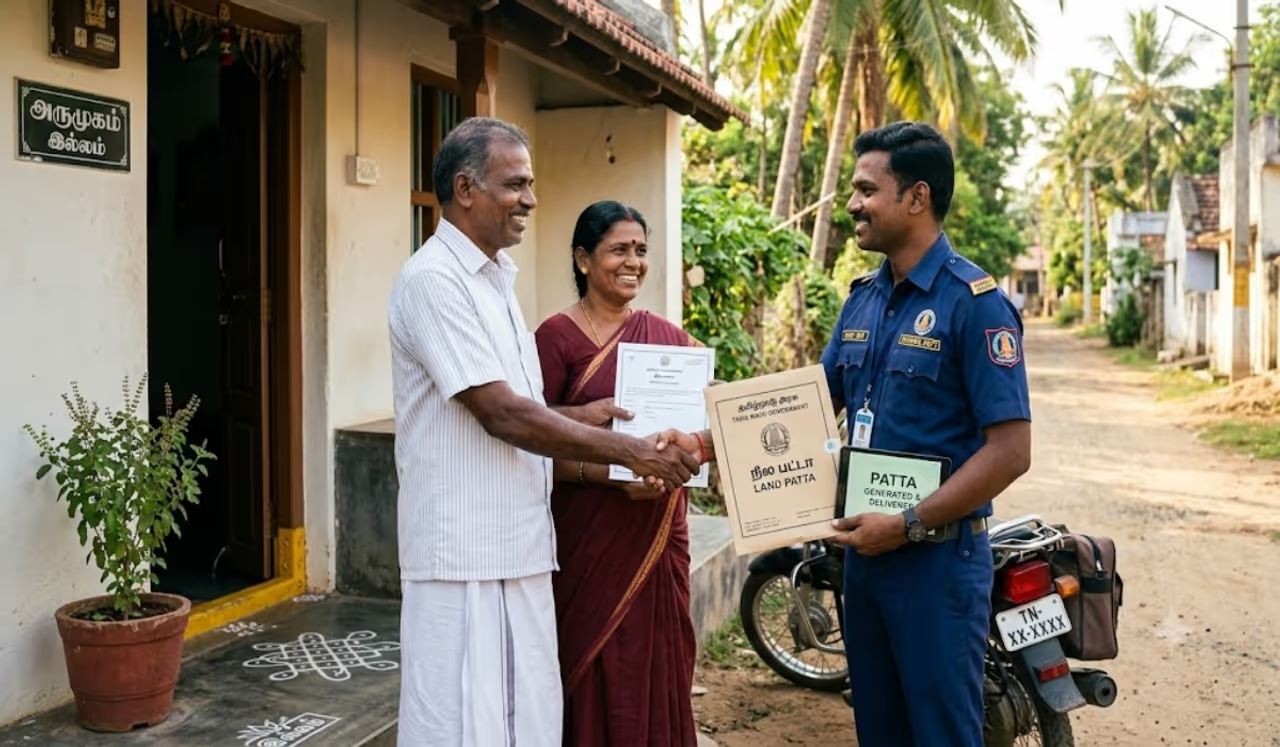
Vijay Govt: நிலம் வாங்கப் போறவங்களுக்கு ஜாக்பாட்! இனி பட்டா தேடி வரும்! தமிழக அரசு குட்நியூஸ்!

Vijay Govt: நிலம் வாங்கப் போறவங்களுக்கு ஜாக்பாட்! இனி பட்டா தேடி வரும்! தமிழக அரசு குட்நியூஸ்! Vijay Govt: நிலம் வாங்கப் போறவங்களுக்கு தமிழக...