Monday, August 9, 2021

Many violate two-year service bond after super-speciality courses in T.N.


Many violate two-year service bond after super-speciality courses in T.N.

Several candidates from other States did not attend counselling for posting

08/08/2021

Serena Josephine M.CHENNAI

Many candidates, who belong to other States and completed super-speciality medical courses (DM/M.Ch) at government medical colleges in Tamil Nadu in 2020, did not attend the counselling held for posting at July-end. While this was not the first time that non-service other State candidates violated the two-year service bond executed with the State government, a cross-section of government doctors feels this will have an impact on the healthcare system in the long run.

Official sources said more than half of the candidates of the batch did not attend the online counselling, while a few candidates who attended the counselling said at least 80% of the other State candidates of the 2017 batch skipped the process.

An official of the Health Department said, “More than 50% of the candidates in super-speciality batches are from other States. They must work for two years as per the bond for ₹40 lakh executed at the time of admission. Some doctors finish the course and leave. They join work in their States and approach the court saying they did not get postings or departments as soon as they finished the course. According to the rules, they have to work in a government set-up anywhere in Tamil Nadu. In such circumstances, we will have to take action under the Revenue Recovery Act for bond violation,” he said.

There have been instances of posting orders having been issued but no one having turned up for duty, he said. “Services of a cardiologist or oncologist may be required at a secondary care hospital, not only at a tertiary centre.”

In an analysis, the Service Doctors and Post Graduates Association (SDPGA) found that in the 2017 batch of DM medical gastroenterology, all 16 seats were occupied by non-service candidates — one from Tamil Nadu and 15 from other States. Among them, the sole candidate from Tamil Nadu and two other State candidates joined the service. On the contrary, 15 other State candidates of the 2018 batch have joined service.

Of the 19 urology seats, there was one service candidate and the rest were non-service candidates in the 2017 batch. Only one non-service candidate who belonged to Tamil Nadu took up posting, while the remaining did not attend the counselling. No candidate who belonged to other States and completed M.Ch gastroenterology, urology, neurosurgery, cardiothoracic surgery and surgical oncology and DM gastroenterology, cardiology, neurology and endocrinology attended the counselling, the association said.

“There are nearly 280 other State candidates in the 2017 batch and a majority of them did not attend the counselling on July 30. This means they are not going to join the Tamil Nadu government service to serve their bond, and this is a gross disservice to the healthcare delivery system in the State,” SDPGA State president P. Saminathan said. “This is why we have been demanding exclusive State counselling and a 50% service quota in courses. The State government should pass a special ordinance for the quota,” he added.

He said there were no service PGs in a few courses in the last two batches. “If this continues, no one will come to work at government medical colleges in these departments, leading to lack of faculty,” he said.

“Many other State candidates, who completed in 2020, did not attend because it has been a year since they completed the course and so, many returned to their States and started working there. This could have been prevented had postings been given as soon as the course was completed. There is no certainty on when the Directorate of Medical Education will issue postings to work under bond. Another problem was the lack of official intimation regarding counselling by way of email or call letter. It was put up on the Health Department’s website,” a doctor who attended the counselling said.

A doctor working at a primary health centre said that with no service quota in super-speciality seats, students study here and return to their States without completing the mandatory service. “This is creating an acute shortage of super-specialists at government hospitals. This is why we are demanding a 50% service quota,” he said.
Follow G.O., HC tells police

Follow G.O., HC tells police

08/08/2021

B.Tilak Chandar Madurai

Citizens should be provided police protection, based on a government order, when they seek it after a favourable a civil court decree, the Madurai Bench of the Madras High Court told the the Director General of Police and directed him to issue a reminder to all the police stations.

Justice J. Nisha Banu referred to the G.O. issued in 2008 by the Home Department and said police should not insist on a specific court direction while their protection is sought.

The court was hearing the petition filed by P. Packianathan of Melur taluk in Madurai district. The petitioner had sought a direction to the Madurai police to provide him adequate protection to carry out agricultural works in his land. A civil dispute pertaining to the land was settled in his favour. He made the representation to the police seeking their protection, but the latter had insisted on a specific order from the court. The court observed that the government itself had issued the guidelines to the police officers directing them to give protection in the light of the civil court order by constituting a committee. Based on the recommendations of the committee, the guidelines were issued. But, even after all these years, the G.O. was not implemented driving people unnecessarily to the court. “It is high time the police officers respected the orders of the court and government orders,” the judge said.

To avoid recurrence, the court directed the DGP to issue reminders to police stations. Referring to an earlier judgment of the High Court, the judge said the the function of the police officials was to control law and order and investigate crimes. The police cannot take over the job of the civil court to adjudicate the disputes.

Perhaps without understanding the stage at which they can interfere in civil jurisdiction, the police were insisting upon the production of the specific court order, the judge said and disposed of the petition.

High Court lets 16-year-old take NEET though minimum age is 17

High Court lets 16-year-old take NEET though minimum age is 17

It refuses to stay single judge order allowing her to write test

08/08/2021

Since the girl had a very high IQ, her candidature can be considered, the HC said.GANESAN V

Mohamed Imranullah S. CHENNAI

A Division Bench of the Madras High Court has refused to grant an exparte interim stay on an order passed by a single judge, permitting a 16-year-old girl to write the National Eligibility-cum-Entrance Test (NEET) without insisting upon the completion of 17 years of age as on December 2021.

Justices M.M. Sundresh and S. Kannammal said no order of interim stay could be passed without ordering notice to the student on the writ appeal preferred by the National Testing Agency (NTA) on the ground that underaged candidates cannot be allowed to join medical colleges.

The appeal had been preferred against an order passed by Justice B. Pugalendhi, who had permitted 16-year-old SP. Shree Harini to write NEET 2021 for undergraduate medical admissions, despite the National Medical Commission (NMC) having rejected her plea to relax the minimum age. “People should go to university and college when they are ready, not when they are old enough to go,” the single judge had said, referring the writ petitioner to the National Institute of Mental Health and Neuroscience (NIMHANS) in Bengaluru for testing her intelligence quotient (IQ).

If NIMHANS finds her fit to write NEET 2021, then she must be allowed to sit for it, the judge had said. The order was passed after it was brought to the court’s notice that even at the age of two years and eight months, the petitioner had a superior IQ of 169, and her mental age then was assessed to be that of a four-years-and-six-months-old child.

She was given double promotion during her school days, and was hence able to complete Class XII at the age of 16 this March. Anticipating trouble in appearing for NEET 2021, she made a representation to the Union Ministry of Health and Family Welfare in July 2019 itself, seeking relaxation of the minimum age of 17 required to appear for NEET.

The Ministry forwarded her representation to the NTA, but the latter rejected the plea on August 22, 2019, on the premise that candidates below 17 years of age could not be permitted to appear for NEET in view of a specific bar under the Graduate Medical Education Regulations of 1997.

When the rejection order was challenged, Justice Pugalendhi cited instances of Belgian child prodigy Laurent Simons having become the second youngest person in the world to complete graduation at the age of 11 and that of Indian American Tanishq Abraham who became a biomedical engineering graduate at the age of 15. As far as Ms. Harini was concerned, she would be four months and five days short of completing 17 years this year. Since she has a very high IQ, “this court is of the view that her candidature can be considered and she can be permitted to sit for NEET. In fact, she is asking for a chance to appear for the entrance examination and not for a seat in a medical course straight away,” the single judge had observed.

When the matter was taken on appeal, the Division Bench, led by Justice Sundresh, also prima faciefelt that talent must be recognised irrespective of age.

Medical students come up with awareness videos on COVID-19


Medical students come up with awareness videos on COVID-19

‘Aim is to educate the public on the need to continue safety practices’

08/08/2021
 
A still from the awareness video brought out by house surgeons of the Coimbatore Medical College Hospital.

Staff Reporter Coimbatore

Medical students of the Coimbatore Medical College Hospital (CMCH) have come up with two awareness videos on the need to follow safety practices to arrest a third wave of COVID-19.

House surgeons, who are doing Compulsory Rotatory Residential Internship, and undergraduate medical students brought out the awareness videos as part of the information, education and communication activities of the Department of Community Medicine.

“The main aim of the videos is to educate the public on the need to continue safety practices to save the country from getting into a third wave of the pandemic,” said CMCH Dean A. Nirmala.

The videos reinforce safety practices such as wearing of mask, hand washing, physical distancing and getting vaccinated against COVID-19. They also warn that sharing of fake information and rumours on COVID-19 on social media will hamper efforts to contain the disease spread.

“The students made the videos in two days with available facilities. The videos have been shared on social media for the reach of the public,” said P. Kalidas, head of the Department of Community Medicine.

While house surgeons shot their video on the medical college campus, a group of second year medical students shot video clips from their houses which were edited and compiled together. “After cases declined, people have a tendency not to follow safety practices. But it is a crucial time to follow all the safety practices as they can stop a third wave of the disease,” said K. Gayatri Sri, a house surgeon.

Sunday, August 8, 2021

When Parliament becomes a noisy fish market, and MPs irrelevant


RIGHT & WRONG

When Parliament becomes a noisy fish market, and MPs irrelevant

SWAPAN DASGUPTA

08.08.2021 

Political life can never be separated from its cultural and historical context. In British public life, there is a time that is popularly described as the silly season. In the pre-pandemic age, this time in summer was marked by holidays, lazy afternoons in the sun, endless glasses of Pimms and general merriment all round. But the celebratory mood didn’t make the season silly. It was called the silly season because with Parliament in recess, newspaper editors had a tough time thinking of stories that would fill up the pages.

It is impossible to overstate the importance of Parliament, particularly the House of Commons, in the political life of Westminster. Barring weekends, the customary breaks for Easter and Christmas and, of course, the long, silly season respite, British MPs must literally sing for their supper. On an average, the Commons sit for anything between 150 and 160 days each year, and some of the sittings extend to well beyond midnight. While this may go some way in explaining the plethora of extra-marital affairs among British MPs, it also indicates that parliamentary work can be very demanding. Indeed, political careers are made and unmade by parliamentary performances. Ministers are grilled relentlessly by backbenchers and both the Prime Minister and the Leader of Opposition are under exacting scrutiny during the weekly Prime Minister’s Questions. To be a successful politician in Britain necessarily involves masterly parliamentary performances.

On its part, the media is merciless. The most read section of parliamentary proceedings in the ‘quality’ press isn’t about the reportage of who said what but the parliamentary sketches. Normally the preserve of the most acerbic writers, the sketches contain irreverent accounts of the proceedings, focussing naturally on who got the better of who and which MP made a complete ass of himself.

Public life is naturally bound in a nation’s culture. Despite their innate conservatism, the British are quite naturally irreverent. The reverence attached to political leaders in India has little place in British life. Even at the height of World War II, when he had become a national icon, Winston Churchill was subjected to the most scathing attacks in the Commons, attacks that had made his predecessor Neville Chamberlain wilt and, finally, resign.

Had the Indian media refashioned its non-existent coverage of Parliament, its sketch writers would not have starved for ammunition during the present monsoon session of Parliament. A washout in terms of meaningful debate, the session witnessed the exceptional importance that has been accorded by some parties to unruly hyenas. The Rajya Sabha, where the opposition feels less outnumbered, saw dancing protesters, multilingual slogans and even broken glass panes in the lobby. Parliamentary visibility shifted to those whose contributions to profound discourse had hitherto been undiscovered.

In recent times, parliamentary sittings have been declining steadily. From the rough average of around 60 days annually, it touched an all-time low of 33 sittings in 2020, courtesy the pandemic. If present trends persist, this may even become the new normal. The state legislatures appear to have shown the way — hardly surprising because the quantum of law-making in the states has been shrinking. Even in Parliament, thanks to the incessant din and the brazen disregard of all rules, Bills have been rushed through in minutes because no discussion is possible in the fish-market atmosphere. What is also striking is the lack of public reaction to this travesty. The indifference suggests there are nominal expectations of people from Parliament.

The issue of a dysfunctional Parliament shouldn’t be brushed aside casually. First, there is growing public confusion over the role of the MP. The tendency to equate an MP with a corporator or zilla parishad member and an MLA is rampant. With financial powers having devolved substantially to the GST Council and fresh legislation becoming increasingly technical in nature, many of the earlier responsibilities of Parliament have gone. The MP, in effect, has become either a bridge between the people and the Centre or just another functionary of a political party — albeit with state privileges.

Most important, with parliamentary elections becoming more presidential in nature, the vote is now more for a Prime Minister rather than a local representative. With voters increasingly concerned with effective delivery of government schemes, the focus has shifted entirely to the executive and the bureaucracy. Today’s MP is in search of a role that goes beyond establishing a government’s majority and endorsing legislation crafted by the executive.

Indian democracy is thriving, but the parliamentary system is in deep crisis.

‘Free darshan at TTD once Covid-19 over’


‘Free darshan at TTD once Covid-19 over’

Sandeep.Raghavan@timesgroup.com

Tirupati: 08.08.2021 

Sarvadarshan (free darshan) at Tirumala Tirupati Devasthanams (TTD) can be resumed only after the World Health Organisation (WHO) denotifies the Covid-19 pandemic. This was informed by TTD specified authority chairman and executive officer (EO) Dr KS Jawahar Reddy, on Saturday.

Addressing the pilgrim callers during the monthly ‘Dial your EO’ programme at the TTD administrative building here, Jawahar Reddy said the temple administration was forced to impose curbs on inflow of pilgrims due to the pressing situation.

“We are forced to issue only limited darshan tokens. However, the TTD has increased the special entry darshan tickets quota to 8,000 tickets a day from 5,000 ,” the EO said.

“Pilgrims can register complaints at 9989078111 and before their departure from Tirumala, their grievances will be resolved,” Jawahar Reddy added. About 5.32 lakh devotees visited the temple in July.

Covaxin under ‘active review’ of Health Canada

Covaxin under ‘active review’ of Health Canada

Swati.Bharadwaj@timesgroup.com

Hyderabad: 08.08.2021  

Bharat Biotech’s US and Canada partner Ocugen Inc said it has submitted all the requisite data of indigenously developed Covid-19 vaccine Covaxin to Canadian authorities and the application is under “active review” by Health Canada.

“We have submitted all the data, what is needed for...Canadian submission...it's under active review by Health Canada,” Ocugen chairman and CEO Shankar Musunuri said during an earnings call on Friday but declined to comment on approval timelines.

Ocugen, which inked a deal for the development, manufacture and commercialisation of Covaxin in Canada in June this year after bagging US rights in December 2020, had initiated rolling submission of Covaxin data to Health Canada through affiliate Vaccigen in mid-June.

He said the regulatory submission filed under Canada’s interim order was transitioned into a new drug submission for Covid-19 “in such a short order, especially when urgency is increasing in Canada”.

Pointing out that Covaxin was the first vaccine to evaluate efficacy against the Delta variant in a controlled setting, he said: “Majority of the symptomatic cases identified in aggregate in Covaxin and control arms in phase-3 clinical trial were Covid-19 variants...majority were identified as Delta variant B.1.617.2. Data showed Covaxin achieving a 65.2% efficacy rate against Delta variant.”

“Data from Covid cases demonstrated low viral load...in vaccinated individuals compared to placebo group, showing potential for less transmission of the disease by individuals who received Covaxin...these data on Delta are very suggestive that Covaxin is a valuable tool in our fight against this virus now, especially with this variant now dominating this fourth wave we are experiencing,” he said.

Musunuri said as Covaxin trains the immune system to attack the whole Covid-19 variants based on multi-antigens, including the spike in nucleocapsid proteins, it has the potential to be effective against multiple variants and reduce the possibility of mutant virus escape.

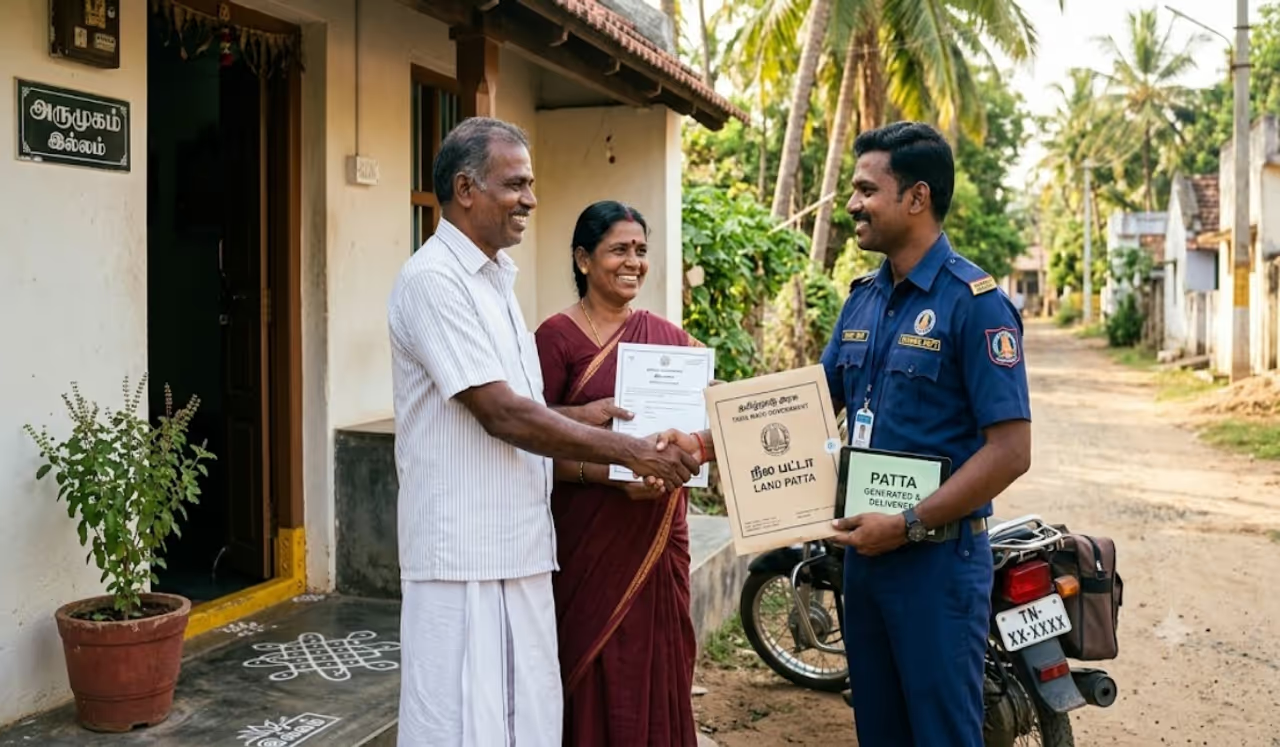
Vijay Govt: நிலம் வாங்கப் போறவங்களுக்கு ஜாக்பாட்! இனி பட்டா தேடி வரும்! தமிழக அரசு குட்நியூஸ்!

Vijay Govt: நிலம் வாங்கப் போறவங்களுக்கு ஜாக்பாட்! இனி பட்டா தேடி வரும்! தமிழக அரசு குட்நியூஸ்! Vijay Govt: நிலம் வாங்கப் போறவங்களுக்கு தமிழக...