Monday, August 9, 2021

Is it the end of MPhil programme


Is it the end of MPhil programme

While NEP has specified discontinuation of MPhil degree, DU is allowing MPhil admissions for 2021-22, but few universities are planning to completely do away with it

Astha.Hemant@timesgroup.com

09.08.2021 

One of the major changes introduced by the National Education Policy (NEP) 2020 is the discontinuation of MPhil (Master’s in Philosophy) programme. Instead, there is an emphasis upon a four-year Bachelor’s degree and a research intensive Master’s degree. Despite the uncertainty, the University of Delhi (DU) has received more than 12,500 applications for MPhil during the ongoing admission process. Rajeev Gupta, chairperson (admissions), shares, “A policy floated by the Centre applies to individual universities only when we receive instructions from our respective executive councils. Till then, it is not possible to scrap an entire course.”

DU is planning on implementing changes mentioned in the NEP from next year (2022), which may include scrapping MPhil degree, adds Gupta. “For the time being, we are continuing with our MPhil course,” he says.

Various other universities have done away with the MPhil course. Kanchan Mullick, spokesperson, University of Hyderabad (UoH), explains, “UoH set up a committee for implementation of NEP, which recommended that the varsity should discontinue the MPhil programme from 2021-22.” The committee placed its recommendations before the academic council (AC) held in March, 2021, she adds. “The recommendations were accepted by the AC. So, after adopting NEP last year, UoH has discontinued MPhil admissions from 2021-22,” clarifies Mullick.

Abhay G Chebbi, prochancellor, Alliance University, Bengaluru, says that the varsity has never made an MPhil degree a compulsion for PhD candidates. “Graduates and postgraduates both can enroll in our PhD course. Thus, this NEP guideline has not affected us,” he clarifies.

Gupta explains “The duration of an MPhil course is around 18 months, including six months of thesis work. As per norms, all students applying for the MPhil course this year will be exempt from the initial coursework that they are required to do as PhD candidates in DU. Thus, MPhil candidates will not suffer in their academic pursuits.”

Mullick says that MPhil students admitted last year and those finishing their MPhil from previous years will be awarded the degree as per the eligibility criteria and the period duration at UoH, as prescribed by University Grants Commission (UGC). “The grace period that has been set by the UGC will be followed, and these degrees will be valid,” she adds.

As per the grace period, which has been changed thrice since the announcement of NEP 2020, students who were scheduled to submit their MPhil thesis in June 2020, have been given extra three semesters, explains Mullick. “These candidates can now submit their thesis by December 2021,” she says.
Education Times

These 13 colleges will offer tech lessons in five languages

The institutes have been sanctioned 60 additional seats by AICTE to impart first-year Engineering courses in the regional languages

Rajlakshmi.Ghosh@timesgroup.com

09.08.2021 

In line with provisions of the National Education Policy (NEP) 2020 that calls for education in one’s mother tongue as far as possible, as many as 13 Engineering colleges from 8 states are starting to impart education in five Indian languages that include Hindi, Tamil, Telugu, Marathi and Bengali from the 2021-22 academic session.

To facilitate the process, the All India Council for Technical Education (AICTE) has already completed the task of translating video lectures of Engineering on the SWAYAM platform in eight regional languages with plans to translate content into Oriya, Assamese and Punjabi, as well. For helping the institutes, an AI Indian language-translation tool has been developed by the technical education regulator that will aid in developing content in 12 different regional languages.

Divided opinion

The push for technical education, more so Engineering, to be imparted in regional languages, beginning from the 2021-22 academic year, was first mooted by the Education Ministry in November 2020. A few of the IITs and NITs were also shortlisted, though opinions were divided over what would be most effective for the students, keeping in view their long-term research interests and overseas study plans, though English would be one of the mandatory subjects for the students studying in mother tongue.

Bridging the gap

In a recent turn of events, however, 13 colleges have been approved to impart engineering courses in five regional languages. This follows in the wake of the emphasis on mother tongue as the medium of instruction to instil confidence among students from humble backgrounds.

Accreditation matters

“While 14 Engineering colleges had applied to impart courses in Indian regional languages, 13 were approved. AICTE will not compromise on the quality of technical education and will permit only the institutions with accredited programmes. Currently, only those colleges that are running accredited programmes have been permitted to run the courses in the regional languages. Sanctions for additional 60 seats in Engineering and technical subjects over and above the existing seats have also been granted to each of them,” says Anil Sahasrabudhe, chairman, AICTE, while talking to Education Times.

Resources in regional languages

“AICTE has further mandated that any technical institution that is willing to impart AICTE-approved courses can also run programmes in regional languages, as long as they earmark certain seats from the sanctioned intake,” Sahasrabudhe adds. AICTE is ready with the first-year undergraduate and polytechnic course books in the regional languages that were earlier not available. Approval for select streams of Engineering have been granted to these 13 colleges. “Most of the approvals are for Computer Science, followed by Electrical and Electronics Engineering, Civil Engineering, Mechanical Engineering and Information Technology,” Sahasrabudhe says. Of the 13 colleges that received the AICTE nod, two colleges from Rajasthan, four from UP, one college from Madhya Pradesh and another college from Uttarakhand will run courses in Hindi; one college from West Bengal will impart courses in Bengali; a Maharashtra-based college will run courses in Marathi, while one college from Andhra Pradesh will run courses in Telugu and remaining two colleges from Tamil Nadu are slated to impart courses in Tamil.

Easy to comprehend

“Our faculty members were already teaching the courses in Tamil, though at an informal level. Since many of our students come from the rural interiors of Tamil Nadu and are first generation learners, they were finding it difficult to comprehend the courses in English; most of them are afraid to even ask questions,” says B Nagaraj, principal, Rathinam Technical Campus, Andhra Pradesh, that will soon impart Computer Science courses in Tamil for 60 seats, for which it has sought affiliation from Anna University. “Local language will enhance both the creative thinking and analytical skills of the students who were earlier too stressed to have faith in their strengths and abilities,” adds Nagaraj.

Much like Rathinam Technical Campus, the Noida Institute of Engineering and Technology (NIET), Greater Noida, will start BTech in Computer Science & Engineering in regional language. “Students will be able to answer in their native tongue. Over some time, the demand for software in regional languages will increase,” says Raman Batra, executive vice president, (NIET).

KGMU To Give Two Mercy Attempts To MBBS Students Unable To Clear Exams For Last 8-27 Years


KGMU To Give Two Mercy Attempts To MBBS Students Unable To Clear Exams For Last 8-27 Years

By Barsha Misra Published On 8 Aug 2021 4:00 PM | Updated On 8 Aug 2021 4:01 PM

Lucknow: Opining that MBBS students who will fail to clear exams even after spending more than 10 years in the University should consider changing the course of life, the King George's Medical University (KGMU) has decided to expel such students if they fail in two more mercy attempts.

"Students at the King George's Medical University (KGMU) unable to clear MBBS since over a decade will be gi two more mercy attempts to clear their exams and supported with extra classes," stated the executive council of the

The executive council of the University took such a decision on Friday regarding the MBBS students who haven't been  able to pass at their MBBS examinations for the last 8-27 years. At present, there are 20 such students in the University.

Previously, there was no rule at the maximum number of attempts for clearing the examination at KGMU. Later, after consulting the National Medical Commission (NMC), the University had set the timeline for clearing the MBBS examination at 10 years. It was decided that after 10 years, only 4 mercy attempts would be given.

As the rule had been implemented only after 2019, it couldn't be applied to the earlier students and eventually a committee was constituted to consider the matter of the 20 students, adds TOI.

Now, the committee has decided to give two more mercy attempts to such students for clearing the examination. However, considering the weaknesses of such candidates the University has also decided to provide extra and remedial classes to those students.

As per the latest media report by the Times of India, the MBBS students were not able to clear the course as either they had not appeared for the examination or they simply didn't appear for the same. Among these 20 students, one student belongs to 1994 batch, whereas another one is from 1997 batch. The rest of the students are from batches between 2000 and 2013.

10 among the 20 students had failed only in the fourth year, eight in the first year and two students are stuck in the second and third years of the MBBS examination.

Hindustan Times adds that in two cases, students are still pursuing their MBBS, while their children have cleared their medical examinations.

The daily adds that belonging to backward classes and having rural backgrounds the students faced difficulties in understanding the subjects.

In fact, alleging discrimination, some of the students had even lodged a complaint at the Chief Minister's portal, reports TOI. However, vehemently denying such allegations, KGMU had submitted written evidence in the support of their fair play.

Speaking to the Times of India regarding granting two more mercy attempts to such students, KGMU VC Lt Gen Prof Bipin Puri said, "After thorough discussion, we decided to give two mercy attempts to these students. We understand that they are weak and need extra attention. The university will provide remedial classes to clear doubts. Extra classes may also be arranged on the request of students."

"If students have spent more than 10 years here, have failed more than four times in one exam and despite two more

Lucknow: KGMU’s old students failing to clear MBBS to get "two mercy attempts"

Lucknow: KGMU’s old students failing to clear MBBS to get "two mercy attempts"

TNN | Aug 7, 2021, 04.53 AM IST

LUCKNOW: MBBS students at the King George’s Medical University (KGMU) who have not been able to clear examinations for the last 8-27 years will get “two mercy attempts”.

Those who fail in these two attempts will be expelled. The decision was taken by the KGMU’s executive council on Friday. Currently, there are 20 such students who have not been able to clear the course as they either failed or did not appear for the examination.

The oldest among them is a student who took admission in 1994, followed by another who joined in 1997. The remaining students are from batches between 2000 and 2013.

Of the total, 10 have been failing in the fourth year of MBBS for several years, while eight have not been able to clear the first year so far. Two students are stuck in second and third years. These students have been failing in subjects like surgery, obstetrics and gynaecology, and paediatrics.

Most students belong to backward classes or rural backgrounds and had difficulty in understanding the subjects. Some of them even alleged discrimination and lodged a complaint at the chief minister’s portal. The charge, however, was vehemently denied by KGMU which also submitted written evidence of fair play. Till 2019, KGMU had no rule on how many times a student can appear for examinations. After consulting the National Medical Commission (NMC), it was decided that every MBBS student will have to clear all examination within 10 years and only four mercy attempts will be allowed thereafter. Those who fail in all the attempts will be debarred.

However, this rule was implemented from 2019 onwards and did not apply to students enrolled earlier. Later, a committee was constituted to resolve the issue.

“After thorough discussion, we decided to give two mercy attempts to these students. We understand that they are weak and need extra attention. The university will provide remedial classes to clear doubts. Extra classes may also be arranged on the request of students,” said KGMU VC Lt Gen Prof Bipin Puri.

KGMU to give two mercy attempts to MBBS students unable to clear exams for last 8-27 years

KGMU to give two mercy attempts to MBBS students unable to clear exams for last 8-27 years: Lucknow: Opining that MBBS students who will fail to clear exams even after spending more than 10 years in the University should consider changing the course of life, the King George's Medical...

Many violate two-year service bond after super-speciality courses in T.N.


Many violate two-year service bond after super-speciality courses in T.N.

Several candidates from other States did not attend counselling for posting

08/08/2021

Serena Josephine M.CHENNAI

Many candidates, who belong to other States and completed super-speciality medical courses (DM/M.Ch) at government medical colleges in Tamil Nadu in 2020, did not attend the counselling held for posting at July-end. While this was not the first time that non-service other State candidates violated the two-year service bond executed with the State government, a cross-section of government doctors feels this will have an impact on the healthcare system in the long run.

Official sources said more than half of the candidates of the batch did not attend the online counselling, while a few candidates who attended the counselling said at least 80% of the other State candidates of the 2017 batch skipped the process.

An official of the Health Department said, “More than 50% of the candidates in super-speciality batches are from other States. They must work for two years as per the bond for ₹40 lakh executed at the time of admission. Some doctors finish the course and leave. They join work in their States and approach the court saying they did not get postings or departments as soon as they finished the course. According to the rules, they have to work in a government set-up anywhere in Tamil Nadu. In such circumstances, we will have to take action under the Revenue Recovery Act for bond violation,” he said.

There have been instances of posting orders having been issued but no one having turned up for duty, he said. “Services of a cardiologist or oncologist may be required at a secondary care hospital, not only at a tertiary centre.”

In an analysis, the Service Doctors and Post Graduates Association (SDPGA) found that in the 2017 batch of DM medical gastroenterology, all 16 seats were occupied by non-service candidates — one from Tamil Nadu and 15 from other States. Among them, the sole candidate from Tamil Nadu and two other State candidates joined the service. On the contrary, 15 other State candidates of the 2018 batch have joined service.

Of the 19 urology seats, there was one service candidate and the rest were non-service candidates in the 2017 batch. Only one non-service candidate who belonged to Tamil Nadu took up posting, while the remaining did not attend the counselling. No candidate who belonged to other States and completed M.Ch gastroenterology, urology, neurosurgery, cardiothoracic surgery and surgical oncology and DM gastroenterology, cardiology, neurology and endocrinology attended the counselling, the association said.

“There are nearly 280 other State candidates in the 2017 batch and a majority of them did not attend the counselling on July 30. This means they are not going to join the Tamil Nadu government service to serve their bond, and this is a gross disservice to the healthcare delivery system in the State,” SDPGA State president P. Saminathan said. “This is why we have been demanding exclusive State counselling and a 50% service quota in courses. The State government should pass a special ordinance for the quota,” he added.

He said there were no service PGs in a few courses in the last two batches. “If this continues, no one will come to work at government medical colleges in these departments, leading to lack of faculty,” he said.

“Many other State candidates, who completed in 2020, did not attend because it has been a year since they completed the course and so, many returned to their States and started working there. This could have been prevented had postings been given as soon as the course was completed. There is no certainty on when the Directorate of Medical Education will issue postings to work under bond. Another problem was the lack of official intimation regarding counselling by way of email or call letter. It was put up on the Health Department’s website,” a doctor who attended the counselling said.

A doctor working at a primary health centre said that with no service quota in super-speciality seats, students study here and return to their States without completing the mandatory service. “This is creating an acute shortage of super-specialists at government hospitals. This is why we are demanding a 50% service quota,” he said.

Follow G.O., HC tells police

Follow G.O., HC tells police

08/08/2021

B.Tilak Chandar Madurai

Citizens should be provided police protection, based on a government order, when they seek it after a favourable a civil court decree, the Madurai Bench of the Madras High Court told the the Director General of Police and directed him to issue a reminder to all the police stations.

Justice J. Nisha Banu referred to the G.O. issued in 2008 by the Home Department and said police should not insist on a specific court direction while their protection is sought.

The court was hearing the petition filed by P. Packianathan of Melur taluk in Madurai district. The petitioner had sought a direction to the Madurai police to provide him adequate protection to carry out agricultural works in his land. A civil dispute pertaining to the land was settled in his favour. He made the representation to the police seeking their protection, but the latter had insisted on a specific order from the court. The court observed that the government itself had issued the guidelines to the police officers directing them to give protection in the light of the civil court order by constituting a committee. Based on the recommendations of the committee, the guidelines were issued. But, even after all these years, the G.O. was not implemented driving people unnecessarily to the court. “It is high time the police officers respected the orders of the court and government orders,” the judge said.

To avoid recurrence, the court directed the DGP to issue reminders to police stations. Referring to an earlier judgment of the High Court, the judge said the the function of the police officials was to control law and order and investigate crimes. The police cannot take over the job of the civil court to adjudicate the disputes.

Perhaps without understanding the stage at which they can interfere in civil jurisdiction, the police were insisting upon the production of the specific court order, the judge said and disposed of the petition.

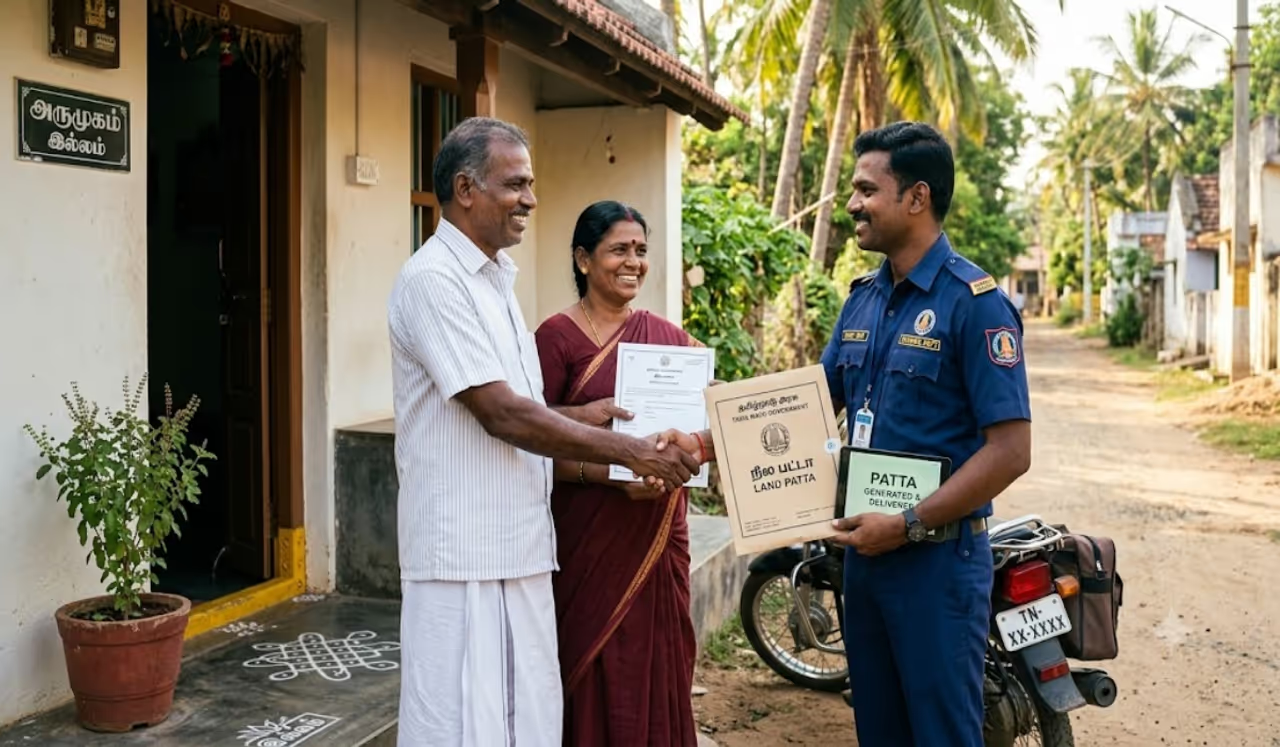
Vijay Govt: நிலம் வாங்கப் போறவங்களுக்கு ஜாக்பாட்! இனி பட்டா தேடி வரும்! தமிழக அரசு குட்நியூஸ்!

Vijay Govt: நிலம் வாங்கப் போறவங்களுக்கு ஜாக்பாட்! இனி பட்டா தேடி வரும்! தமிழக அரசு குட்நியூஸ்! Vijay Govt: நிலம் வாங்கப் போறவங்களுக்கு தமிழக...