Sunday, January 11, 2026

Chennai Central station’s retiring rooms & dorms to get makeover

Chennai Central station’s retiring rooms & dorms to get makeover

Venkadesan.S@timesofindia.com 11.01.2026


Chennai : Southern Railway will renovate retiring rooms and dormitories at MGR Chennai Central station to provide a star-hotel-like experience to passengers. The station has nine airconditioned rooms, a 23-bed air-conditioned male dormitory, and a fivebed female dormitory at the concourse level. They are available for up to ₹500 for three hours. “The unused vacant space at the concourse will also be developed to provide a premium experience to passengers looking for a short stay ahead of, or after, a long journey,” said an official with the Chennai division of the Southern Railway. 

The railways will outsource the facility to an agency. Those with prior experience in the hospitality sector can participate in the open tender, develop the facility, and maintain it for five years, which can be extended by up to four years. “So far, the railways maintained the facility. Now, the facility will be modernised under the renovate, operate, maintain, and transfer model. The aim is to provide passengers with a more comfortable, contemporary, and pleasant stay experience in line with present-day standards,” he added.

The retiring rooms are close to commercial outlets, restaurants, eateries, and other essential amenities, and passengers can easily reach the platforms. T Sadagopan, a civic activist, while welcoming the move, raised concern about whether the facility would remain affordable to all passengers. “If they hike the price to premium rates, many may not be able to afford it,” he said.

 1/11/26, 6:32 AM Times of India ePaper chennai - Read Today’s English News Paper Online https://epaper.indiatimes.com/timesepaper/publication-the-times-of-india,city-chennai.cms 1/2 MODERN UPGRADE 1/11/26, 6:32 AM Times of India ePaper chennai - Read Today’s English News Paper Online

Network issues mar Pongal gift distribution

Network issues mar Pongal gift distribution 

Venkadesan.S@timesofindia.com 11.01.2026


Chennai : Network issues at public distribution shops (PDS) and inordinate delay in biometric recognition forced ration card holders to wait in long queues to get the state govt’s Pongal gift of ₹3,000 in cash, 1kg raw rice, 1kg sugar, and a stalk of sugarcane. 

In many cases, people were asked to come back later. Chief minister M K Stalin, on Sunday, announced a Pongal gift of ₹3,000 to 2.23 crore ration card holders. Officials at cooperative societies said the dole was distributed to 78.30 lakh beneficiaries until 10am on Saturday. Ration card holders, however, narrated stories of how they were turned away in many places in the city after hours of waiting. “For most people, the system captures the fingerprints on the second or third attempt. But for some, it did not recognize them even after multiple attempts. We cannot hand over the Pongal gift and the cash without biometric confirmation. So, we ask them to come again during leisure hours,” said a salesman at a PDS shop in Anakaputhur in Tambaram corporation. 

Initially, the salesmen were given two options to record the biometrics—through fingerprints or iris scan. However, supervisors said that the iris scan option was disabled, as it could further slow down the system. Sekar, a ration card holder, said he was asked to update the biometrics at Aadhaar centres. “Aadhaar centres claim it takes one month for the new fingerprints to be recorded in the UIDAI system. I visit the ration shop every day without any luck,” he said. 

Supervisors blamed a slow server for the delay. “We were directed to speed up the cash distribution, but the system does not support it. We turn up early at shops and stay back beyond working hours. It still does not help,” said a supervisor.

No separate recognition needed for MBBS seats: NMC


No separate recognition needed for MBBS seats: NMC

Once seats are approved or renewed annually, that batch will be treated as recognised for that year, regulatory body tells medical colleges; directs them to submit only an annual report and fee

Earlier practice of granting separate recognition to
MBBS seats had been discontinued under fresh regulations issued in 2023. File photo

Bindu Shajan Perappadan

NEW DELHI  11.01.2026


The National Medical Commission (NMC) has directed medical colleges not to submit separate proposals for recognition of MBBS seats, clarifying that the annual renewal of seats itself will be treated as recognition under the current regulatory framework.

“The commission has issued the clarification after the Undergraduate Medical Education Board (UGMEB) started receiving applications from some medical colleges for recognition, along with fees. Now we have made it clear that there is no need for separate applications for recognition of MBBS seats and fee structure,’’ said a Union Health Ministry official. The earlier practice of granting separate recognition to MBBS seats had been discontinued following the implementation of the Maintenance of Standards of Medical Education Regulations, 2023.

As per these regulations, medical colleges are required to submit only the annual disclosure report (ADR) along with the prescribed fee on the NMC portal, as and when called for. The ADR is a mandatory report, which colleges submit to the NMC with details on their infrastructure and ability to maintain standards needed to conduct the medical courses.

Once MBBS seats are approved or renewed annually, the permitted batch and the seats will be treated as recognised for that particular academic year, the NMC said in its order. Such medical colleges and institutions will be considered accredited ones for the said courses, it added.

T.N.’s assured pension scheme comes into effect from Jan. 1


T.N.’s assured pension scheme comes into effect from Jan. 1

The Hindu Bureau  11.01.2026


CHENNAI

The Tamil Nadu Assured Pension Scheme (TAPS) for State government employees, announced recently by Chief Minister M.K. Stalin, has come into effect from January 1.

A Government Order (G.O.) to this effect was issued by the Finance Department on Friday and circulated on Saturday. According to the G.O., the TAPS will be mandatory for all eligible employees who enter service from January 1, 2026. All eligible employees governed by the Contributory Pension Scheme (CPS) and retiring on or after January 1, 2026, will come under the TAPS.

Opting for CPS

Employees who were in service before January 1, 2026, and were covered by the CPS, will be given an option at the time of retirement to choose between the benefits under TAPS or those equivalent to what they would have received under the CPS. Employees covered under the TAPS, including those who initially joined service under the CPS but were subsequently covered by the TAPS and opt for TAPS benefits at the time of retirement, will be entitled to a minimum pension. They will also be permitted to commute a portion of their pension.

Saturday, January 10, 2026

Madras HC relief for SC medico denied government quota


Madras HC relief for SC medico denied government quota

Affirmative action is not exception or bounty, but is constitutional right of student concerned, says Justice Chakravarthy


Differing with the submission, Justice Chakravarthy said, “I find force in the case of the petitioner that even though she comes within the government quota seats in the Private Medical College, she has wrongly been denied the seat.”(Express illustration)


Updated on:
09 Jan 2026, 8:28 am

CHENNAI: The Madras High Court has come to the rescue of an Arunthathiyar (SC-A) MBBS student, who was given admission under the management quota though eligible for government quota, by ordering the state government to bear the excess amount of fees over and above the government quota.

Justice D Bharatha Chakravarthy passed the orders recently on a petition filed by S Malarvizhi, of Palaiyapalayam village in Namakkal district, currently pursuing MBBS course at the Karpaga Vinayaga Medical College in Madhurantagam.

The petitioner scored 455 marks out of 720 in NEET and was eligible for admission under the government quota seat under SC-General category. However, she was given admission under the management quota during 2024-25. Seeking to quash the merit list as less meritorious candidates were given government quota seats, she moved the HC.

Representing the petitioner, advocate N G R Prasad, assisted by advocate Parveen Banu, submitted that the Selection Committee has committed the mistake of considering her only for SC-A quota and not under SC-General for which she was very much eligible.

He said the TN Arunthathiyars (Special Reservation of seats in Educational Institutions including Private Educational Institutions and of appointments or posts in the services under the State within the Reservation for the Scheduled Castes) Act, 2009, and Clause 18 (6) of the admission prospectus provided for considering the candidate under the SC-General category also but such benefit was denied.

However, standing counsel for the Selection Committee, advocate Sneha, submitted that as per the relevant Act and rules, an SC-A candidate can be considered for admission under the SC-General category only if there are no seats available in the former and when the petitioner was considered for admission, there were BDS seat vacancies under the SC-A category.

Differing with the submission, Justice Chakravarthy said, “I find force in the case of the petitioner that even though she comes within the government quota seats in the Private Medical College, she has wrongly been denied the seat.”

He said reservation is not a bounty but a right. “Even assuming that the procedure that is adopted by the respondents is right, now the law is very well-settled that the reservation or positive discrimination/affirmative action is not an exception or a bounty that is conferred on the student concerned but is a valuable constitutional right ensuring equality and merit,” he said.

Justice Chakravarthy also said the relevant Act, rules and the 2010 G.O. provide for consideration of SC-A candidates under the SC-General category too.

Declaring the non-selection of the petitioner to the government quota seat as “illegal”, he ordered the student to pay only the government quota fees and directed the respondent authorities to pay the difference of fees amount above the government quota amount of Rs 4.35 lakh per year and reimburse the difference in fees already paid.

The judge made it clear that the order of payment of difference in fee amount shall not preclude the petitioner from availing of scholarships or other benefits meant for SC-A students.

Chennai Metro trial run in Porur-Vadapalani stretch on Sunday

 Chennai Metro trial run in Porur-Vadapalani stretch on Sunday

10.01.2026

Chennai Metro Rail said the trial run, scheduled for January 11, follows the completion of initial traction testing and electrification works, which are expected to conclude by Friday midnight.


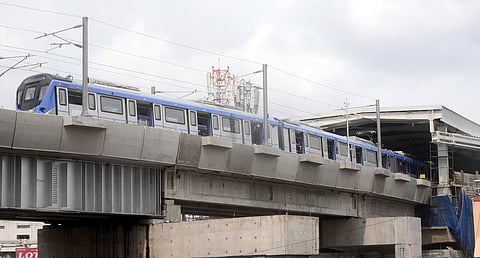
Chennai Metro train stationed at the CMRL station near Porur junction.(File Photo | Express)

Express News Service

Updated on:
09 Jan 2026, 7:10 pm

CHENNAI: One of Chennai’s most complex new transport structures — a double-decker viaduct carrying metro trains above a major arterial road — will come under live testing on Sunday as Chennai Metro Rail conducts the first trial run on the Porur–Vadapalani stretch of its Phase II expansion.

Chennai Metro Rail said the trial run, scheduled for January 11, follows the completion of initial traction testing and electrification works, which are expected to conclude by Friday midnight. Integrated system testing, covering rolling stock movement, power supply and signalling interfaces, will continue through Saturday, with the timing of Sunday’s run to be announced later.

The Porur–Vadapalani section is notable not only for being among the first Phase II stretches to enter the trial stage, but also for incorporating a double-decker design — a relatively rare solution in Indian urban rail projects. The structure allows metro infrastructure to be layered above an existing road corridor, reducing the need for land acquisition while preserving surface traffic capacity in a densely built part of the city.

Connectivity along the Porur–Vadapalani corridor carries particular urban significance. The stretch cuts across heavily congested east–west routes linking western suburbs with central Chennai, serving dense residential neighbourhoods, educational institutions, healthcare clusters, and emerging commercial pockets.

The corridor has been executed using round-the-clock shifts involving several hundred engineers, technicians and contract workers across civil, electrical and signalling disciplines. The corridor is likely to be put into use for commuters by February.

NEWS TODAY 10.01.2026


NEWS TODAY 11.01.2026