Thursday, July 19, 2018

Missing files: High Court orders CBI probe

CHENNAI, JULY 19, 2018 00:00 IST

They disappear from ex-judge’s house

A fit case for ‘Ripley’s Believe It Or Not’. With about a hundred case bundles having mysteriously disappeared from a Madras High Court judge’s residence, the court has now ordered a Central Bureau of Investigation (CBI) probe to get to the bottom of the matter.

The bundles went missing from the residence of former judge T. Mathivanan before he retired from service in May 2017.

Justice G. Jayachandran directed the central agency to investigate the issue and proceed against those found guilty. “This court is worried about the missing case records from the chartered High Court, which is also a court of record (a court whose proceedings are recorded and available as evidence of fact),” he said.

Wondering how case bundles sent to a judge’s residence did not return to the High Court Registry, and remained untraced, Mr. Justice Jayachandran said: “It is alarming to note that case bundles have disappeared from the radar like missing vessels in the Bermuda Triangle.”

The issue created a furore, with a number of lawyers taking it up with Chief Justice Indira Banerjee. One of those complaints stated that Mr. Mathivanan had allowed a petition on March 21, but a copy of the order was not delivered to the petitioner till the judge retired from service.

Subsequently, the High Court Registry informed the lawyer, G. Saravanan, that his entire case bundle was missing. However, curiously, the Information Centre on the court campus had issued him a printout of the case status information, wherein it was clearly mentioned that the case had been disposed of by Mr. Mathivanan on March 21.

The Chief Justice received similar complaints from many other lawyers who complained of bundles related to appeals, original petitions and revision cases going missing. All those cases were related to CBI investigations and all of them had been dealt with by Mr. Mathivanan during his tenure as a judge of the High Court.

Shocked over such complaints, Ms. Justice Banerjee ordered an in-house enquiry which revealed that about a hundred case bundles sent to the judge’s residence, before his retirement, for various purposes such as dictating and signing of the judicial orders, were not returned.
Sabarimala temple bar unreasonable: SC

NEW DELHI, JULY 19, 2018 00:00 IST


The Sabarimala temple is a public place of worship, the Supreme Court noted. 

‘Why tag entry with menstruation?’

Tagging a woman’s right to enter the famous Sabarimala temple with her menstrual cycle is unreasonable, the Supreme Court’s Constitution Bench observed on Wednesday.

The Bench, led by Chief Justice of India Dipak Misra, asked whether the exclusion of women aged between 10 and 50 from entering a temple because they are considered ‘impure’ amounts to the practice of untouchability, a social evil abolished by law.

The CJI said there is no concept of “private mandirs (temples).” Once a temple is opened, everybody can go and offer prayers. Nobody can be excluded. The Chief Justice noted that the Sabarimala temple drew funds from the Consolidated Fund, had people coming from all over the world and thus, qualified to be called a “public place of worship.”

A batch of petitions has challenged the prohibition on women of a certain age group from entering the Sabarimala temple.
How did students with zero or negative marks in physics, chemistry qualify in NEET? It’s not the fault of NEET

Rema.Nagarajan@timesgroup.com  19.07.2018

The National Eligibilitycum-Entrance Test (NEET) has brought in much needed transparency in medical college admissions. This has exposed how students with abysmal scores in the entrance examination have got admission for MBBS, mostly in private colleges. This situation has been created by the health ministry and the Medical Council of India (MCI) keeping the qualifying cutoff very low so that private colleges can fill their seats despite their exorbitant fees.

With the Supreme Court ruling that all colleges will have to go by NEET ranking for admissions in 2017, one would have imagined that merit-based admissions were finally in place. However, even students with ranks below 6 lakh got admission though there were only about 60,000 MBBS seats in 2017. How did that happen? The exorbitant fees charged by most private colleges forced lakhs of relatively meritorious students to forego seats allotted to them in these colleges, allowing poor performers with more money to get admission.

Many high scoring students cannot afford the exorbitant fees, but the health ministry and MCI, by keeping the cutoff at 50th and 40th percentile for general and reserved categories respectively, have ensured that the private colleges can go further and further down the merit list till they find students rich enough to fill their seats at the price demanded by them. Low cutoffs ensured that over six lakh students qualified for just 60,000 seats.

An analysis of NEET scores indicates that, other than ST, for all other categories even an 88th percentile cutoff would have been enough to comfortably fill the seats available. For the ST category, this would be true at about the 75th percentile. Several students with zero or negative marks in the physics and chemistry papers of NEET qualified for admission as the MCI has not fixed any minimum cutoff in individual subjects.

If zero or negative marks do not make a candidate ineligible for admission, why bother to test in the subject at all? Equally, how can a candidate scoring 15 out of 360, or 4%, in the NEET biology paper be eligible for MBBS? Several such students not only qualified, but also got admission in private colleges, paying average annual tuition fees of Rs 17 lakh. Thus the merit-based admission that NEET promised has been subverted by keeping the qualifying criteria fixed at ridiculously low levels despite the NEET results of 2013, 2016 and 2017 exposing the flaws in them.

If the cutoff was raised and minimum marks for individual subjects made mandatory, there would be fewer students qualifying and the private colleges demanding sky-high fees will not be able to fill their seats. They would be forced to charge more reasonable sums. TOI had analysed the annual tuition fees charged in 210 private colleges to show how 25 colleges averaged Rs 5 lakh or less and about half averaged under Rs 8 lakh. Why does the government allow some to charge up to Rs 25 lakh when they teach the same MCI-stipulated curriculum?

The high fees are the root cause of the dilution of merit. As TOI’s analysis of NEET
Govt bus driver’s daughter flies high with pilot licence

Ananth.MK@timesgroup.com

Madurai:19.07.2018

It was a moment of pride for V R Ravikumar, 58, a TNSTC bus driver, when his daughter Kavya made her first visit to the city on Wednesday after securing a commercial pilot licence (CPL). Their small rented house on Irulappasamy Koil Street at Palanganatham was crammed with visitors who came to appreciate the 22-year-old and her thrilled parents.

For Kavya, the dream of becoming a pilot happened after an incident with a toy plane, when she was barely five years old. “A family friend leaving for a foreign country asked me to pick my choice from a heap of toys belonging to their son. I picked a plane not knowing that it was damaged. My father got it repaired seeing which the aunt took it back and gave it back to her son,” she recalled. That was when she thought about flying a plane that everyone would see. “I did not know who to approach and where I could study until I saw an article in a newspaper when I was in Class X. It was about a flying school in Bengaluru,” she said. That was when her parents realized she was serious about her ambition.

She was all the more excited on coming to know that all she needed was a Class XII pass with 50% marks. Paying the huge fees was the next hurdle which the parents crossed by pledging jewellery and taking loans of ₹6 lakh. But that was just enough for theory classes and to complete fewer than 35 hours of flying at Government Flying Training School (GFTS), Bengaluru.

Due to insufficient funds, she had to wait close to the runway and watch others fly while she could not complete the mandatory 200 hours of flying to complete the course. Her attempt to apply for a scholarship for Scheduled Caste students in Tamil Nadu too did not yield results. At last, help came from the Centre which awarded her a scholarship of ₹20 lakh. “I am confident of handling even a flight with an engine failure,” she chuckled.

Two weeks ago she became the first student from GFTS Bengaluru to get a CPL in 21 years. “I am disproving claims that there is no life without obtaining a degree. I want to fly and teach. There are many options before me like flying chartered flights and for airlines,” she added. Kavya’s mother Kalpana, 46, a homemaker, said she used to regret not having a son but only two daughters. “I am sure a son would not have made me so proud,” she added.

SETC mulls flexi-fares; prices may drop by 25%

Ram.Sundaram@timesgroup.com

Chennai:19.07.2018

Fares on State Express Transport Corporation (SETC) buses may soon be reduced by 25% to 30% during the weekdays.

“The corporation has sent a proposal to the state transport department in connection with the flexifare model and we are expecting the necessary order to be issued soon,” a senior official from SETC told TOI on condition of anonymity.

At present, SETC charges ₹2 for every kilometre in their A/C buses. Once the flexi-fare model is in place, it will be reduced to 1.70 paise per km.

For example, once this system is introduced, travel to Madurai in an SETC bus from Chennai would cost ₹975 during weekends, festivals and ₹830 to ₹840 on weekdays when the occupancy ratio reduces significantly.

Similar fare slabs have been proposed for various categories of SETC buses.

Despite operating 1,180 buses on long routes, the corporation’s revenue has been crumbling in recent years. The bus fare hike in January was a major blow as it made travelling in an SETC bus more expensive than in a private bus on weekdays.

On the other hand, by reducing fares on weekdays private omni buses attract more passengers.

“Unlike private operators, we are not allowed to alter fares as per market demand. Though our buses run full on weekends and festivals because pricing by private buses, there is a dip during weekdays as the same fare is collected by SETC then,” the official said.

Under the proposed model, passengers would pay much less than what omni buses charge on weekdays and regular fares would be collected on weekends and festivals, he added.
In bid to attract techies & students, govt AC buses shift boarding point to Egmore

SETC TAKES A LEAF OUT OF BOOKS OF PRIVATE OPERATORS, ATTEMPTS TO MAKE PASSENGERS’ JOURNEYS EASIER


Ram.Sundaram@timesgroup.com

Chennai:19.07.2018

In a bid to attract more IT professionals and college students, who frequently visit their native places over the weekend, the government-owned State Express Transport Corporation (SETC) has shifted the boarding point from Koyambedu.

Starting this week, select airconditioned sleeper buses plying to Madurai-Tirunelveli, Trichy-Karur and Theni-Bodi have been departing from Egmore after 8pm.

These buses ply along Adyar, SRP Tools on Old Mahabalipuram Road, Velachery and Tambaram before joining other buses at Perungulathur.

The buses have been scheduled 45-60 minutes after the last soughtafter Express trains to these cities depart from Egmore and Central railway stations in Chennai.

Previously, all SETC buses departed only from Koyambedu bus terminus, located at least 30km to 40km away from the IT corridor.

“On an average, it takes an hour and 30 minutes to reach Koyambedu and it turns worse during peak hours, weekends or holidays,” said K Dinesh, a software professional from Sholinganallur.

On the other hand, private buses halt at multiple points near our locality, he added.

A preliminary analysis by SETC suggested that aping this operation might help them attract more passengers.

“So, we have tweaked operations and our buses too will ply along areas where most of our target population reside. We hope this will help us to improve the daily footfall,” an SETC official said.

In the first phase, two new A/C sleeper buses and one A/C sleeper-cum-seater bus will be operated to Tirunelveli, Bodi and Karur respectively.

The fare collected for travel on these buses will be the same as the one collected from those boarding other SETC buses at Koyambedu.

Buses, with a seating capacity of 30, bound towards Bodi and Karur will ply via the IT corridor.

In addition to this, the Tirunelveli bus will take a detour via the Ashok Nagar-Kathipara Junction route so that more passengers can be accommodated, the official added.

Madras univ to turn affiliated colleges into support centres

Siddharth.Prabhakar@timesgroup.com

Chennai:19.07.2018

After taking a decision on shutting down its distance education study centres in Chennai, outside Tamil Nadu and those abroad, University of Madras has approached its affiliated colleges to serve as ‘learning support centres’ from the current academic year as per the University Grants Commission’s (UGC) Open Distance Learning programme.

In the syndicate meeting held on June 28, the university approved 22 affiliated colleges which have given approval to become the university’s learning support centres. Out of these, a few colleges are situated in Chennai, while others are in Tiruvallur and Kancheepuram districts.

Currently, students who take the distance education courses are given study material by the university study centres or at the Institute of Distance Education (IDE) office in Chepauk. However, those taking the now courses will be able to attend classes at colleges near them.

“We are also planning to upload video lectures on our website which can be downloaded and played at these centres. Students can directly get their doubts cleared at these colleges,” said P Duraisamy. Wary of UGC’s regulations, the university has ensured that the franchise model does not come in.

The agreement with colleges is likely to be on a revenue sharing model with the university taking a 40% share for the lab-oriented courses and 60% for non-lab courses.

“We have written to the UGC and will soon get approval for running the courses in this manner,” Duraisamy said.

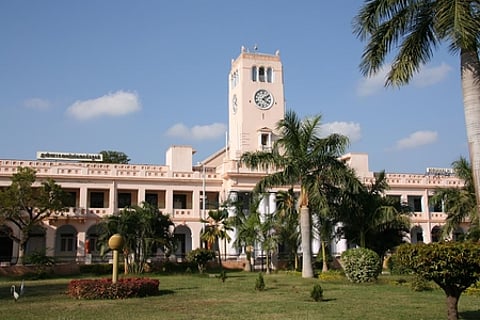
Annamalai University staff begin indefinite sit-in over pending dues

Annamalai University staff begin indefinite sit-in over pending dues The members also sought settlement of retirement benefits, including co...