Saturday, July 21, 2018

‘Rent-a-lab’ policy to bring revenues to institutions

NEW DELHI, JULY 21, 2018 00:00 IST

The government has proposed a policy that could transform scientific instruments in government labs into lucrative assets generating a steady rental income. It plans to hire out to researchers all lab equipment that cost more than Rs. 10 lakh. This would also reduce the amount of time such expensive instruments remain idle.

The policy, called Scientific Research Infrastructure Management and Networks (SRIMAN), wouldn’t, “for the present,” apply to strategic sectors. The policy is open to public comments for a month, says a note on website of Department of Science and Technology (DST).
IRCTC to charge portals a fee on each ticket’s sale

Service Providers Have To Pay ₹12 Plus Taxes

Mayur.Shetty@timesgroup.com

Mumbai: 21.07.2018

In a move that will make purchase of railway tickets from portals such as Make-MyTrip, Yatra, Paytm and Cleartrip more expensive, the Indian Railway Catering and Tourism Corporation (IRCTC) has said it will charge a fee of ₹12 plus taxes on every ticket booked from service providers.

IRCTC is a subsidiary of the Indian Railways and handles the catering, tourism and online ticketing operations of the parent. Earlier, IRCTC used to charge a flat annual maintenance charge. The new fee structure appears to have been introduced with the objective of opening a new revenue stream ahead of its proposed initial public offering (IPO).

Service providers are, however, unhappy with the move. “Railway ticket booking was a revenue-negative or, at best, revenue-neutral. The expenditure on fees paid to the payment gateway was more than the fee charged to the customer. If this fee is not passed on to the customer, rail booking will become revenue-negative,” said one of the service providers.

According to them, hiking the fees is not an option as this would then make them uncompetitive vis-à-vis IRCTC’s own booking site. Also, the IRCTC contract prescribes a ‘look to book’ ratio of 1:70. What this means is that there should be at least one ticket booking for seventy enquiries. With IRCTC opening up its systems to service providers, they can offer customers facilities such as PNR status search and other inquiry facilities. If the bookings do not keep up with the ‘look to book’ ratio of 1:70, the service providers will have to pay 25 paise for every enquiry.

“IRCTC’s position contrasts with that of airlines. In the case of airlines, the service providers get a commission for the tickets they sell. Railways, on the other hand, charge us for selling their tickets,” said an official with one of the service providers. Curiously, it is cheaper to buy a railway ticket offline as none of the extra charges are applicable. In addition to the annual maintenance charges, IRCTC has said that it will charge Rs 5 for display of advertisements and Rs 15 for cashback offers or for clubbing ticket sales with third-party products and services. In case of cross-selling of any third-party products, there will be an additional charge of ₹25 per ticket.
Flexi fares cost railways premium passengers: CAG

Air Travel Cheaper Than Train In A Number Of Sectors

New Delhi:21.07.2018

The flexi fare scheme introduced by the Railways has resulted in lower occupancy though the government has benefited by more than ₹550 crore, the national auditor has said as it cautioned that the scheme may force passengers to look at the option of air travel.

The comptroller and auditor general (CAG) study on flexi fares in Rajdhani, Shatabdi and Duronto trains has found that “post implementation of this scheme, occupancy decreased in all classes, except sleeper class in Duronto trains”. “The occupancy increased only in a few premier trains. Even in AC 3 class, which was one of the most profitable classes, the occupancy dropped significantly after introduction of flexi fare and the vacant berths increased from 0.6% in pre-flexi period to 4.5% in post-flexi period,” CAG said. “Though, Railways earned ₹552 crore from passenger earnings from premier trains post flexi fare system during September 2016 to July 2017, there was de-growth of 2.7% in number of passengers, despite availability of higher number of berths/seats,” the national auditor observed.

The CAG, which tabled a report in Parliament on Friday, said a survey conducted on passengers showed that they expected better quality services with enhanced fare, which the Railways failed to provide. The auditor also compared Railways’ flexi fare with air fare for different periods in 13 sectors. Its study revealed that air fares were cheaper than the respective train fares for a large number of routes. The CAG recommended that there was a “need for review and fine-tuning in the scope of the scheme, so that not only more revenue is earned but number of passengers also increases, thus, further enhancing revenue”.

“While in air fares prices of tickets increase with increase in demand, in flexi fare, there is a fixed increase in fares after every 10% of tickets booked, irrespective of the demand. By paying a higher price for an air ticket, a passenger is ensured a confirmed seat, but a passenger who purchases a wait-listed train ticket by paying a higher amount does not have an assurance of a confirmed ticket,” the report said.

“Thus, charging a higher fare without providing confirmed seat/berth would force passengers to explore other available alternatives,” it added. In absolute numbers, CAG said, the premier trains carried 2.4 crore passengers during the post flexi period as compared to 2.5 crore passengers during the preflexi period.

Scarred by rape, but Russian stays on for spiritual solace

Shanmughasundaram.J@timesgroup.com

Chennai:21.07.2018

The 21-year-old Russian tourist raped by four men last week at a service apartment in Tiruvannamalai is said to be firm in her decision to stay back in the temple town to seek spiritual solace. She wanted to spend time at the Ramana Ashram along the Girivalam Path near the famous Arunachaleswarar temple. Collector K S Kandasamy said a policewoman would accompany her all through her stay in the town.

A three-member team from the Russian embassy, led by senior counsellor Andrey Fedorov, met the rape survivor at the Government Medical College Hospital in Tiruvannamalai on Friday. A doctor, who was part of the team, examined her before she was discharged from the hospital around 6pm. Inspector of police Mangayarkarasi and two women constables escorted her to the Ramana Ashram.

Though the diplomats advised her to fly back home, she indicated that she wished to remain in the town. They were even ready to book a ticket for her on the next available flight to Moscow. She declined it, said sources. She has a valid visa until August 7. She reached Tiruvannamalai on July 10 from Chennai prior to which she visited Vadodara, Jaipur and Mumbai.

Collector Kandasamy, who met her, said that she was a “strong-willed woman” and that she was recovering well. “She speaks only Russian,” he said.

Police have been directed to speed up the investigation and file chargesheets soon. Deputy inspector general of police V Vanitha said an identification parade would be held on Saturday at the Vellore Central Prison for Men where the four accused have been lodged.
Amend rules on digital banners in 6 mths: HC to govt

TIMES NEWS NETWORK

Chennai: 21.07.2018

The Madras high court has set a six-month ultimatum for the Tamil Nadu government and Greater Chennai Corporation to bring in necessary amendments to rules governing hoardings and digital banners and to provide for stringent punishment to those erecting illegal structures.

“The government and the corporation of Chennai shall consider, within six months from the date of the order, for an amendment to rules, making it mandatory for all further display of hoardings and banners to indicate whether permission has been granted and if so the date, number and other particulars of the permission to enable stringent action against unauthorized erection and display of hoardings and banners,” said the first bench of Chief Justice Indira Banerjee and Justice P T Asha on Friday.

Making it clear that banners and hoardings can only be put up in strict compliance of the provisions of law after getting requisite approvals or permissions, the judges said there was no need to entertain a new PIL filed by social activist Traffic Ramaswamy as the court had already passed several orders directing the government to bring in amendments to rules.

The PIL sought a direction to consider Ramaswamy’s representation dated July 11, 2018 to the authorities and to restore the statutory powers of district collectors to take regulatory measures regarding display boards, digital and cloth banners and other hoardings in Tamil Nadu, and also to take such punitive action as necessary, immediately.

It was Ramaswamy’s contention that despite the persistent court orders questioning authorities about repeated violations in erection of illegal and unauthorized banners, hoardings and display boards, which posed a constant threat to the common public.

He also alleged that due to mindless acts of the ruling partymen, who erected illegal banners, people had been put to great hardship said there was no action by the authorities.

Ramaswamy said Chennai city was a “victim to gross and innumerable violations” and added that the government and civic authorities were unmindful of the hardship caused to the general public, and were either colluding with violators or turning blind eye to violations.
WhatsApp to limit ‘forwards’ to 5 chats

TIMES NEWS NETWORK

New Delhi:21.07.2018

The instant messaging service WhatsApp, facing increasing censure from the government over the spread of fake news and rumours and their deadly consequences, announced fresh curbs on Friday on its India service, including limiting simultaneous message-forwarding to just five users at a go.

Under pressure after rumours and fake news spread via its app led to a spate of horrific lynchings, WhatsApp said it was launching a test to limit message-forwarding on the app. In addition, it said, it would ‘remove the quick forward button next to media messages’. “We believe that these changes — which we’ll continue to evaluate — will help keep WhatsApp the way it was designed to be: a private messaging app,” the company said in a statement.

On Thursday, the Centre had issued a fresh warning to the company, saying it had to play a more aggressive role in curbing fake news.

The government warned the company that failure to contain fake news made the messaging platform an ‘‘abettor’ to the crime and this could lead to ‘consequent legal action’.

“It has been conveyed to them in unmistakable terms that it is a very serious issue which deserves a more sensitive response,” the information technology ministry had said in the latest warning.

The company, though, is yet to file a specific response to the government’s new warning.

WhatsApp, which had added a feature to let people forward a message to multiple chats at once a few years ago, had earlier this month launched a ‘forward label’ to identify messages which are not original and have been forwarded.


‘Committed to user safety & privacy’

More than 20 people have been killed by mobs in the past two months across the country after being accused of kidnapping children and other crimes in viral messages circulated on WhatsApp.

“In India, where people forward more messages, photos, and videos than any other country in the world, we’ll also test a lower limit of five chats at once and we’ll remove the quick forward button next to media messages,” it said. Earlier, it had announced features to help users identify messages that had been forwarded and then issued full-page advertisements containing tips on how to spot misinformation.

“We built WhatsApp as a private messaging app — a simple, secure, and reliable way to communicate with friends and family. And as we’ve added new features, we’ve been careful to try and keep that feeling of intimacy, which people say they love,” the company’s statement said. “We are deeply committed to your safety and privacy which is why WhatsApp is end-to-end encrypted, and we’ll continue to improve our app with features like this one,” it added.
SC stays Madras HC ruling on NEET

24,000 Students Were Granted 196 Marks Each For Wrong Tamil Translation

AmitAnand.Choudhary@timesgroup.com

New Delhi: 21.07.2018

The Supreme Court on Friday stayed the Madras high court’s directive to the CBSE to grant 196 grace marks to candidates who appeared in NEET in Tamil for translation errors in questions and ordered that admissions and counselling be done on the basis of the original merit list.

The HC had directed that all students who took NEET in Tamil for admission to medical courses be given compensatory marks for translation errors in 49 questions and directed the CBSE to revise the merit list.

The order was passed after the first round of counselling was over and thousands of students had taken admission in medical colleges across the country. As the merit list in NEET changes dramatically with even one mark, the students who had taken admission were apprehensive that their rank would come down significantly if 196 grace marks were given to 24,000 students who had taken the test in Tamil.

Dispelling the clouds of uncertainty, a bench of Justices S A Bobde and L Nageswara Rao said awarding compensatory to such a large number of students was not a solution and stayed the operation of the HC order. The court, however, agreed that some of the questions framed in Tamil language for NEET were wrong. It said the court would examine setting up of a mechanism to ensure that such problems did not occur in future.

“What will happen to the meritorious students? This is an all-India exam. And this is not some pass marks, but a bonus of 196 marks. These grace marks are given even without taking into consideration that students may have gone wrong in their answers even if the translations were accurate,” the bench said.

The court passed the order on a batch of petitions filed by CBSE and aggrieved students challenging the HC order. Additional solicitor general Maninder Singh, appearing for the board, contended that the counselling process for admission to medical courses had come to a standstill after the HC order, hampering the smooth conduct of the process.

The ASG said the test was conducted as per the order of the apex court and the HC had erred in passing the direction. “CBSE had also demonstrated that if the judgment of the HC is to be implemented, some of the candidates who had taken the NEET examination in Tamil language and had scored up to to 544 out of 720 marks, would now get 750 marks when the maximum marks of the entire question paper are 720,” he said.

Senior advocate Siddhartha Luthra, appearing for Tamil students, contended that the apex court had granted grace marks to students who faced technical glitches in the online CLAT exam and there was nothing wrong if compensatory marks were granted in NEET. He said only 500 of the 24,000 students would benefit if grace marks were given and that the bench should not stay the HC order.

The court, however, was not convinced and said, “We acknowledge the problem but this is not the solution.” It posted the case after two weeks to examine how to prevent such errors in future.


FUTURE BLEAK: The bench said: ‘This is not some pass marks, but a bonus of 196 marks. These grace marks are given even without taking into consideration that students may have gone wrong in their answers even if the translations were accurate’

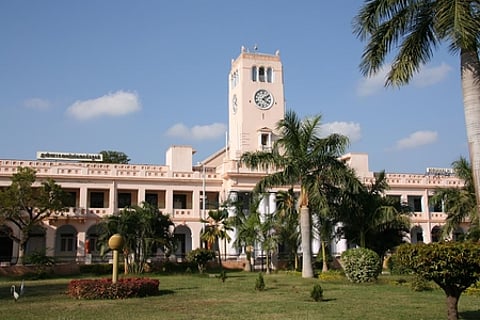
Annamalai University staff begin indefinite sit-in over pending dues

Annamalai University staff begin indefinite sit-in over pending dues The members also sought settlement of retirement benefits, including co...