Tuesday, January 28, 2020

‘Don’t link PhD and NAAC accreditation’

TNN | Jan 28, 2020, 04.50 AM IST


Former vice-chairman of University Grants Commissionm professor H Devaraj, spoke to TOI on why there is a rush to publish papers and getting PhDs, how the UGC intervened to discontinue the part-time PhD programme in Bharathiar University and the measures taken to end outsourcing of PhD.

Why is there a rush to get PhDs and to publish in journals?

We should not ask PhD or research papers for NAAC or NBA accreditation. It causes inbreeding PhDs and paid publications. Clearing NET/SLET is tougher than getting PhDs. But UGC adopted a wrong policy when it decided to give increments for faculty members who completed PhD. MHRD also announced that PhD would be a minimum qualification for assistant professors in universities from 2021.

Too many papers being published ...

We need to be careful while allowing colleges to do research work. Many colleges do not have the infrastructure or resources to do it. Yet they are publishing papers due to the prominence given in accreditation for research publications. Part-time PhD (category B) is another major reason for the dilution in quality of PhDs. Unless there is a collaborative research by industry experts and academia, we should not allow any part-time PhDs.

What can be done to ensure quality?

Candidates with JRF or project fellowship alone should be allowed to do PhD. PhDs are not required to teach in colleges. Candidates who clear National Eligibility Test will be competent to do research and write thesis. If we ensure these steps, then there will not be any need for outsourcing research work.

UGC once intervened to stop part-time PhD programme in Bharathiar University. How should UGC deal with outsourcing PhD and ghost writing?

Monday, January 27, 2020

Research, development & innovation cells to help college teachers seek funds for projects

TNN | Jan 23, 2020, 04.40 AM IST

PANAJI: With the University Grants Commission (UGC) stepping back as a major funding agency for research projects by university and college teachers, the state directorate of higher education (DHE) is set to form research, development and innovation cells in all 33 government and aided colleges in Goa. Through these cells, college faculty will be motivated and trained to pursue proposals for funding of their small research projects with central government agencies.

The research cells will help develop and coordinate strategies to maximise the faculty’s success in gaining external research funding.

An umbrella initiative, ‘research, development and innovation cell’, has already been formed in the DHE and is headed by astronomer Vithal Tilvi, who has worked with NASA.

“Though the UGC has stopped funding research in a big way, every central government department has provision for funds for research projects. Most of these funds remain unutilised. College teachers require training on how to effectively write research proposals to be able to bag the funds. The research, development and innovation cell will provide this training and motivation,” a DHE official said.

In each college, a faculty member oriented towards research will be chosen to head the cell. Teachers will subsequently be coached to submit proposals for projects that can be accomplished with financial aid of Rs 5-10 lakh.

“Taking on these projects will help promote the teachers’ personal growth as they will be able to pursue research in varied subjects of their interest. It will also help their careers to progress in terms of promotions, etc. The exposure teachers get will benefit their students as well. It will boost innovation in institutions of higher education,” the official said.

The DHE’s research, development and innovation cell already has 60 teachers involved in writing research proposals.
AG stumbles upon office history dating back to 1828

Vijay Narayan saves the documents, mostly handwritten in cursive, digitises all of them

27/01/2020, MOHAMED IMRANULLAH S.,CHENNAI


The documents found in the cupboards were in a brittle condition due to passage of time.

If there is one place in Chennai where you can see, touch and feel historical remnants at every turn of your eye, it is the iconic Madras High Court building. Every brick in this building is steeped in history and it is here that Advocate General (A-G) Vijay Narayan recently stumbled upon the history of his own office since 1828.

Amazed to have discovered a nearly 200-year-old treasure trove of official communication between his English predecessors and top government officials of the colonial era, the A-G digitised the entire set of documents running into thousands of pages which were rotting in cupboards and turning brittle due to passage of time.

Issue of charter

It was on June 26, 1852 that Queen Victoria issued a charter to establish the High Court of Judicature at Madras for the Presidency of Madras. However, it was preceded by many other courts established here since 1687 and they included the Supreme Court of Judicature at Fort St. George established by George the third on December 26, 1800.

The documents digitised include those penned when the Supreme Court at Madras was in existence. Mostly handwritten in cursive, the documents show that communication between the Chief Secretary to Government and the Advocate General had always ended with an interesting complimentary closing ‘Your most obedient servant.’

A further rummage through these materials leads to legal opinions given by the Advocates General on varied issues, including those relating to the erstwhile Binny Mills in Chennai, establishment of the famous Demonte Colony near St. Mary’s Road here, sale of properties belonging to the then Nawabs and even on criminal cases booked against Englishmen.

An interesting letter among them is the one penned on January 22, 1862 by the then Advocate General T. Sydney Smith to the Chief Secretary. In that letter, Mr. Smith states that the only case in which he considered it necessary to appear for the Crown during the first criminal sessions of that year was a case of manslaughter (culpable homicide not amounting to murder).

In that case, one Thomas George Saunders of the Telegraph department had been charged with manslaughter of his horse keeper Ramudu in Nellore (now in Andhra Pradesh) on November 30, 1861. Stating that the prisoner was acquitted from the case by the presiding judge, Mr. Smith said he completely concurred with the decision.

“The alleged cause of death was a kick on the testicles but while there was nothing to show that the death resulted from any injury to those parts and much to show that the death resulted from natural causes as the Zillah surgeon deposed he had no doubt the evidence of the alleged kick was most unsatisfactory.

“It was only deposed to by two little boys of 8 and 12 years old who in many material respects contradicted with each other grossly and moreover on cross examination contradicted themselves and swore to particulars utterly incredible. These boys, moreover, it appears, were kept together in the house of Mr. Holman, Inspector of Police at Nellore for eight days and not allowed to leave it till they had made statements before the Magistrate,” the A-G said.

Further, referring to the Inspector having kept another witness in the case handcuffed for three days, Mr. Smith said: “It is chiefly on this account that I bring this case to the notice of His Excellency the Governor in Council. There is nothing before me to show that Mr. Holman, in doing so, was actuated by any improper motives.

‘Mistaken notion’

“Giving him the fullest credit for acting only from mistaken zeal, it is plain that he has a very mistaken notion of his duty as Inspector of Police.” Records further show that the Chief Secretary, in turn, had communicated the A-G’s letter to the then Inspector General of Police on January 30, 1862 and also marked a copy to the A-G’s office.

However, what action was taken against the Inspector is not found in the records. “Reading these records itself is a very difficult process because they are handwritten. The papers are also very fragile. So, I handed the job to a company that uses robotic arms to lift the documents and scan them and they charged me just ₹3 a page,” the A-G Mr. Narayan said.

The digitised documents include legal opinions given by Vanbakam Bhashyam Iyengar, the first Indian Advocate General of the Madras High Court, in 1897, when he was initially appointed as Acting AG before being made permanent. It is also interesting to note that only 45 lawyers had so far been able to make it to the post of Advocate General of Madras High Court since 1853.
Coronavirus effect: kin of students studying in China a worried lot

Many want Centre to provide updates


27/01/2020, R. KRISHNAMOORTHY , S. POORVAJA ,TIRUCHI / CHENNAI

Relatives of students from Tamil Nadu studying in universities in China are gripped by anxiety and helplessness in the backdrop of the outbreak of coronavirus in China.

Hundreds of students from the State are pursuing higher education in various universities in China. Their relatives have been trying to reach out to them for several days now.

P. Arun, a resident of Pudukottai, said he was worried about the well-being of his brother P. Manishankar, a student of Wuhan University.

“The assurance on Sunday morning by the Central government to safeguard Indian students in China has given us hopes. But, there has been no further update. We feel helpless and expect some quick action,” Mr. Arun said.

Ravi, whose son, Robin Raj, from Nagapattinam, is studying medicine at the Wuhan university, sounded relieved after a telephonic talk with his son in the afternoon.

“I could gauge from our conversation that the Chinese authorities have planned to translocate the stranded people in Wuhan to a neighbouring province. As of now, no one has been permitted to go from Wuhan,” he said. A student from Tenkasi, who is pursuing medicine in Qingdao, said that since it is vacation time, many students had already left for their home town in Tamil Nadu.

“There are about 150 students pursuing medicine here. Some students who decided to stay back have booked tickets to Tamil Nadu last week since a few cases were reported in Qingdao as well,” said the student.

Centre in touch

Central government officials are in touch with Indian students in Wuhan and other cities in Hubei province. They are also talking with local governments regarding their safety and the possibility of their return, sources said.

The officials are contacting universities to find out about the re-opening dates and several institutions have deferred the reopening. Students have been advised to avoid non-essential travel.

Meanwhile, the Directorate of Public Health and Preventive Medicine along with Airports Authority of India officials, continues to screen passengers from China at airports in Chennai, Tiruchi and Coimbatore. Isolation wards are ready in all government medical college hospitals. K. Kolandaswamy, director of public health, said thermal screening along with symptomatic screening was being done at the airports.

(With inputs from Serena M. Josephine)
TNPSC scam: accused re-marked scripts in a moving vehicle and replaced them

Record clerk Omkanthan hoodwinked escort team to aid offender

27/01/2020, S. VIJAY KUMAR,CHENNAI

The Crime Branch CID of the Tamil Nadu police on Sunday arrested H. Omkanthan, 45, a TNPSC record clerk, for allegedly handing over the key to a safe containing answer script bundles to prime suspect Jayakumar of Chennai, who made fresh entries on select papers and replaced them at an opportune time. The police searched Omkanthan’s premises and seized a couple of mobile phones.

Investigators said the accused, in a midnight operation, took away the answer scripts of the TNPSC Group-IV Services examination from a vehicle and tampered with them, before replacing them.

Investigation revealed that Jayakumar had approached Omkanthan, seeking his help to access the answer scripts, and had offered him ₹15 lakh as a bribe. After taking ₹2 lakh as an advance, the clerk managed to get himself posted in Ramanathapuram district for examination duty on September 1, 2019.

Omkanthan was part of a team also comprising another TNPSC employee, Manickavel, and a police constable entrusted with transporting the answer scripts from the Sivaganga treasury to the TNPSC headquarters in Chennai in a parcel vehicle. After collecting the sealed bundles of answer scripts around 8 p.m., the team left for Chennai, and Jayakumar followed it in another vehicle.

At 10.30 p.m., the team stopped for dinner. While the others were in the restaurant, Omkanthan handed over the key to the safe to Jayakumar, who took select bundles away in his car. During the next few hours, he made fresh entries on the answer scripts of candidates from whom he had taken money. However, he could mark answers only on 39 answer scripts owing to time constraints.

When the escort team stopped near Vikravandi for tea, Jayakumar replaced the bundles, returned the key to Omkanthan and fled. The record clerk was aware that some candidates had used evaporative ink to mark answers, and that Jayakumar had made fresh entries.

The answer scripts reached the TNPSC headquarters shortly after noon. The offence took place in the intervening night of September 1 and 2, 2019 along the Sivaganga-Chennai national highway.

While a search is on for Jayakumar, a special team has arrested A. Balasundaraj, 45, of Seelayampatti in Theni district, who was a middleman in the scam.

Parrying questions on whether the TNPSC staff had checked the seal on the safe and the answer script bundles when they received the consignment, a CB-CID official said the investigation had revealed that both the seals were tampered with. The statement of the accused would further be corroborated with technical evidence, he said.

The CB-CID has so far arrested 9 persons, including three candidates, in connection with the scam. Investigation is on to determine who leaked the question paper to the prime suspect.

Candidates in soup

Sources in the investigation agency said all the 99 candidates who had paid for clearing the examination fraudulently and had used the pens with evaporative ink provided by the accused would have to face action, irrespective of whether or not they had passed.
High court acquits man jailed for assaulting policeman
K.Kaushik@timesgroup.com

Madurai:27.01.2020

Madras high court has set aside the conviction and sentence imposed on a man who assaulted a police constable in Madurai in 1997, saying the trial court had not examined important witnesses.

The prosecution case is that constable Rathinamani of Teppakulam police received a phone call informing him that a person was being assaulted by seven others at Kuruvikaran Salai on March 28, 1997. When Rathinamani and an SI were searching for the accused in the southern and northern banks of Vaigai river, one of the accused, appellant Sikkandar, assaulted him using a sickle in which he sustained injuries.

Following the incident, the police registered a case against Sikkandar and he was arrested. The fast track court in Madurai convicted and sentenced him to undergo three years imprisonment under section 332 (voluntarily causes hurt to any person being a public servant in the discharge of his duty as such public servant) of IPC on June 30, 2009. Sikkandar moved HC Madurai bench the same year challenging the order.

On perusal of the submissions, Justice B Pugalendhi observed that the police constable was assaulted by a rowdy element and the complainant is the same police constable. “Even though the investigation was conducted in such a shabby manner, the trial was concluded even without examining the relevant witnesses for arrest and recovery as well as the doctor who provided treatment to the constable,” he said. Though an SI accompanied the constable at the time of occurrence, the person was also not examined. Hence the judge noted that it was not safe to sustain the conviction and sentence and acquitted the appellant of the charges framed against him.

Justice B Pugalendhi said the investigation was conducted in a shabby manner and the trial was concluded without examining the relevant witnesses
UGC asks universities not to award degrees without its approval

TIMES NEWS NETWORK

Chennai:27.01.2020

The University Grants Commission (UGC) has directed all universities and institutions not to award any new degree without the prior approval from the commission.

Many private institutions are offering degrees in new areas without UGC nod. Students enrolled in such courses face issues when they opt to apply for government posts or pursue higher education.

“It has been observed that some universities/ institutions are awarding unspecified degrees leading to litigation and different problems for the students conferred with such degrees. The universities are once again requested to abide by the provision of section 22 of the UGC Act, 1956, and award only such degrees as have been specified by the UGC,” UGC secretary Rajnish Jain said in a circular to all universities. The circular said the consolidated list of UGC approved degrees is available on UGC website.

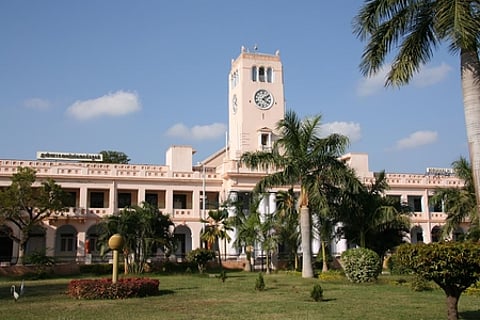
Annamalai University staff begin indefinite sit-in over pending dues

Annamalai University staff begin indefinite sit-in over pending dues The members also sought settlement of retirement benefits, including co...