Friday, February 21, 2025

Sending Messages 'You Look Smart, I Like You' 'To Unknown Woman Amounts To Insulting Her Modesty: Mumbai Court


Sending Messages 'You Look Smart, I Like You' 'To Unknown Woman Amounts To Insulting Her Modesty: Mumbai Court


20 Feb 2025 9:12 PM


Sending messages like "You are slim. You look very smart. You are fair, I like you, Are you married or not?" etc to an unknown woman on WhatsApp, that too late in the night, would amount to insulting her modesty, a sessions court in Mumbai held recently while upholding the conviction of a man, who sent such objectionable messages to a former corporator.

Additional Sessions Judge DG Dhoble noted from the record that on January 26, 2016, the victim, who was then a sitting corporator from Mumabi's Borivali area, received messages - “Are you asleep? Are you married or not? You are looking smart. You are very fair. I like you. My age is 40 years. Meet you tomorrow" on her WhatsApp. The judge further noted that soon after she informed her husband and tried to call the 'unknown' number, the person who owned the said number - Narsingh Gude, did not receive the call and instead sent - “Sorry, call not accepted at night. WhatsApp chatting I like, come online” messages along with some 'obscene' photographs and messages too.

In the order passed on February 18, the judge observed that the messages and photographs were indeed 'obscene' and also noted that there was no relationship between the accused Gude and the victim or her husband, who too was a former corporator.

"No married woman or her husband, who are reputed and Corporator would bear such WhatsApp messages and obscene photos sent on her mobile in evening time from 11.00 pm to 12.30 am, especially, when there is no any relationship with sender. The alleged messages words, acts would amount to insult the modesty of women (under section 509 of the IPC)," the judge held in his order.

The court also held that the act of sending the obscene phots and the objectionable messages were sufficient for attracting punishment under sections 67 (transmission of obscene material in electronic form) and 67A (transmission of sexually explicit material in electronic form) of the Information and Technology (IT) Act.

According to the complainant, she approached the police because she felt 'ashamed' and 'outraged' after receiving those messages. However, the defence contended that no such incident took place and that the complainant and her husband had a 'political rivalry' with the accused and thus by using her 'political influence' the complainant, got a false case registered.

However, the court junked their argument. It said, "No woman would stake her dignity by implicating an accused in a false case. Therefore, the oral and documentary evidence of the complainant and her husband proves that she was received messages and obscene photographs from the accused on the relevant day."

As regards, the argument of the accused that he was not the one who sent, the judge said, "Since the appellant had exclusive knowledge of his phone's usage, he had the burden to explain how the messages originated from his number. His failure to provide any plausible explanation allows the Court to draw an adverse inference. The sender's identity is not automatically presumed but is established through circumstantial evidence, documentary proof and adverse inference under Section 106 of the Indian Evidence Act which is duly established by the prosecution."

Therefore, the court upheld the three months simple imprisonment imposed upon Gude and the fine amounts.

With these observations, the court dismissed the appeal filed by Gude against his conviction and sentence by a Metropolitan Magistrate Court in Borivali.

Appearance:

Advocate Ninad Muzumdar appeared for the Appellant.

Additional Public Prosecutor Mahajan represented the State.

Case Title: Narsingh Gude vs State of Maharashtra (Criminal Appeal 272 of 2022)

Madras HC upholds attendance requirement, denies exam plea


Madras HC upholds attendance requirement, denies exam plea

It further noted that even if 10% attendance is provided through condonation, the petitioner would have 67%, which is still 8% short of the requirement.


Updated on:
20 Feb 2025, 9:35 am

CHENNAI: The Madras High Court has refused to order a private educational institution to allow an undergraduate student with low attendance rate to attend examinations, stating such a relief would amount to mocking other students who regularly attended classes.

The student, who was studying BCom (second year) at the SRM Institute of Science and Technology, moved the HC praying for a direction to allow him to take the examinations and also attend classes in the 2024-2025 academic year. A single judge had dismissed his petition. Later, he filed an appeal.

Dismissing his appeal petition recently, a division bench of Justices R Subramanian and C Kumarappan observed that it has repeatedly been held that in academic matters, the court will not interfere but leaves it to the wisdom of academicians.

As per UGC regulations, a student should have at least 75% attendance to become eligible for writing the examinations, and if a student does not meet the requirement, the only result could be that he cannot appear for examinations, the bench said. It further noted that even if 10% attendance is provided through condonation, the petitioner would have 67%, which is still 8% short of the requirement.

Concurring with the counsel for the university, the bench said, “If this court chooses to sympathise with such students, it will only be misplaced sympathy and it would amount to mocking the students who attended classes regularly.”

Saying that the bench does not find any infirmity in the single judge’s order, it dismissed the petition. However, it said if the student is willing to re-do the course by paying the required fee, the university has to take him back on its rolls.

Must clear NEET-UG to pursue medical courses abroad: SC

Must clear NEET-UG to pursue medical courses abroad: SC

21.02.2025

NEW DELHI: Supreme Court has refused to interfere with a 2018 decision of Medical Council of India (MCI) mandating qualication in NEET as an eligibility criterion to pursue an undergraduate medical course in a foreign institution.

A bench of Justices B R Gavai and K Vinod Chandran said introducing National Eligibility cum Entrance Test (NEET) qualication criterion ensures a fair and transparent procedure in the grant of eligibility certicate, and the regulation does not in any manner conict with the law. 

It said, "We find absolutely no reason to interfere with the regulations, in which context, the learned counsel sought for a one-time exemption as applicable to the petitioners. Obviously, afer the amended regulations came into effect, if any candidate chose to obtain admission in a foreign institution for pursuing a course   leading to a primary medical qualication, they cannot seek for an exemption from the regulations.. This does not restrict their right to practice anywhere outside India." "The regulations, especially additional mandate to satisfy the eligibility criteria, is not ultra vires the Constitution and neither is it in conict with any provisions of the Act (Indian Medical Council Act) nor arbitrary or unreasonable. Hence, all the petitions are dismissed," the bench said.

Wednesday, February 19, 2025

Important MCQs Based On Latest Supreme Court Judgments For Law Examinations


Important MCQs Based On Latest Supreme Court Judgments For Law Examinations


15 Feb 2025 2:26 PM


Live Law brings to you interesting questions on recent important Supreme Court Judgments for judicial services and other law competitive examinations. Here are the ten most important questions :

Q 1. Under Article 22(1) of the Indian Constitution, what constitutes proper compliance with the requirement to inform an arrested person of the grounds of their arrest?

A) Informing the arrestee's relative about the arrest and its reasons.

B) Recording the reasons for arrest in the arrest memo, remand report, or case diary.

C) Personally and effectively communicating the grounds of arrest to the arrestee.

D) Providing the grounds of arrest in a later court hearing.

Answer: Option (C)

Case Title: VIHAAN KUMAR Versus THE STATE OF HARYANA AND ANR, Citation: 2025 LiveLaw (SC) 169

Explanation: The Supreme Court has clarified that merely informing a relative or recording the grounds in official documents does not fulfill the constitutional mandate under Article 22(1). The arrested person must be directly informed of the grounds of arrest in a clear and effective manner.

Q 2. Decide when a repealing Act is not required to obtain fresh Presidential Assent under Article 254 of the Constitution.

A) When the original Act had received Presidential Assent, and the repealing Act alters the law significantly.

B) When the repealing Act is intended to correct flaws in the old law without contradicting prior judicial rulings.

C) When the repealing Act establishes an entirely new legal framework in place of the old law.

D) When the original Act was a Central law, and the repealing Act is passed by a State Legislature.

Answer: Option (B)

Case Title: M/S S.R.S. TRAVELS BY ITS PROPRIETOR K.T. RAJASHEKAR VERSUS THE KARNATAKA STATE ROAD TRANSPORT CORPORATION WORKERS & ORS, Citation : 2025 LiveLaw (SC) 166

Explanation: The Supreme Court clarified that a repealing Act does not require fresh Presidential Assent if it falls within the legislative competence of the State and is meant to rectify the shortcomings of the prior law rather than introducing a new legal framework. The mere fact that the original Act had Presidential Assent does not automatically mandate the same for the repealing Act.

Q 3. A woman, without obtaining a formal divorce from her first husband, marries a second time with a man who is fully aware of her first marriage. They live together, have a child, and later separate due to disputes. The woman seeks maintenance under Section 125 CrPC from her second husband. The second husband opposes the claim, arguing that she is not legally his "wife" as her first marriage was never legally dissolved. Decide whether the woman can claim maintenance under Section 125 CrPC from her second husband.

A) The woman is not entitled to maintenance as her second marriage is void due to the subsistence of her first marriage.

B) The woman is entitled to maintenance since her second husband knew about her first marriage and lived with her as husband and wife.

C) The woman can claim maintenance only if she proves that her first husband is unable to provide for her.

D) The second husband is liable for maintenance only if he legally adopted their child.

Answer: Option (B)

Case Title: SMT. N. USHA RANI AND ANR. VERSUS MOODUDULA SRINIVAS, Citation : 2025 LiveLaw (SC) 156

Explanation: The Supreme Court ruled that a woman is entitled to claim maintenance under Section 125 of the Cr.P.C. from her second husband, even if her first marriage was not legally dissolved. The Court clarified that a formal decree of dissolution is not mandatory. If the woman and her first husband mutually agreed to separate, the absence of a legal divorce does not prevent her from seeking maintenance from her second husband.

Q 4. Flat purchasers challenged the builder's forfeiture of 20% of the basic sale price as earnest money as per the Apartment Buyer Agreement (ABA) following their cancellation of the flat booking. They contended that the 20% forfeiture was arbitrary and excessive amounting to a penalty for 'breach of contract' under Section 74 of the Contract Act. Decide the most appropriate option.

A) Forfeiture of earnest money is always considered a penalty, regardless of the amount.

B) Any forfeiture of more than 10% of the BSP is deemed excessive and arbitrary.

C) Earnest money can be forfeited, but the amount must not be so excessive that it becomes a penalty for a breach of contract.

D) The Apartment Buyer Agreement (ABA) did not mention any forfeiture clause, making the builder's claim invalid.

Answer: Option (C)

Case Title: GODREJ PROJECTS DEVELOPMENT LIMITED VERSUS ANIL KARLEKAR & ORS., Citation : 2025 LiveLaw (SC) 150

Explanation: The Supreme Court held that while forfeiture of reasonable earnest money is permissible, it must not be excessive or punitive under Section 74 of the Contract Act. In this case, the Court ruled that 20% forfeiture of the BSP was excessive and amounted to a penalty, while 10% was reasonable and enforceable. The Court emphasized that forfeiture should act as a security for contract performance, not as a punitive measure.

Q 5. It is a settled proposition of law that a Magistrate should not mechanically order an FIR under Section 156(3) CrPC without judicial application of mind. Under the newly introduced Section 175(3) of the Bharatiya Nagarik Suraksha Sanhita (BNSS), 2023, what additional safeguards have been introduced before a Magistrate can direct the registration of an FIR?

A) The complainant must submit an affidavit and a copy of their application to the Superintendent of Police if their FIR is refused.

B) The Magistrate must conduct a preliminary inquiry before ordering an FIR.

C) The Magistrate must consider the police officer's reasons for refusing to register the FIR before passing an order.

D) All of the above.

Answer: Option (D)

Case Title: OM PRAKASH AMBADKAR VERSUS THE STATE OF MAHARASHTRA & ORS, Citation : 2025 LiveLaw (SC) 139

Explanation: The Court highlighted three new safeguards in BNSS Section 175(3) [absent in Cr.P.C. 156(3)]: 1) mandatory application to the Superintendent of Police (with copy and affidavit); 2) Magistrate's power of inquiry; and 3) consideration of the police's refusal to register the FIR. These codify existing safeguards against misuse of magisterial powers.

Q 6. An incident happened inside the private chamber of the Revenue Inspector-complainant in the government office, where the accused upon knowing the caste of the complainant remarked “if you people are appointed in Government service you all will do like this only…”. Thereafter, he scolded the complainant calling his caste name, and insulted him using vulgar words. Following the incident, other colleagues of the complainant came, pacified the accused, and took him away. Decide whether the act of the accused would be covered under the SC/ST (Prevention of Atrocities) Act, 1989.

A) Yes, there was caste-based abuse as the accused abused the complainant in front of the complainant's colleague coming within the public view.

B) No, because no one was present when the accused abused the complainant inside the four walls of his private chamber.

C) The act of the accused abusing the complainant in his caste name was done privately not qualifying the public view.

D). Both (B) and (C)

Answer: Option (D)

Case Title: Karuppudayar v. State, Citation : 2025 LiveLaw (SC) 133

Explanation: The Supreme Court ruled that for an offense under Sections 3(1)(r) and 3(1)(s) to be made out, caste-based abuse must occur in public view. If the abuse happens inside a private office or chamber, where no public members are present, it does not constitute an offense under the SC/ST Act. The Court referenced Swaran Singh v. State (2008) and Hitesh Verma v. State of Uttarakhand (2020) to clarify that public accessibility is essential for such offenses.

Q 7. X and Y have been legally married since 2010. In 2020, Y gave birth to a child. X suspects that he is not the biological father because Y had an extramarital affair during the time of conception. X files a petition challenging the paternity of the child and requests a DNA test to prove his claim. Y argues that, under the law, the child is presumed to be X's legitimate offspring. As per Section 112 of the Indian Evidence Act, which of the following is correct regarding Aman's claim?

A) Aman can rebut the presumption of paternity by proving Y's extramarital affair, as it raises suspicion about the child's parentage.

B) The presumption that X is the father can only be rebutted if he provides conclusive proof that he had no access to Y during the time of conception, making it impossible for him to be the father.

C) X has an absolute right to demand a DNA test since the child's paternity is in question, and mere suspicion is sufficient for the court to allow it.

D) Since Y had an affair, the child is automatically considered illegitimate unless X accepts the paternity voluntarily.

Correct Answer: Option (B)

Case Title: Ivan Rathinam versus Milan Joseph, Citation : 2025 LiveLaw (SC) 118

Explanation: The Supreme Court reaffirmed that a child's legitimacy determines paternity, emphasizing that a child born during a valid marriage is presumed to be the legitimate offspring of parents who had access to each other at the time of conception. The Court dismissed the argument that legitimacy and paternity are distinct concepts requiring separate determination. It held that legitimacy and paternity are inherently intertwined, as the legitimacy of a child directly establishes paternity. The Court clarified that if it is proven that the married couple had access to each other at the time of the child's conception, the child is deemed legitimate, thereby establishing the paternity of the couple.


Q 8. X agrees to sell his property to Y in January 2023 but later refuses, prompting Y to sue for specific performance. While the suit is pending, X sells the property to Z in May 2024. Unaware of the litigation, Z seeks impleadment, which the trial court rejects. Z appeals, and the High Court grants leave. Can Z, whose impleadment was denied, challenge the trial court's decree favoring Y by appealing to the High Court, claiming adverse effects on his rights?

A) Z, as a pendente lite transferee, has an absolute right to be impleaded in the suit under Order I Rule 10 CPC.

B) The High Court correctly allowed Z's appeal because a pendente lite transferee is not bound by the decree if he was not made a party to the suit.

C) The High Court erred, as Z had no automatic right to be impleaded in the suit, and he is bound by the outcome of the litigation under Section 52 Transfer of Property Act.

D) Z can avoid the effects of lis pendens (pending litigation) by proving that he was unaware of the suit at the time of purchase.

Answer: Option (C)

Case Title: Case Title: H. ANJANAPPA & ORS. VERSUS A. PRABHAKAR & ORS, Citation : 2025 LiveLaw (SC) 123

Explanation: The Supreme Court ruled that a pendente lite transferee (someone who purchases a suit property during the pendency of the litigation) has no automatic right to be impleaded in a suit. It said only in exceptional cases, where the transferee's rights are adversely affected or jeopardized, a leave would be granted to the pendente lite transferee (who wasn't impleaded in the suit) to appeal against the decree.

In this case, the transfer of the suit property to Z occurred during the ongoing suit and was subject to the case's outcome under Section 52 TPA. Since the trial court ruled against him, he cannot be considered adversely affected, entitling them to leave to appeal without being impleaded in the suit.

Q 9. W is accused of murdering his neighbor, Z. The police arrested W and during interrogation, he disclosed the location of the alleged murder weapon, a knife hidden in his garden shed. The knife is recovered based on his statement. At trial, the prosecution's case rests solely on W's disclosure statement and the recovery of the knife. There are no eyewitnesses, and no other evidence linking W to the crime. W argued that the disclosure statement alone is insufficient for a conviction. Decide.

A) W's conviction should be upheld, as the disclosure statement and recovery of the weapon are sufficient evidence.

B) The conviction should be overturned, as a disclosure statement alone, without corroborating evidence, is insufficient for conviction.

C) The trial court should conduct a fresh trial, allowing the prosecution to gather additional evidence.

D) The admissibility of the disclosure statement depends on whether W confessed voluntarily.

Answer: Option (B)

Case Title: Vinobhai versus State of Kerala, Citation : 2025 LiveLaw (SC) 127

Explanation: The Supreme Court stated that a disclosure statement under Section 27 of the Indian Evidence Act unaccompanied by the supporting evidence is not sufficient to prove the guilt of the accused beyond a reasonable doubt. The Court reasoned that the conviction cannot be solely based on the disclosure statement because it is considered a weak piece of evidence.

Q 10. A intends to kill B due to a long-standing enmity. One night, he enters B's house and, in the darkness, mistakenly stabs C, B's brother, who dies on the spot. A argues in his defense that he never intended to harm C and should not be held liable for his death. Based on the doctrine of "transmigration of motive" under Section 301 of the IPC, how should the court decide A's liability?

A) A is not guilty, as he did not intend to kill C.

B) A is guilty of murder under Section 302 IPC, as the intention to kill B is transferred to C under Section 301 IPC.

C) A is guilty of culpable homicide not amounting to murder under Section 304 IPC.

D) A is guilty only of causing grievous hurt, as he did not specifically target C.

Answer: Option (B)

Case Title: Case Name: ASHOK SAXENA v. THE STATE OF UTTARAKHAND ETC. Citation: 2025 LiveLaw (SC) 163

Explanation: The Supreme Court recently observed that Section 301 of the IPC (Culpable homicide by causing the death of a person other than the person whose death was intended) reflects the doctrine of transfer of malice or the transmigration of motive. Explaining this provision, the Court said that culpable homicide may be committed even if the offender causes the death of a person he did not intend. Provided that the killing takes place while doing an act which the offender intended.




26 Principles Relating To Compassionate Appointment : Supreme Court Explains


26 Principles Relating To Compassionate Appointment : Supreme Court Explains


16 Feb 2025 11:36 AM


In a recent judgment, the Supreme Court (bench of Justice Dipankar Datta and Justice PK Mishra) summarised the principles relating to compassionate appointment.

a) Appointment on compassionate ground, which is offered on humanitarian grounds, is an exception to the rule of equality in the matter of public employment [see General Manager, State Bank of India v Anju Jain (2008) 8 SCC 475]

b) Compassionate appointment cannot be made in the absence of rules or instructions [see Haryana State Electricity Board v. Krishna Devi (2002) 10 SCC 246]

c) Compassionate appointment is ordinarily offered in two contingencies carved out as exceptions to the general rule, viz. to meet the sudden crisis occurring in a family either on account of death or of medical invalidation of the breadwinner while in service [see V. Sivamurthy v. Union of India (2008) 13 SCC 730]

d) The whole object of granting compassionate employment by an employer being intended to enable the family members of a deceased or an incapacitated employee to tide over the sudden financial crisis, appointments on compassionate ground should be made immediately to redeem the family in distress [see Sushma Gosain v. Union of India (1989) 4 SCC 468].

e) Since rules relating to compassionate appointment permit a side- door entry, the same have to be given strict interpretation [see Uttaranchal Jal Sansthan v. Laxmi Devi (2009) 11 SCC 453].

f) Compassionate appointment is a concession and not a right and the criteria laid down in the Rules must be satisfied by all aspirants [see SAIL v. Madhusudan Das (2008) 15 SCC 560].

g) None can claim compassionate appointment by way of inheritance [see State of Chattisgarh v. Dhirjo Kumar Sengar (2009) 13 SCC 600]

h) Appointment based solely on descent is inimical to our constitutional scheme, and being an exception, the scheme has to be strictly construed and confined only to the purpose it seeks to achieve [see Bhawani Prasad Sonkar v. Union of India (2011) 4 SCC 209].

i) None can claim compassionate appointment, on the occurrence of death/medical incapacitation of the concerned employee (the sole bread earner of the family), as if it were a vested right, and any appointment without considering the financial condition of the family of the deceased is legally impermissible [see Union of India v. Amrita Sinha (2021) 20 SCC 695].

j) An application for compassionate appointment has to be made immediately upon death/incapacitation and in any case within a reasonable period thereof or else a presumption could be drawn that the family of the deceased/incapacitated employee is not in immediate need of financial assistance. Such appointment not being a vested right, the right to apply cannot be exercised at any time in future and it cannot be offered whatever the lapse of time and after the crisis is over [see Eastern Coalfields Ltd. v. Anil Badyakar (2009) 13 SCC 112 ].

k) The object of compassionate employment is not to give a member of a family of the deceased employee a post much less a post for post held by the deceased. Offering compassionate employment as a matter of course irrespective of the financial condition of the family of the deceased and making compassionate appointments in posts above Class III and IV is legally impermissible [see Umesh Kumar Nagpal v. State of Haryana (1994) 4 SCC 138].

l) Indigence of the dependents of the deceased employee is the first precondition to bring the case under the scheme of compassionate appointment. If the element of indigence and the need to provide immediate assistance for relief from financial destitution is taken away from compassionate appointment, it would turn out to be a reservation in favour of the dependents of the employee who died while in service which would directly be in conflict with the ideal of equality guaranteed under Articles 14 and 16 of the Constitution [see Union of India v. B. Kishore (2011) 13 SCC 131].

m) The idea of compassionate appointment is not to provide for endless compassion [see I.G. (Karmik) v. Prahalad Mani Tripathi (2007) 6 SCC 162].

n) Satisfaction that the family members have been facing financial distress and that an appointment on compassionate ground may assist them to tide over such distress is not enough; the dependent must fulfil the eligibility criteria for such appointment [see State of Gujarat v. Arvindkumar T. Tiwari (2012) 9 SCC 545].

o) There cannot be reservation of a vacancy till such time as the applicant becomes a major after a number of years, unless there are some specific provisions [see Sanjay Kumar v. State of Bihar (2000) 7 SCC 192].

p) Grant of family pension or payment of terminal benefits cannot be treated as substitute for providing employment assistance. Also, it is only in rare cases and that too if provided by the scheme for compassionate appointment and not otherwise, that a dependent who was a minor on the date of death/incapacitation, can be considered for appointment upon attaining majority [see Canara Bank (supra)]

q) An appointment on compassionate ground made many years after the death/incapacitation of the employee or without due consideration of the financial resources available to the dependent of the deceased/incapacitated employee would be directly in conflict with Articles 14 and 16 of the Constitution [see National Institute of Technology v. Niraj Kumar Singh (2007) 2 SCC 481].

r) Dependents if gainfully employed cannot be considered [see Haryana Public Service Commission v. Harinder Singh (1998) 5 SCC 452].

s) The retiral benefits received by the heirs of the deceased employee are to be taken into consideration to determine if the family of the deceased is left in penury. The court cannot dilute the criterion of penury to one of “not very well-to-do”. [see General Manager (D and PB) v. Kunti Tiwary (2004) 7 SCC 271].

t) Financial condition of the family of the deceased employee, allegedly in distress or penury, has to be evaluated or else the object of the scheme would stand defeated inasmuch as in such an eventuality, any and every dependent of an employee dying-in- harness would claim employment as if public employment is heritable [see Union of India v. Shashank Goswami (2012) 11 SCC 307 , Union Bank of India v. M. T. Latheesh (2006) 7 SCC 350, National Hydroelectric Power Corporation v. Nank Chand (2004) 12 SCC 487 and Punjab National Bank v. Ashwini Kumar Taneja (2004) 7 SCC 265].

u) The terminal benefits, investments, monthly family income including the family pension and income of family from other sources, viz. agricultural land were rightly taken into consideration by the authority to decide whether the family is living in penury. [see Somvir Singh (supra)].

v) The benefits received by widow of deceased employee under Family Benefit Scheme assuring monthly payment cannot stand in her wayfor compassionate appointment. Family Benefit Scheme cannot be equated with benefits of compassionate appointment. [see Balbir Kaur v. SAIL (2000) 6 SCC 493]

w) The fixation of an income slab is, in fact, a measure which dilutes the element of arbitrariness. While, undoubtedly, the facts of each individual case have to be borne in mind in taking a decision, the fixation of an income slab subserves the purpose of bringing objectivity and uniformity in the process of decision making. [see State of H.P. v. Shashi Kumar (2019) 3 SCC 653].

x) Courts cannot confer benediction impelled by sympathetic consideration [see Life Insurance Corporation of India v. Asha Ramchandra Ambekar (1994) 2 SCC 718].

y) Courts cannot allow compassionate appointment dehors the statutory regulations/instructions. Hardship of the candidate does not entitle him to appointment dehors such regulations/instructions [see SBI v. Jaspal Kaur (2007) 9 SCC 571].

z) An employer cannot be compelled to make an appointment on compassionate ground contrary to its policy [see Kendriya Vidyalaya Sangathan v. Dharmendra Sharma (2007) 8 SCC 148].


Case Name: CANARA BANK VERSUS AJITHKUMAR G. K., CIVIL APPEAL NO. 255 OF 2025

Citation : 2025 LiveLaw (SC) 187

Stop Periyar univ interview, govt urged

Stop Periyar univ interview, govt urged

TNN | Feb 19, 2025, 04.00 AM IST

Salem: Educationalists on Tuesday urged the state govt to take steps to cancel the interview scheduled by Periyar University on March 1 for the registrar post.

The state govt had in a 2017 directive to all universities advised vice-chancellors against making any appointments or policy decisions within three months of the end of their term.

Pointing out that Periyar University vice-chancellor R Jagannathan’s term would end on May 19, educationalists said the interview for the registrar post was being scheduled just two months and 18 days before the end of the VC’s tenure.

V Vaithyanathan, member, national executive committee of All India University and College Teachers’ Federation, said the VC, who was facing a probe into various corruption charges, was moving forward with the interview plans without any regard for the directive.

“This action is unacceptable and violates the govt order.”

When contacted, Jagannathan declined to comment on the matter, questioning the relevance of a letter from 2017.

“What will I comment on the letter?” he asked, refusing to elaborate.```

Uber scraps commission, leaves fare negotiation to passengers


Uber scraps commission, leaves fare negotiation to passengers

Feb 19, 2025, 04.01 AM IST

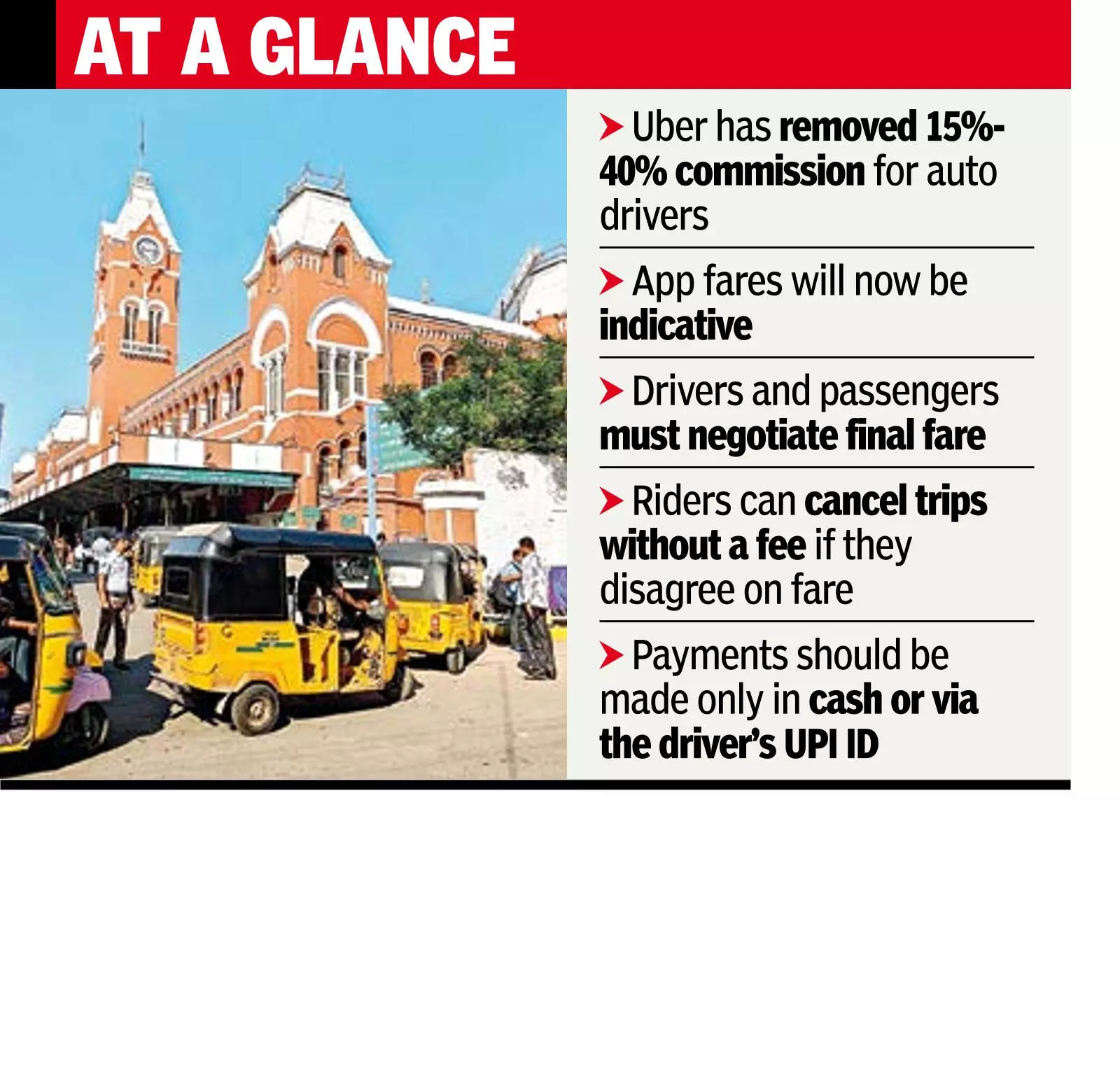
Chennai: Uber made a major change in its fare model by scrapping commission charges for auto drivers and switching to a fixed subscription-fee system, similar to Namma Yatri and Rapido. More significantly, fares displayed in the app will be only suggestive, with final pricing left to direct negotiation between drivers and passengers, as the platform will no longer intervene in fare disputes.

In a notification on Tuesday, the platform said it will now act only as a tech intermediary between passengers and drivers. An Uber spokesperson said the shift aligns with the industry-wide move towards subscription-based models and ensures the company remains competitive. However, Uber did not disclose how much will be charged as a daily subscription or platform fee from its drivers from this month-end.


Auto drivers on other platforms currently pay 25 to 30 per shift, after which they retain the full fare collected from passengers. There are no commission deductions, no cap on the number of trips and earnings depend entirely on workload. Previously, Uber deducted 15% to 40% per ride, leading to discontent and a partial boycott in Chennai.

Also, Tuesday’s notification said that Uber suggests a fare, but the final amount is decided by the driver and customer. Passengers will have the option to walk away from a ride with no cancellation charges if they do not agree on a fare. Uber advised riders to discuss concerns directly with drivers.

Additionally, all payments must now be made directly to the driver in cash or via UPI. Digital payment options such as credit/debit cards, Uber-integrated UPI payments and Uber credits will no longer be available. Promotions and discounts will also not apply to auto rides.

With Uber stepping back, booking an auto through the app is now like hailing one from the street. "Fare control is gone, leaving passengers, especially newcomers, vulnerable to overcharging," said D Ramakrishnan, a resident-activist from Adambakkam.

Uber, however, said it would continue to address safety concerns.This story had continued from a page 1 story in the newspaper. For your reading convenience we have added it below.

Passengers, drivers to fix Uber auto fares

Uber on Tuesday announced changes in its fare model scrapping commission charges for auto drivers and switching to a fixed subscription-fee system, similar to Namma Yatri and Rapido, reports Ram Sundaram. Fares displayed in the app will be only suggestive, with final pricing to be negotiated between drivers and passengers. The platform will no longer intervene in fare disputes. An Uber spokesperson said the shift aligns with the industry-wide move towards subscription-based models.

NEWS TODAY 28.01.2026