Tuesday, December 5, 2017

Class V boy 'rapes' 7-year-old girl in Ghaziabad school

Ayaskant Das| TNN | Updated: Dec 5, 2017, 07:11 IST


GHAZIABAD: When the shocking incident of rape of a four-year-old by a classmate at a Dwarka school was reported about two weeks ago, it was considered as an aberration. However, it may only have served to lift the lid over what could be a widespread crime.

On Sunday, December 3, police registered an FIR in Sahibabad police station, following a complaint by the father of a seven-year-old girl (studying in Class II) who alleged she had been sexually assaulted by a schoolmate in a washroom of a school in Ghaziabad. TOI is not revealing the name of the school to protect its identity.

The incident, which reportedly took place on November 8, came to light after a woman doctor figured out the crime when her family took the girl over to her for treatment on December 1. The FIR has been registered against an 'unidentified person' under IPC Section 376 (rape) and relevant sections of the Protection of Children from Sexual Offences (POCSO) Act, 2012, as the girl could not name the accused.

On Monday, Ghaziabad police accompanied the girl to her school along with her parents, where she identified the accused in the presence of the school principal and teachers, as a boy studying in Class V. It has been alleged in the complaint that the boy had inserted a 'wooden twig' inside the girl's private parts, inflicting injuries.

The girl's father, who works in a gas agency in Ghaziabad, told TOI she had been bleeding from her private parts since November 8. "We took her for a check-up to a local doctor, who did not find anything seriously amiss with her. We thought the bleeding could be a result of eating hot and spicy food, and changed her diet. However, it didn't stop. On Friday, we took her to a female doctor, who confirmed sexual assault. The doctor took her into confidence at her clinic, following which she narrated the sequence of events," her father told TOI.

Ghaziabad police had a medical examination of the girl conducted on Monday. Its report is awaited. "On November 8, classes were dismissed at around 10am due to smog. The school management called up parents and asked them to take their kids back home. Around 15 students could not go back immediately. My daughter was huddled in a classroom along with other students, who were all waiting for their parents. The boy, who was also waiting for his parents, followed my daughter to the washroom, where he committed the crime," her father added.

The school management said an inquiry was being conducted into the incident.

Mourning Jayalalithaa

DECCAN CHRONICLE. | E T B SIVAPRIYAN
PublishedDec 5, 2017, 6:02 am IST

Prime Minister Modi and Jayalalithaa shared special relationship of mutual admiration, respect.

Jayalalithaa

Chennai: On this first anniversary of J Jayalalithaa's death, there are many reasons to grieve than just her personal loss to her family, party and the people who had overwhelmingly voted for her second consecutive term that lasted barely six months.

First, her legacy as an Iron Butterfly who could take on the toughest political adversary with scary confidence — and that included the Prime Minister of the day — and a Queen Bee who ran her fiefdom at the Fort St.George and the AIADMK headquarters with a stranglehold that brooked no challenge of even the mildest kind, lay in tatters.

Until her death this day last year at the Apollo Hospital, no Minister or AIADMK functionary — big or small, senior or junior — would even raise his / her voice over the whispering decibels even while discussing an inane theme like the previous day's weather. But things changed dramatically after her demise as lieutenants quickly changed into the tunics of generals and multiple islands of authority emerged where just the other day, there was just one Empress holding sway over one tightly held kingdom.

When she lived, and ruled, even senior leaders from the neighbouring states and the Centre would rue in private conversations with media persons that they not just admired Jayalalithaa's competence in governance but were also mighty jealous of her control over the party and the public mood. Even her mentor MGR had ministers and party functionaries, such as RM Veerappan and S D Somasundaram, questioning him on issues personal and political, but none dared to raise a finger against Amma.

So much so, even after her death and to this day, the ministers and party members deem it necessary to flaunt her photograph in their transparent shirt pockets - like the deep sea diver carrying the O2 cylinder in the survival kit. It's another matter that the picture in pockets could do little in holding them together after Amma's death, as the AIADMK splintered into multiple factions and midget groups. If all this chaos did not add up to the collapse of the government and the party, the BJP government at the Centre must take the most credit.

It is common knowledge that Prime Minister Narendra Modi and Jayalalithaa shared a special relationship, of mutual admiration and respect, and the former tried his best to protect her — particularly when her health came under severe stress — and when she died, might have decided it's his duty to lend support for her government and the party. In the process, DMK's longtime prince-in-waiting MK Stalin found the slip between the cup and the lip terribly annoying.

The Supreme Court verdict confirming the conviction of Judge Cunha in the Disproportionate Assets case has posthumously guillotined Amma's image while sending her controversial companion to the Parappana Agrahara jail. Even the illiterate engaging in teashop political discourses argued that had Jayalalithaa been alive, she too would have been 'driven' to Bengaluru.

But then, all this is to recap in a nutshell the many flaws in the J-era. The bitterness over opportunities lost in the state, known for its high degree of education and enterprise over decades, might linger on for long among those who are intelligent enough and have been privy to inside information. They have only now begun to openly talk about investors having been driven away by demands of huge bribes for even an appointment with CM.

The great things missed post-J is her able handling of the state's administration, particularly at times of crisis. Fishermen leaders wailing about the delayed response from the administration to Cyclone Ockhi disaster are recalling, repeatedly, the way Amma had responded at lightning speed to the tsunami of 2004 by setting up high-level relief/rehab mechanism under her direct supervision.
26,000 school teachers in Tamil Nadu not qualified

DECCAN CHRONICLE. | A RAGU RAMAN

PublishedDec 5, 2017, 1:24 am IST

NIOS is conducting a two-year diploma programme for untrained teachers working in primary and upper primary schools in the country.


As many as 17,812 teachers From Telangana registered for the course, from Karnataka 5,175, Andhra Pradesh 5,022 and Kerala 705.

Chennai: As many as one in seven teachers working in private nursery, primary and matriculation schools in Tamil Nadu are unqualified. This fact is made evident by the statistics on admission to the National Institute of Open Schooling (NIOS), which has started a diploma programme for untrained elementary teachers.

As per the direction from Ministry of Human Resource and Development (MHRD), NIOS is conducting a two-year diploma programme for untrained teachers working in primary and upper primary schools in the country.


The last date for applying for the course was in November. Totally 25,929 teachers working in private schools have applied for the course, which is highest among the southern states. Roughly around 1.75 lakh teachers are working in all private schools in the state.

As many as 17,812 teachers From Telangana registered for the course, from Karnataka 5,175, Andhra Pradesh 5,022 and Kerala 705.

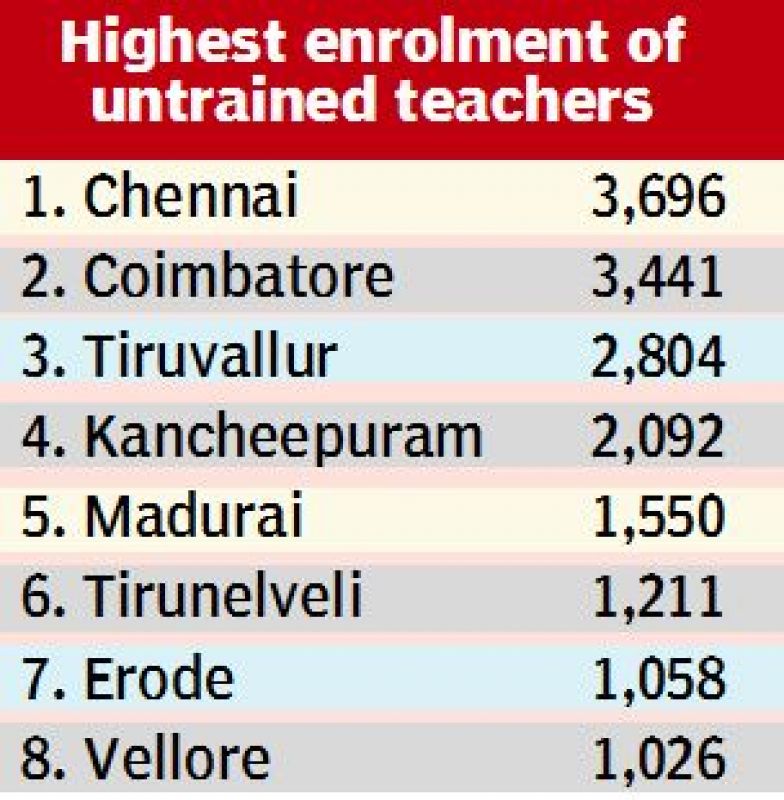
Among the districts, Chennai has 3,696 registrations for the course highest in the state. From Coimbatore 3,441 teachers registered and Thiruvallur district had 2,804 registrations.

"Right to Education Act mandates diploma in elementary education for teaching the primary classes. Due to the huge number of untrained teachers working in the schools, the HRD ministry has decided to give them a chance to get trained and introduced specifically designed diploma programme for in-service teachers," said P. Ravi, regional director, NIOS, Chennai.

As per the HRD ministry's announcement, teachers without the diploma in elementary education will not be allowed to work in primary and nursery schools after March 31, 2019.

Teachers have to study the entire course online and appear for the written test to qualify for the diploma. The candidates have to register themselves at the Swayam portal for accessing video lectures.

"They will study five papers in the first year and four papers in the second year. They will understand important aspects of elementary education such as child psychology, children growth and development and learning disorders like dyslexia," he said.

"Working teachers have the distinct advantage as they can practice in classrooms what they learnt in their lessons," he added. Though the course is conducted online, the students have to write a paper, pen test to get the diploma.
From all over the country, 14,02,962 teachers have registered for the course.

Bihar with 2.82 lakh teachers has the highest registration among the states followed by 1.82 lakhs from Uttar Pradesh and 1.77 lakh from West Bengal.
NIOS also has come up with six-month bridge course for B.Ed graduates who teach in primary classes 1 to 5.

Following the circular from the HRD ministry, the state government has made this course mandatory for BEd graduates employed in primary and nursery schools and for those who take classes for primary students in matriculation schools.

This order has stirred up a controversy among the private school managements who claimed that it has added the burden for private schools and teachers.

"The course fee is Rs.5,000 and a majority of teachers earning less than Rs.10,000 in private schools. We feel that this bridge course is unnecessary and the government should revoke the order," said K.R. Nandakumar, general secretary, Tamil Nadu Nursery, Primary, Matriculation and Higher Secondary Schools Association.

"B.Ed. graduates are only qualified to teach secondary and higher secondary classes. Teaching and understanding elementary students are completely different as they have to teach the language and subjects in a unique way," Mr Ravi said.

The teachers would be taught about pedagogy, learning process and challenges in elementary education in the bridge course. When enquired, officials from school education department said as per the National Council for Teacher Education (NCTE) guidelines, the elementary teachers should possess a diploma in elementary education. "B.Ed. teachers should use this one time opportunity and enrol themselves in the bridge course as it's only a six months course," an official said. The last date for applying for the course has been extended up to December 15.
Man creates ruckus at Chennai airport

DECCAN CHRONICLE.

PublishedDec 5, 2017, 1:19 am IST

Police investigations revealed that the passenger, Subhadutt Nath, 28, was under medication for mental health issues.


Chennai airport

Chennai: Drama ensued at domestic terminal of the city airport on Monday after a passenger assaulted at least six persons including security personnel, airport staff and passengers after an argument. Two flights had a delayed departure because of the incident.

Police investigations revealed that the passenger, Subhadutt Nath, 28, was under medication for mental health issues.

A resident of Kolkata, Nath, and his wife had come to Tamil Nadu a fortnight ago for treatment at the Christian Medical College Hospital in Vellore. After treatment, the couple was supposed to fly back to West Bengal on Monday.

After treatment, the couple was supposed to fly back to West Bengal on Monday. They were to travel by a SpiceJet flight supposed to leave at 2.50 pm, airport sources said.

After checking into the airport, the man however went to gate no. 3 instead of gate no. 5. The CISF men on security detail informed the passenger that he was on the wrong gate and asked him to check into gate no. 5. Nath, however, insisted that he was at the right gate and picked up an argument with CISF men. All of a sudden, he started assaulting them and hit the airline staff and two passengers who attempted to pacify him.

He was pinned to the ground and later handed over to the Airport police. His wife shared with the cops that he was under medication and pleaded with the authorities to drop charges. After learning this, those who were attacked also chose not to proceed with the complaint, police said.

The flights to Kolkata and Coimbatore, supposed to depart before 3 pm, had a delayed start because of this. Much to the chagrin of the couple, they were denied travel as the passenger was suffering from mental health issues. Cops suggested the couple travel by train.
New system to bring heavy rain to Chennai from Tuesday

TNN | Updated: Dec 2, 2017, 08:51 IST

CHENNAI: The city and its suburbs can expect heavy to very heavy rain from Tuesday as a "well-marked low pressure area over the South Andaman sea and adjoining Strait of Malacca is likely to become a depression by Sunday". The India Meteorological Department has forecast one or two spells of rain or thundershowers on Saturday and said rainfall would reduce until the next weather system approaches the Tamil Nadu coast.

Area cyclone warning centre director S Balachandran said, "By Monday or Tuesday, the low-pressure system is very likely to move towards north Tamil Nadu and the South Andhra Pradesh coast."

City received 100cm rain since October

The Central Water Commission, meanwhile, said the pouring might trigger a rapid rise in the water level of rivers in Kerala and Tami Nadu and had advised the states to monitor the water levels in all the major river sytems in the states.

Mahesh Palawat of Skymet Weather, a private forecaster, said there was a 25% chance the well-marked low pressure area could turn into a cyclone. Palawat said Cyclone Ockhi, which passed the southern peninsula, had drained the energy in the region. "It is rare for two cyclones to form one after another in such short duration. But there is a good chance that the system could intensify into a deep depression, bringing very heavy rainfall in Chennai," he said.

Cyclone Ockhi brought exceptionally heavy rainfall in southern Tamil Nadu, wreaking extensive damage. During the 24 hours between 8.30am on Thursday and 8.30am on Friday, Papanasam in Tirunelveli was virtually drowned, receiving 45cm of rain, while Manimutharu (Tirunelveli district) received 38cm, Mylaudy (Kanyakumari district) 19cm, Gudalur (Theni district) 16cm and Watrap (Virudhunagar) 15cm all received copious rain.

In Chennai, during the same period, the DGP's Office on the Marina received 8cm rainfall, Anna University and Nungambakkam received 7cm each, while Chennai Airport got 5cm of rain. Balachandran said, "More rainfall is expected in Tamil Nadu and Puducherry on Saturday. Heavy rainfall can be expected in Nilgiris, Coimbatore, Theni and Dindigul."

Every year, Chennai on average receives 80cm of rainfall during the northeast monsoon from October to December. This year, since October, the city has already recorded nearly 100cm of rain. However, despite the excess rainfall, the four reservoirs that supply drinking water to the city's residents still only have a combined storage of 45% of the total capacity.
College of Engineering ‘sought’ special class fees without permission

Ram Sundaram| TNN | Dec 5, 2017, 06:00 IST


CHENNAI: The College of Engineering, Guindy, under Anna University, 'illegally' collected fees for special classes for weak students, show documents taken up for review by the higher education department in 2016.

Besides ?22 lakh collected from these students, mostly from economically backward families, ?17 lakh was spent on staff remuneration in the past without proper permission from the university syndicate, the documents show.

The Centre for Faculty Development in CEG decided to conduct in 2010-11'refresher courses' for various subjects for the students, to help them clear arrears. A total of 1,117 students, who joined CEG between 2004 and 2010, registered.

Based on then Vice-Chancellor Mannar Jawahar's instruction, ?2,000 was collected from per student per course. This, the management claimed, would be used to pay faculty members, heads of departments and programme co-ordinators.

Spl classes are obligatory work of teachers: Report

While faculty members handling such classes were entitled to ?15,000 per subject, HODs got ?10,000 and co-ordinators ?1,000-?1,500.

As per the university statute, approval of the finance committee (FC) and syndicate is needed to collect money from students and pay staff who handled those classes.

The varsity, documents show, neither got the approval of the FC nor the syndicate but collected ?22.34 lakh from students.

"Itis a part and parcelof theduty of teachers to 'uplift' the poor and weaker students by coaching them specially. Conduct of special classes is obligatory work of teachers to train the weaker studentswithservice motive," said D Rathinavelu, deputy director of local fund audit, in his report for the particular year released in August 2016 Collecting ?2,000 from each student without prior approval for such classes was not in order, the report said and recommended prior approval from syndicate and FC in future.

While former VC Jawahar claimed the decision was ratified after the 2016 August Assembly session, incumbent authorities could not confirm it. "It was not taken up for discussion in syndicate meetings conducted after March this year," sources told TOI.

Sources added that many students failed in mathematics and physics that year and the programme was aimed at helping them. However, they refused to comment on not getting prior approval.

அருவருப்பல்ல, எதார்த்த உண்மை!

By இரா. செல்வம்  |   Published on : 04th December 2017 02:10 AM  
 
மாதவிடாய் என்பது பெண்களின் பாலின முதிர்ச்சி தொடங்கும் போது / பருவ மாற்றத்திற்கேற்ப இயற்கையாக ஏற்படும் ரத்தப் போக்காகும். 52% பெண்களுக்கு இது ஏற்படுகின்றது. பெண்கள் தங்கள் வாழ்நாளில் 6 -7 ஆண்டுகளை மாதவிடாய் காலங்களில் கழிக்கிறார்கள். இருப்பினும் மாதவிடாய் காலங்களில் சுகாதார மேலாண்மையைப் பற்றிய ஒரு தெளிவான சிந்தனை இல்லை. இந்தியாவில் 70% தாய்மார்கள் மாதவிடாயை ஓர் அருவருக்கத்தக்க நிகழ்வாகப் பார்க்கின்றார்கள் என்று "வாட்டர் எயிட்-இந்தியா' அமைப்பு கூறுகிறது.

மாதவிடாய் காலங்களில் பெண்கள் வீட்டிற்குள் வரக்கூடாது என்பதும், சமையல் அறைக்குள் நுழையக் கூடாது எனவும், ஆலயங்களுக்குச் செல்லக்கூடாது எனவும், அவர்களைத் தொடக்கூடாது, தீட்டு என்று ஒதுக்கி வைப்பதும் இன்றும்கூட சில வீடுகளில் நடைமுறையில் உள்ளது. இவ்வாறு மாதவிடாய் ஏற்படும்போது, பெண்களை சமூகம் இழிவாகக் கருதுவது மிகவும் வேதனைக்குரிய விஷயமாகும். இது ஒரு சமூகப் பிரச்னை மட்டுமல்லாமல், மனித உரிமையைப் பாதிக்கும் செயலுமாகும். "மாதவிடாய் காலத்தில், சமூகத்தில் பெண்களை அருவருப்பாகப் பார்ப்பது, மனித கண்ணியத்தையும், உரிமையையும் மீறும் செயல்' என 2014-ஆம் ஆண்டு ஐக்கிய நாடுகளின் மனித உரிமை ஆணையத்தின் தலைவர் ஜோதி சங்ஹெர கூறியுள்ளார்.

இந்தியாவில் 35.5 கோடி பெண்களும், மாணவிகளும் மாதவிடாய் பருவத்தில் உள்ளார்கள். இவர்களில் பெரும்பாலோர் மாதவிடாய் பருவத்தில் கண்ணியத்துடன் நடத்தப்படவில்லை என அறிக்கைகள் கூறுகின்றன. மேலும், இவர்களுக்கு மாதவிடாய் காலம் சுமுகமாகவும் இல்லை.

பருவமெய்தியவுடன் 20% மாணவிகள் இந்தியாவில் பள்ளிப் படிப்பைக் கைவிடுவதாக ஐக்கிய நாடுகளின் அறிக்கை குறிப்பிடுகிறது. இதனால், பெண்களின் கல்வியறிவு பெரும் அளவில் பாதிப்படைகிறது. 2011-ஆம் ஆண்டின் மக்கள்தொகை கணக்கெடுப்பின்படி ஆண்களின் கல்வியறிவு 82.1% மற்றும் பெண்களின் கல்வியறிவு 65.5%-ஆகவும் குறைந்திருப்பதற்கு இதுவே முக்கிய காரணமாகும்.

எனவே, மாதவிடாய் சுகாதாரத்தைப் பற்றிய விழிப்புணர்வை சமூகத்திலும் குறிப்பாக, மாணவியர் மத்தியிலும் ஏற்படுத்துவது மிகவும் முக்கியமானதாகும். இதில் மாணவிகளும், பெண்களும் படும் அவலங்களை அமைதியாகப் பார்த்துக்கொண்டும், சகித்துக்கொண்டும் இருப்பது சரியான சமூக வளர்ச்சியை ஏற்படுத்தாது.

இங்கு இரண்டு முக்கியமான விஷயங்களைப் பற்றி விவாதிக்க வேண்டியுள்ளது. ஒன்று, மாதவிடாய் பற்றிய சரியான விழிப்புணர்வை சமூகத்தில் ஏற்படுத்துதல். இரண்டாவது, மாதவிடாய் சுகாதார மேலாண்மை. அதாவது மாதவிடாய் காலங்களில் சானிடரி நாப்கின்களை அதிகம் பயன்படுத்துவதற்கான ஊக்கத்தையும், மேலும் அதனை அப்புறப்படுத்துவதற்கான வழிமுறைகளையும் பெண்களிடம் கொண்டு செல்லுதல்
.
மாதவிடாய் பற்றி சமூகத்தில் ஒரு தெளிவான பார்வை இருந்தால் மட்டுமே பெண்கள் பள்ளி, கல்லூரிப் படிப்பை சரியாகத் தொடரவும், அன்றாடம் வேலைக்குச் செல்லவும், வீட்டு வேலைகளை கவனிக்கவும் முடியும். பள்ளி, கல்லூரிகளில் சரியான சுகாதார வசதி இன்மையானது பெண்கள் படிப்பைத் தொடர்வதற்கு ஒரு தடைக்கல்லாக உள்ளது. இதைப் பற்றி அலுவலகங்கள், பள்ளி, கல்லூரிகளில் பெண்கள், மாணவ- மாணவிகளிடம் ஓர் ஆரோக்கியமான விவாதம் இல்லை.

மேலும், பெண்களுக்கு என்று அலுவலகங்களிலும், மாணவிகளுக்குப் பள்ளிகளிலும் தனிக் கழிவறைகள் இல்லாதது, பிரச்னையை அதிகப்படுத்துகிறது. இது குறித்துப் பேசுவதற்குப் பெண்களும், பெண் ஆசிரியர்களும் மாபெரும் தயக்கம் காட்டுவதாகத் தெரிகிறது. மேலும், வீட்டில் பெற்றோரும் இதைப் பற்றிய விழிப்புணர்வை மகள்களுக்கு ஏற்படுத்த வேண்டும்.

இன்று பாலியல் தொடர்பான விஷயங்களையும், மாதவிடாய் தொடர்பான விஷயங்களையும் பற்றிப் பேசுவதற்கு ஒரு சமூகக் கட்டுப்பாடு உள்ளது. இதை வெளியில் விவாதிப்பது தவறான ஒன்று என்கிற இறுகிய மனநிலை நிலவி வருகிறது. இதைப் பற்றிய விழிப்புணர்வை பள்ளி, கல்லூரி மாணவ- மாணவியர்களிடையே ஆசிரியர்கள் ஏற்படுத்த வேண்டும்.

அதேபோல் அலுவலகங்களிலும், கிராமப்புறங்களில் பருவமைடைந்த மாணவிகளிடத்திலும், பெண்களிடத்திலும் ஒரு சரியான புரிதலை உருவாக்க வேண்டும். மாதவிடாய் குறித்துப் பேசுவதை சமூகம் வெட்கக்கேடாக நினைக்கிறது. இன்றும் மத, புராண கட்டுக் கதைகளின் அடிப்படையில் சமூகத்தில் ஒரு பாதி அங்கத்தினர்களின் பிரச்னையை மறுபாதி அங்கத்தினர்கள் பேசாமலும், புரிந்துகொள்ளாமலும், மேலும் அதற்கான தீர்வைக் காணாமலும் இருப்பது, ஒரு சமமான சமூக வளர்ச்சிக்கு இட்டு செல்லாது. ஆண்களின் பாலின முதிர்ச்சியை இழிவாகக் கருதாத சமூகம், பெண்கள் பருவமடைந்து மாதவிடாய் ஏற்படுவதை மட்டும் அருவருப்பாகப் பார்ப்பது ஒரு மனவளர்ச்சி குன்றிய சமூகத்தின் பிரதிபலிப்பேயாகும்.

இந்தியாவில் இப்போது 12% மகளிர் மட்டுமே மாதவிடாய் காலங்களில் நாப்கின்களைப் பயன்படுத்துவதாகவும், மீதம் 88% பெண்கள் துணிகளையும், கந்தலாடைகளையும், சாம்பலையும், செய்தித்தாள்களையும் பயன்படுத்துவதாகவும் ஆய்வறிக்கைகள் தெரிவிக்கின்றன. நகர்ப்புறங்களில் உள்ளவர்கள் மட்டுமே நாப்கின்களை அதிகம் பயன்படுத்துகின்றார்கள். ஆனால், கிராமப்புறங்களில் உள்ள பெண்கள் நாப்கினிற்குப் பதிலாக மற்ற வழிமுறைகளையே அதிகம் பயன்படுத்துகின்றார்கள்.

இதற்கான முக்கிய காரணங்கள் ஒன்று, கிராமப்புறங்களில் நாப்கின்கள் அதிகம் கிடைப்பதில்லை என்பதும், அப்படியே கிடைத்தாலும் நாப்கின்களை வாங்கிப் பயன்படுத்தும் அளவிற்கு வசதி இன்மை காணப்படுவதும்தான். பழைய துணிகளோ, கந்தலாடைகளோ வீட்டிலே கிடைப்பதால் கடைக்குச் சென்று வாங்க முற்படுவதில்லை. இதனால் ஏற்படும் பெரும் சுகாதாரக் கேடுகள் குறித்த சரியான விழிப்புணர்வு இல்லை. மேலும் மாதவிடாயை ஒரு வெட்கப்படக்கூடிய நிகழ்வாக சமூகம் பார்ப்பதால், பெண்கள் நாப்கின்கள் வாங்குவதன் மூலம் அதனை மற்றவர்களுக்கு வெளியே காட்டிக்கொள்ள விரும்புவதும் இல்லை.

இவை அனைத்திற்கும் மேலாக, பயன்படுத்திய சானிடரி நாப்கின்களை அப்புறப்படுத்துவதும் மாபெரும் சவாலாக அமைந்துள்ளது. நகர்ப்புறங்களில் பயன்படுத்திய நாப்கின்கள் கழிப்பிடங்களிலும், சாக்கடைகளிலும், தெருக்களிலும் வீசப்படுகின்றன. 

இந்திய நகராட்சி திடக்கழிவு மேலாண்மை மற்றும் கையாளும் விதிகளின்படி பயன்படுத்திய நாப்கின்கள் எரிக்கப்பட வேண்டும். பயன்படுத்திய நாப்கின்கள் 800 டிகிரி செல்சியஸ் வெப்பநிலையில் எரிக்கப்பட வேண்டும் என்று உலக சுகாதார நிறுவனம் (ரஏஞ) கூறுகிறது. இந்த வெப்ப நிலைக்குக் குறைவாக எரிக்கப்படும்போது, அதிலிருந்து உருவாகும் நச்சு புகையானது, காற்றை மாசுபடுத்துவதுடன் அருகில் வசிப்பவர்களுக்கு சுகாதாரக் கேடுகளையும் விளைவிக்கலாம் என அறிக்கைகள் கூறுகின்றன.

மேலும், இத்தகைய திடக்கழிவுகளை சேகரிப்பவர்களுக்கும் பல்வேறு சுகாதாரக் கேடுகளும், நோய்களும் வர வாய்ப்புள்ளது. எரிக்கப்படாமல் குப்பைத் தொட்டிகளிலும், சாக்கடைகளிலும், தெருவோரங்களிலும் தூக்கி எறியப்படும் நாப்கின்கள் மிகவும் மோசமான சுகாதாரக் கேடுகளுக்குக் காரணமாகின்றன. எனவே, பயன்படுத்திய நாப்கின்களை சரியான முறையில் பிரித்து அப்புறப்படுத்துவதற்கு வழிவகைகள் கண்டறியப்பட வேண்டும். "கிளீன் இந்தியா' ஆய்விதழின்படி (ஸ்ரீப்ங்ஹய் ஐய்க்ண்ஹ த்ர்ன்ழ்ய்ஹப்), இந்தியாவில் 9,000 டன்கள் சானிடரி திடக்கழிவுகள் (432 மில்லியன் நாப்கின் அட்டைகள்) ஓர் ஆண்டிற்கு உற்பத்தி செய்யப்படுவதாகக் கூறப்படுகிறது. மாநகரங்களில் இத்திடக் கழிவுகளை அப்புறப்படுத்துவது மாபெரும் சவாலாக இருப்பதுடன், சுற்றுச்சூழல் பாதுகாப்பிற்கு மிகப் பெரிய சவாலாகவும் இருந்து வருகிறது.

ஒரு சமூகத்தின் நிறைவான வளர்ச்சி என்பது, ஆண் - பெண் இருபாலரையும் சார்ந்தே உள்ளது. இருபாலருக்கும் உள்ள பிரச்னைகளைச் சரியாகப் புரிந்துக்கொண்டு தீர்வுகள் காண்பதன் மூலமே ஓர் ஊனமற்ற சமூகம் உருவாகும். இதற்குப் பல்வேறு முயற்சிகள் தேவைப்படுகின்றன. இருப்பினும் அரசு இன்று வெற்றிகரமாக செயல்படுத்திக்கொண்டு வரும் "தூய்மை இந்தியா' திட்டத்துடன், மாதவிடாய் சுகாதார மேலாண்மையையும் இணைத்து செயல்படுத்தினால்தான் பொதுமக்களுக்கு ஒரு மாபெரும் விழிப்புணர்வு ஏற்படும்.

கல்வி துறை, சுகாதார வளர்ச்சித் துறை, பெண்கள் மற்றும் குழந்தைகள் வளர்ச்சித் துறை, ஊரக வளர்ச்சி மற்றும் பஞ்சாயத்து ராஜ் துறையும் சேர்ந்து இதற்கான ஒரு விழிப்புணர்வை மாபெரும் அளவில் ஏற்படுத்த வேண்டும்.

கார்த்திகையில் அணைந்த தீபம்!

கார்த்திகையில் அணைந்த தீபம்!  பிறருக்கு சிறு நஷ்டம்கூட ஏற்படக் கூடாது என்று மின் விளக்கை அணைக்கச் சொன்ன பெரியவரின் புதல்வர் சரவணன் என்கிற வி...