Showing posts with label Assembly. Show all posts

Monday, October 27, 2025

Withdraw T.N. Private Universities (Amendment) Bill: former V-C


Withdraw T.N. Private Universities (Amendment) Bill: former V-C

E. Balagurusamy

The Hindu Bureau

Chennai 27.10.2025

Former Vice-Chancellor (V-C) of Anna University E. Balagurusamy has urged Chief Minister M.K. Stalin to withdraw the recently introduced Tamil Nadu Private Universities (Amendment) Bill, 2025.

In a letter to the Chief Minister on Sunday, a copy of which was shared with the media, he highlighted that the conversion of government-aided colleges to private universities would lead to the dilution of public control, uncertainty for faculty and staff, and possible withdrawal of government support. “The private university status can lead to a steep increase in fees, reducing access for students from economically and socially weaker sections who rely on affordable aided-college education,” he contended.

The State government on Saturday decided to review what Higher Education Minister Govi. Chezhiaan called the “Draft” Private Universities (Amendment) Bill, in response to pushback from teachers’ bodies and a section of MLAs. The Bill was passed by the Assembly on October 18. “The dilution of reservation policies and social justice measures threatens equitable access to higher education and undermines decades of progress in inclusive education,” Mr. Balagurusamy added, and 

urged the State to hold consultations with all stake-holders before introducing any amendments to the Act.

Saturday, October 18, 2025

Bill passed to let TNPSC handle university staff hiring


Bill passed to let TNPSC handle university staff hiring

The Bill stated that the move would establish a more uniform, efficient, professional and transparent system for recruiting non-teaching staff at the universities.


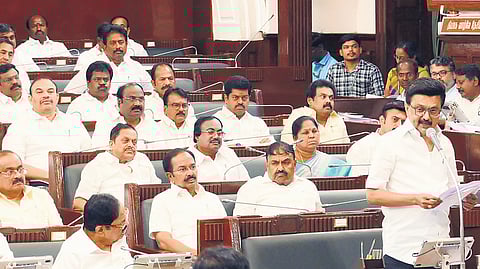
Chief Minister M K Stalin speaking during the state Assembly session on Thursday.


Updated on:
17 Oct 2025, 8:51 am
3 min read

CHENNAI: The state Assembly on Thursday passed a Bill allowing the Tamil Nadu Public Service Commission (TNPSC) to manage the recruitment of non-teaching staff for 22 state universities. The Bill amends the TN Public Service Commission (Additional Functions) Act, 2022, which empowers the TNPSC to conduct recruitment for various government departments and undertakings. Until now, the recruitment for non-teaching positions in these state-run universities was managed by the respective university administrations.

The Bill stated that the move would establish a more uniform, efficient, professional and transparent system for recruiting non-teaching staff at the universities. It would also make it easier for job seekers from rural areas to apply for such positions, while relieving universities of the cumbersome task of conducting their own recruitment drives

Bill passed to extend tenure of SOs in rural local bodies

The Assembly also passed a Bill to amend the TN Panchayats Act, 1994, to extend the term of office of special officers (SOs) appointed to administer village panchayats, panchayat union councils and district panchayats till January 5, 2026, or until the first meeting of the local bodies after the general elections. While the rural development department had issued an order in this regard in July, the Bill was now passed in the Assembly.

According to the Bill, the government is finalising proposals to expand municipal corporations, municipal councils and town panchayats by including certain adjoining village panchayats in 28 districts. Only after the delimitation and reservation processes are completed after this amalgamation, elections for these rural local bodies can be notified. A total of 9,581 village panchayats, 314 panchayat union councils and 28 district panchayats are being run by the SOs.

The tenure of elected representatives of panchayats in these 28 districts expired on January 5 this year. As elections could not be conducted before that date, the government amended the TN Panchayats Act, 1994, to appoint SOs to administer these bodies until July 5. The Act was now amended to extend the tenure of SOs till January 2026 or until the elections are held.

Tender exemption clause of 1998 Act scrapped

The state government has moved to tighten its tendering system by scrapping the exemption clause in the TN Transparency in Tenders Act, 1998, that allowed select procurements to bypass the standard open tender process. An amendment passed on Thursday removes Section 16 of the law, which previously permitted direct procurement in limited circumstances such as emergencies, ensuring compatibility, or sourcing from state-owned or non-commercial entities. The provision also allowed purchases through the Government e-Marketplace (GeM) platform without adhering to sections 9 and 10 governing open tendering procedures.

According to the Statement of Objects and Reasons, Section 16 explicitly exempted procurements made through the GeM special purpose vehicle from the application of sections 9 and 10 of the Act. This exemption covered purchases through mechanisms such as rate contracts, online bidding, online reverse auctions and any other method notified by the government. The government said the exemption had become redundant as TN already operates its own e-procurement portal (tntenders.gov.in).

This apart, the Assembly on Thursday also introduced a Bill to amend the TN Dr Ambedkar Law University Act, 1996, which sought to amend relevant rules that disqualified the deaf-mute from holding authority positions in the university. The proposed changes also seek to update a penal reference in the Act to align with the new Bharatiya Nyaya Sanhita, 2023.

Assembly passes Private Universities Amendment Bill


Assembly passes Private Universities Amendment Bill

The Hindu Bureau. 18.10.2025

Chennai

The Assembly on Friday passed the Tamil Nadu Private Universities (Amendment) Bill, allowing for conversion of existing private or government-aided colleges into a new entity called ‘Brownfield University’, by altering the minimum requirement for contiguous land to establish such a facility. The principal Opposition party, the AIADMK, and some of the ruling DMK’s allies opposed the Bill.

While Section 4 of the Tamil Nadu Private Universities Act, 2019, necessitates a minimum of 100 acres of contiguous land to establish private universities, the amendment has slashed the minimum requirement for Brownfield Universities to 25 acres in municipal corporation areas, 35 acres in municipal council or town panchayat areas, and 50 acres in other areas.


According to the Statement of Objects and Reasons of the Amendment Act, educational institutions operating in municipal corporation areas or municipal council and town panchayat areas found it tough to identify large expanse of contiguous land. “If the requirement of land is reduced in line with the Acts of private universities of neighbouring States, requests of eligible and deserving educational institutions may be considered,” the statement read.

New clause

A new clause was inserted, earmarking 65% of seats in Medical, Dental, Allied Health, and Indian Medicine courses at all non-minority private universities as government seats, while for minority private universities, half of the seats would be allotted to the government.

Section 37 of the original Act, which dealt with service conditions of employees, was also amended to include a clause stating that those employed in government-sanctioned posts in aided institutions “shall not be in any way less favourable than those which would have been applicable to them if there had been no such conversion”.

Another clause inserted into Section 55 stated that students admitted to a private college before conversion to a Brownfield University would be provided arrangements for instruction, teaching, training, and appearing for examinations, and their degrees would be conferred upon by the affiliate university.

In his reply to the debate on the floor of the House, Higher Education Minister Govi. Chezhiaan said the government was keen on protecting aided colleges for the benefit of students. He said if aided colleges were converted into private universities, they would lose the ‘aided’ status, and would stop receiving government grants. Explaining the amendments, he claimed these steps opened up possibilities to take higher education in the State to the next level.

AIADMK MLA and former Higher Education Minister K.P. Anbalagan, CPI(M) MLA Nagaimaali, CPI MLA T. Ramachandran, and Tamilaga Valvurimai Katchi MLA T. Velmurugan opposed the Bill. CPI(M), CPI, Tamilaga Valvurimai Katchi, and VCK MLA Sinthanai Selvan said the Bill may affect reservation.

K. Selvaperunthagai of Congress backed the Bill.

Friday, October 17, 2025

Tamil Nadu introduces Bill to allow existing private colleges to become universities


Tamil Nadu introduces Bill to allow existing private colleges to become universities

As per the draft amendment, 65% of seats in non-minority private universities and 50% in minority institutions will be earmarked as government seats.


Representative imagePhoto | Express Illustrations

Binita Jaiswal


Updated on:
16 Oct 2025, 8:54 a


CHENNAI: The Tamil Nadu government on Wednesday introduced a Bill in the Assembly to amend the Tamil Nadu Private Universities Act, 2019, enabling existing private colleges, including government-aided ones, to be converted into private universities if they meet the prescribed criteria.

Under the existing Act, only greenfield institutions can be converted into private universities.

The proposed amendment introduces a new “Brownfield University” category, which allows the conversion of existing private colleges into universities, and a “Minority Private University” category that permits linguistic and religious minorities to set up and administer universities under Article 30 of the Constitution.

The government may pass the Bill during the current Assembly session that concludes on Friday. AIADMK MLA and former higher education minister K P Anbazhagan opposed the Bill at the introduction stage.

The seats in government-aided courses in all types of private colleges are presently filled as per the state’s reservation policies.

65% of seats in non-minority private univs to be earmarked for govt quota

However, as per the amendment, if such a college becomes a private university, reservation policies would apply only to medical, dental, allied health, and Indian medicine courses, not arts, science, or engineering. Even in the medicine and related courses, reservation will be applied only for seats earmarked as “government seats”.

As per the draft amendment, 65% of seats in non-minority private universities and 50% in minority institutions will be earmarked as government seats.

To protect the interests of staff and students, the Bill states that employees in government-sanctioned posts in aided institutions must not face service conditions less favourable than what was being enjoyed by them before the conversion.

Although it does not explicitly mention that the government will cease funding salaries, sources indicated that this is implied. The amendment also provides that students already enrolled under the affiliating university before conversion can continue and complete their courses in the same institution, with the new brownfield university responsible for facilitating this transition.

The Bill further relaxes the land requirement for setting up private universities. The existing norm of 100 acres of contiguous land is proposed to be reduced to 25 acres within municipal corporation limits, 35 acres within municipalities or town panchayats, and 50 acres elsewhere. If a proposed campus spans multiple local body categories, the requirement of the zone with the larger land share will apply.

Academicians opined that the amendment could encourage several existing colleges to upgrade themselves into private universities, offering greater flexibility and reduced regulatory restrictions. According to the State Higher Education Department’s policy note for 2025–26, Tamil Nadu currently has eight private universities, all established as greenfield institutions.

The Association of University Teachers (AUT) has strongly opposed the proposal, claiming it could lead to the corporatisation of government-aided institutions and undermine equitable access. “The entire admission process will shift from merit-based to money-based, and both teaching and non-teaching staff could face job insecurity,” said K Raja, general secretary of AUT, urging the government to withdraw the Bill.

Brownfield university

Pvt colleges can be turned into univs under ‘Brownfield’ category, while minority institutes can become pvt univs under ‘Minority Pvt University’ category

Saturday, February 8, 2025

Did T.N. Governor refer 10 Bills to President to avoid assent, asks SC


Did T.N. Governor refer 10 Bills to President to avoid assent, asks SC


Continuing tussle: Tamil Nadu Governor R.N. Ravi, right, with

Chief Minister M.K. Stalin at the Raj Bhavan.R. RAGU

Bench asks A-G if Ravi referred the re-passed Bills to the President only to circumvent the procedure under Article 200; the Governor had sat on 12 Bills sent by Legislature between 2020 and 2023, following which T.N. govt. approached the court

Krishnadas Rajagopal

NEW DELHI 08.02.2025

The Supreme Court on Friday questioned whether Tamil Nadu Governor R.N. Ravi referred 10 Bills re-passed by the State Legislature to the President to avoid having to give his consent to them.

A Bench of Justices J.B. Pardiwala and R. Mahadevan asked Attorney-General of India R. Venkataramani if the Governor had referred the re-passed Bills to the President for consideration only to circumvent the procedure under the first proviso of Article 200 (Governor’s assent of Bills) of the Constitution.

Under Article 200, a Governor has three options when Bills are sent to him for assent – give assent, withhold assent, or refer the Bills to the President for consideration.

The Tamil Nadu government has argued that a Governor can refer a Bill to the President only in case of any ‘repugnancy’ under Article 254, that is, if the proposed State law is found to be inconsistent with or encroaches into an existing Central law or if the Bill tends to derogate the Constitutional powers of the State High Court.

Under the first proviso of Article 200, if the Governor chooses to withhold assent to a Bill, he has to return it as soon as possible to the House with a “message” to reconsider the proposed law or specified provisions or suggest amendments.

If the House reiterates the Bill and presents it to the Governor, the “Governor shall not withhold assent”. In short, the proviso makes it clear that the Governor has to grant consent.


V-C appointments

In Tamil Nadu’s case, originally 12 Bills, mostly dealing with appointments of Vice-Chancellors to State universities, were sent by the State Legislature for consent to the Governor between January 2020 and April 2023.

The Governor had sat on them. Ultimately, when the State approached the top court against the Governor’s perceived inaction in November 2023, the latter had referred two of the Bills to the President and proceeded to withhold consent on the remaining 10.

Subsequently, the State Assembly re-passed the 10 Bills in a special session within days and returned them to the Governor for his assent. The State argued in the top court that it was following procedure under the first proviso of Article 200. The Governor had proceeded to refer all 10 Bills to the President for consideration. The President had subsequently assented to one Bill, rejected seven and not considered the remaining two proposed laws.

“Having taken a conscious decision to withhold assent, can the Governor take the third choice and refer the Bills to the President? Having withheld assent, can he try to overcome the first proviso procedure by referring to the President? If he withholds assent, the procedure under the first proviso would have to be followed...,” Justice Pardiwala addressed the A-G.

Mr. Venkataramani argued that the Governor, having withheld consent to the Bills, had not asked the State Assembly to re-consider them. The procedure under the first proviso of Article 200 did not cover a situation when a proposed law is found to be repugnant by the Governor.

“What you are saying is that the first proviso covers only small issues like suggestions and amendments to the Bills sent for assent. On the other hand, if a Bill is found to be repugnant, then the first proviso is completely out of play. The procedure of the first proviso does not kick in... In this case, when the State Legislature unilaterally re-enacted these 10 Bills and sent them back to the Governor, but there was no question of you according consent now,” Justice Pardiwala summed up Mr. Venkataramani’s submissions in defence of the Governor.

Mr. Venkataramani said the ‘message’ in the first proviso did not contemplate repugnancy.

The court posted the case for a final day’s hearing on February 10.

Wednesday, January 8, 2025

Reminders to recite anthem sent well in advance, but ignored, says Raj Bhavan


Reminders to recite anthem sent well in advance, but ignored, says Raj Bhavan

A statement from the Raj Bhavan, after the governor walked out, charged that the Constitution and the national anthem were once again insulted in the Assembly.


Governor RN Ravi walks out of Assembly on Monday (File Photo | ANI)


07 Jan 2025, 8:47 am


CHENNAI: Governor RN Ravi, who has been at loggerheads with the DMK government ever since he assumed office in 2021, clashed with the government on Monday over the old issue of non-recital of national anthem at the beginning of his customary address of the Assembly. . .

A statement from the Raj Bhavan, after the governor walked out , charged that the Constitution and the national anthem were once again insulted in the Assembly.

"The national anthem is sung or played at the beginning and the conclusion of the governor's address in every state assembly in the country," the statement said. Pointing out that it is mandatory as per the “National anthem code,” it said even after “repeated reminders” conveyed “well in advance”, the requests were ignored.

Within 10 minutes of the governor leaving the House, the Raj Bhavan said in a post on X that when the governor noticed that only the Tamil Thai Vaazhthu was sung, he “respectfully reminded” the House of its Constitutional duty and “fervently appealed” to the chief minister and the speaker to play the national anthem, but “they cussedly refused”.

Highlighting it as a matter of "grave concern," the tweet said the governor left the House in "deep anguish", not wanting to be a party to such brazen disrespect to the Constitution and the national anthem.

The Raj Bhavan stressed that the governor has "unwavering love, respect and admiration for the rich cultural heritage of Tamil Nadu" and has always upheld the sanctity of Tamil Thai Vazhthu and sang it with reverence at every event.

In another tweet, Raj Bhavan also expressed concern over "total censorship" of the proceedings of the Assembly on Monday, which reminded of "Emergency days".

It said people of Tamil Nadu “were deprived of the actual proceedings of the House and conduct of their representatives therein and instead were fed only the doctored versions of the state government.”

Wednesday, December 11, 2024

DMK, AIADMK spar over who is to blame for 2015 floods ‘CAG Said 2015 Flood, A Man-made’

DMK, AIADMK spar over who is to blame for 2015 floods ‘CAG Said 2015 Flood, A Man-made’

TIMES NEWS NETWORK  11.12.2024 

Chennai : The Chembarambakkam fiasco continued to haunt AIADMK nine years after the disastrous 2015 floods that ravaged Chennai. DMK and AIADMK locked horns in the state assembly on Tuesday over the issue of water release from the lake and consequent flooding. While chief minister M K Stalin and other ministers said floods in 2015 were caused by unannounced water release from Chembarambakkam lake, AIADMK general secretary Edappadi K Palaniswami argued Adyar river had more carrying capacity than what was released from Chembarambakkam Lake.

“Water was released from Chembarambakkam lake without prior intimation, leading to the death of more than 250 people. Even the CAG report tabled in 2018 made it clear that it was aman-made disaster. There was a problem in seeking permission to open the dam on time, and as the permission could not be obtained, the dam was opened without prior intimation,” Stalin said. 

Palaniswami responded, saying Chembarambakkam lake was constructed for drinking water purposes and only a total of 29,000 cusecs were released from the lake that day. As the total carrying capacity of Adyar river was one lakh cusecs, the release of water at 29,000 cusecs from the lake did not cause flooding. Excess water from more than 100 lakes downstream of Chembarambakkam lake flowed in to Adyar river and resulted in the flooding, said Palaniswami. “Opening of Chembarambakkam lake did not result in flooding in Adyar River. It was the excess rain that resulted in lakes getting filled up quickly, resulting in flooding in Adyar river,” said Palaniswami. 


Health minister Ma Subramanian said the carrying capacity of the river was not one lakh cusecs. “I still reside by the side of Adyar river, and if water is released at 10,000 to 15,000 cusecs there will be flooding in the river,” Subramanian said. He also issued a challenge to Palaniswami, asking him to bring experts from IIT Madras to check the capacity of Adyar river. HR and CE minister P K Sekarbabu argued Chennai had seen severe rainfall in the last 45 years, but never before was the death toll so high as in 2015.

CAG finds lapses in functioning of TNMSC

 CAG finds lapses in functioning of TNMSC


The Hindu Bureau  11.12.2024

CHENNAI

The Comptroller and Auditor General (CAG) of India has found several deficiencies in the functioning of the Tamil Nadu Medical Services Corporation (TNMSC).

In its report tabled in the Assembly on Tuesday, the CAG highlighted issues of non-supply/short supply of drugs to hospitals, deficiencies such as procuring of short-expiry drugs and non-blacklisting of suppliers, and problems in quality control (QC).

The CAG’s performance audit on ‘Public Health Infrastructure and Management of Health Services’ pointed out that during 2016-2021, 185 suppliers provided 1,447 drugs, manufactured much earlier than 30 days before the date of supply.

Audit scrutiny revealed that such drugs costing ₹11.12 crore had expired while in stock during 2016-2021. It noted that the suppliers had replaced the expired items only in 13 instances, of which 10 were during 2020-2021 or later.

The audit observed that during 2016-2021, in 13,922 cases, drugs lying in warehouses for over six months were not sent for quality testing. During the same period, in 19 instances, drugs supplied by different suppliers failed quality check in government laboratories more than two times. Suppliers were not blacklisted in 14 instances.

While the TNMSC replied that suppliers were not blacklisted as penalty was imposed instead, the audit said that instances of failures in quality testing were very high.

Tuesday, September 14, 2021

Armed with Bill, TN gets ready for NEET war


Armed with Bill, TN gets ready for NEET war

Dravidian parties join hands; Legal experts divided on efficacy of Bill as no other State supports TN’s demand

Published: 14th September 2021 05:42 AM 


Express News Service

CHENNAI: Tamil Nadu on Monday started a fresh bout of legal war against the National Eligibility cum Entrance Test (NEET) again. The ruling DMK kept its poll promise of passing a Bill to exempt the State from the exam. However, apprehensions around its ultimate success in getting the Union government’s nod remain the same as was the case five years ago when the previous AIADMK regime passed a similar Bill. Despite being an ally of the AIADMK in the State, the BJP-led Union government did not budge and returned the Bill, then.

This time, however, the new Bill is backed by the report of a special committee, led by Justice AK Rajan, that studied NEET’s impact on students from disadvantaged backgrounds. “The reason for the President to return the Bill then was not because there was a lack of data. It was on the Constitutional propriety of the State trying to get an exemption from a Central law,” said Justice K Chandru, a retired Madras High Court judge. NEET was enabled by a law passed in the Parliament, and at best, the State Assembly can pass a resolution showing its disapproval, he said, adding that there was no support from other States, too.

A few other legal experts have a different opinion. Justice Hari Paranthaman, also a retired Madras HC judge, said there have been earlier instances of such exemptions from the Central law for a single State. “For instance, the Hindu Marriages Act, where only TN was given an exemption.”Much of the course ahead will depend on how the Union government will treat the new Bill that will be sent for a presidential nod. As much as legal, there are also other factors, including political considerations. The BJP-led government also seems determined on having a uniform education policy.

However, the Bill on its part, puts forth its reasons in strong words. Quoting the report of the panel, the Bill said NEET festers inequality, as it favours the rich and more privileged class of society who can afford special coaching, apart from pursuing Class XII. “It virtually barricades the underprivileged social groups from medical and dental education. This is against the very object of the equality clause enshrined in the Constitution, and infringes the right to education of children from underprivileged classes of society,” it said.

The Bill, introduced by Chief Minister MK Stalin, said medical admissions will be based on marks scored in Class 12 board examinations. Barring the BJP, an Opposition ally, all parties in the House supported the Bill, and it was passed by a voice vote. Under this, government school students will have a 7.5 per cent reservation for medical and dental admissions in the State. Incidentally, the passing of the Bill comes a day after Dhanush, a NEET aspirant, committed suicide in Mettur. Although the AIADMK staged a walkout blaming the ruling DMK for the aspirant’s death, Leader of Opposition Edappadi K Palaniswami extended his party’s full support to the Bill during the discussion and the Chief Minister thanked him for the same.

All parties, except BJP, extend support to Bill

When the Bill was introduced by Chief Minister MK Stalin, barring the BJP, an Opposition ally, all parties supported it, and it was passed by a voice vote

‘Infringes right to education...’

The Bill stated, ”It virtually barricades the underprivileged social groups from medical and dental education. This is against the very object of the equality clause enshrined in the Constitution, and it also infringes the right to education of children from these underprivileged classes of society.”

Stalin, EPS engage in verbal battle over NEET


Stalin, EPS engage in verbal battle over NEET

TIMES NEWS NETWORK

Chennai:14.09.2021

Holding the previous AIADMK regime responsible for introducing NEET in Tamil Nadu, chief minister M K Stalin on Monday said 15 students, including Dhanush of Salem, had ended their lives apprehensive about the entrance test.

The state government had kept this in mind while introducing the bill to provide admissions based on class 12 board examinations. Later, Leader of opposition Edappadi K Palaniswami told reporters that DMK was responsible for the suicide of the NEET aspirant in Salem.

The assembly saw heated exchanges between Stalin and Palaniswami before the bill was introduced.

EPS pointed out that NEET exemption was DMK’s poll promise and the party had promised to fulfill it soon after assuming charge. “The students could not prepare for the competitive exam with DMK leaders making continuous assertions about NEET exemption,” the former CM said, before walking out in protest along with AIADMK legislators. Certain remarks by EPS on the Salem student’s suicide were expunged by the speaker.

Stalin said many students, including Anitha, had ended their lives during the AIADMK regime. A bill passed unanimously under the previous regime to exempt the state from NEET was rejected too. “The AIADMK government hid the rejection of the bills by the President. The leader of opposition was the CM then. The student, Dhanush, could not pass NEET twice when you (EPS) were the CM,” Stalin said.

The CM said the AIADMK was an ally of the NDA government at the Centre and could have laid down a condition to its ally that it would support the CAA and farm laws only if the state was exempted from NEET. The AIADMK did not have the courage to do it. “Had it been done; the state could have been exempted. But the AIADMK maintained a stony silence when students were coming suicide,” Stalin said.

In the afternoon, when the bill was taken up for consideration and passage, Palaniswami said the party welcomed the legislation. The present bill only additionally mentioned justice A K Rajan committee’s recommendations and the minister should explain whether the state could pass a bill against the Centre’s legislation, EPS said. The Supreme Court already passed judgments against NEET, he added.

TN assembly passes bill to nullify NEET, BJP walks out


TN assembly passes bill to nullify NEET, BJP walks out

It Also Gives 7.5% Quota To Govt School Students

TIMES NEWS NETWORK

Chennai:14.09.2021

In a near-unanimous motion, the Tamil Nadu assembly on Monday passed a bill for admission to medical courses only on the basis of Class XII marks in board examinations. The bill also provides for 7.5% horizontal reservation in medical courses for students of government schools.

“Admissions to medical education courses are traceable to Entry 25 of List III, Schedule VII of the Constitution. Therefore, the state government is competent to regulate the same. So, I am moving this bill,” chief minister M K Stalin said, evoking loud thumping of desks in the treasury. The bill seeks to circumvent NEET and, instead, have only Class XII marks as criterion for admissions to MBBS, BDS, Indian medicine and homeopathy courses.

While opposition parties like the AIADMK and the PMK, besides DMK allies, supported the bill, the BJP members walked out of the assembly in protest.

A high-level committee, headed by Justice A K Rajan, former judge of the Madras high court, set up by the DMK government in June, reported to the government that NEET had undermined the diverse societal representation in MBBS and higher medical courses, favouring the affluent groups, while thwarting the dream of pursuing medical education by the underprivileged sections.

Constitutional and political tussle

TN’s bid to do away with NEET is as much political as constitutional, reports A Subramani. Political as it would need the Centre’s consent and presidential assent. Constitutional as education, after the 42nd amendment, is on the concurrent list where the Centre and the states have equal say to enact laws. P 5

Allot 1% seats to def personnel’s wards: HC

The Madras high court has said that it expects the TN government to allocate at least 1% medical seats for wards of serving defence personnel from the next academic year and recognise their selfless service to the nation. P 5

Wrong to say NEET improved medical exam quality: CM

The most-affected were students of government schools, those having parental income of less than ₹ 2.5 lakh a year and that of MBCs, SCs and STs.

The committee said the NEET neither seemed to ensure merit nor standard of students being offered MBBS. The Justice Rajan committee received views from 86,342 people both offline and online and submitted its report on July

14. “The committee has recommended that the state government pass an act, like Tamil Nadu Admission in Professional Educational Institutions Act, 2006 (Tamil Nadu Act 3 of 2007),” Stalin said.

Following the recommendations, the state set up another committee of secretaries led by chief secretary V Irai Anbu on July 15. The committee of secretaries recommended the same route to nullify NEET.

The CM said it was wrong to say NEET improved the standard of medical examination. TN had one of the highest number of medical and dental institutions even before 2017. The standard of medical and dental professionals from these institutions was high.

The government decided to enact a law to ensure social justice, uphold equality and equal opportunity, protect all vulnerable student communities, and ensure a robust public health care in the state, especially in the rural areas, Stalin said.

In the afternoon, when the Bill was taken up for consideration and passage, BJP floor leader Nainar Nagendran said his party opposed the Bill. He said 57,219 out of 99,610 students, who wrote NEET, cleared the test last year.

Sunday, September 12, 2021

Stalin vows to monitor all schemes announced


Stalin vows to monitor all schemes announced

TIMES NEWS NETWORK

Chennai:12.09.2021

Tamil Nadu chief minister M K Stalin on Saturday said he would monitor and hold periodical reviews to ensure that all the announcements made by various ministers in the assembly are implemented in time.

“We have devised strategies to implement each scheme announced in the assembly. They will be implemented in a phased manner. No scheme will remain as mere announcement. I am personally taking efforts to implement them. I am holding review meetings with the ministers concerned and officials of the department to speed up implementation,” Stalin said after inaugurating the monthly incentive (₹ 1,000) scheme for the priests of 12,959 temples where only one-time pooja is done every day. He inaugurated the scheme at Marundeeswarar temple in Thiruvanmiyur. The scheme was announced in the assembly and it had been launched even before the session ended, said Stalin.

The CM applauded the HR&CE ministry for implementing various schemes and said minister P K Sekar Babu deserved the moniker ‘Seyal’ (action) Babu.

He said the department was lucky to have an active minister like Babu, who was working round the clock.

Listing out various announcements like construction of houses for priests and setting up of colleges under the department, Stalin said the golden era of the department was in the offing.

He said the government had created an additional corpus fund of ₹130 crore, thereby doubling the corpus from ₹1 lakh to ₹2 lakh for each temple under one-time pooja scheme.

The chief minister said all schemes will be implemented in a phased manner and added that they will not remain as mere announcements

Thursday, September 9, 2021

TN to buy 2,213 new diesel buses


TN to buy 2,213 new diesel buses

TIMES NEWS NETWORK

Chennai:09.09.2021

Tamil Nadu plans to purchase 2,213 new diesel buses and 500 electric buses within the next two months to replace the older vehicles in the fleet, transport minister Raja Kannappan announced in the assembly on Wednesday.

Replying to the debate on demand for grants for the transport department, Raja Kannappan said, "The new buses will be purchased with interest free loan from German bank KfW (German Development Bank) which will cover 80% of the cost and remaining 20% will be funded by the state."

The government entered into an agreement with KfW to procure 12,000 BS-VI buses and 2000 electric buses in a span of five years from 2021. There are 17,333 buses plying in the state.

Sunday, September 5, 2021


Don’t waste time dwelling on past events: Stalin to his MLAs

Intervenes As MLA Recalls ‘Humiliation’ Of Party Over 10yrs

Julie.Mariappan@timesgroup.com

Chennai:05.09.2021

Chief minister M K Stalin on Saturday sought to send a strong message to his legislators to stop recalling past events in the assembly as it amounted to wasting the time of the House.

More than once in recent days, he had also asked his MLAs not to indulge in sycophancy by showering compliments on him. On Saturday, participating in the debate on demand for grants for various departments, DMK (Kumbakonam) MLA G Anbalagan said his party had suffered humiliation in the assembly in the past one decade, with many AIADMK leaders making acerbic remarks against the DMK and its leadership. “A leader made an outrageous statement that there were no rivals for her to see in the assembly. Another leader said Stalin can never win and never become chief minister. Those faces are not to be found in the House. But others have come,” said Anbalagan pointing to Royapuram MLA Idream R Murthy, seated near him. Murthy, who defeated former AIADMK minister D Jayakumar, rose from his seat with folded hands, evoking laughter among the ruling party MLAs.

Stalin intervened at this stage to say the member had been given only 15 minutes by the speaker and hence, he should confine himself to the issues relating to the demand for grants for the department and should not waste time speaking about “unnecessary” things. Leader of the opposition, Edappadi K Palaniswami said the DMK MLA should also talk about the vote on the motion of confidence in 2017 (when the DMK legislators created ruckus). Responding to this, the chief minister said, “I have told my MLA to limit himself to relevant issues to avoid wastage of time. If the Leader of the opposition is ready for a discussion (on the trust vote), then the DMK is also ready.” Palaniswami said the DMK MLA was making unnecessary remarks in the House.

Anbalagan went on to say the DMK was not against any religion and the party remained a fortress for spiritual people. It was portrayed as an anti-Hindu party way back in 1967 elections and in 2021, but people reposed confidence in the Dravidian party. Former CM C N Annadurai deputed his PWD minister M Karunanidhi to oversee the arrangements of mahamagam festival in Kumbakonam, he said. “In 11 seats, known for their spiritual significance, including Kancheepuram, Tiruvannamalai and Mylapore, the DMK won in the last election,” he said.

Later, DMK (Tirupattur) MLA A Nallathambi said rivals (the BJP) took out Vel Yatra to defeat Dravidam and the DMK, but it was Karunanidhi who took out a yatra for tracing the missing diamond spear of Lord Muruga in Tiruchendur.

SC orders all-India audit of pvt & deemed universities Focus On Structural Opacity & Examining Role Of Regulatory Bodies

SC orders all-India audit of pvt & deemed universities Focus On Structural Opacity & Examining Role Of Regulatory Bodies   Manash.Go...