Saturday, September 22, 2018


You can’t score less and join foreign medical colleges: HC

CHENNAI, SEPTEMBER 22, 2018 00:00 IST


Only meritorious students should be allowed to enter any medical college, says the High Court. (Picture used for representational purpose only) 

Wants MCI to insist on scoring 75 to 80% in Plus Two besides clearing NEET

The Madras High Court has asked Medical Council of India (MCI) to spell out minimum marks that had been prescribed by it for issuing eligibility certificates to Indian students wanting to join medical courses in foreign colleges. The court wanted to know if any changes had been effected after the introduction of National Eligibility-cum-Entrance Test (NEET).

Substandard doctors

Justice N. Kirubakaran directed the counsel for MCI to get instructions on the subject by Monday. He said students who scored at least 75 to 80% marks in Plus Two alone should be allowed to pursue medicine in foreign institutions.

“Otherwise, children of moneyed people will easily obtain medical degrees and people will end up getting substandard doctors,” he said.

The judge was hearing a writ petition filed by a youth who had obtained a medical degree from a university in West Indies and had approached the court seeking a direction to Tamil Nadu Medical Council to register his name so that he could undergo Compulsory Rotatory Residential Internship (CRRI) in any approved medical college hospital in the State.

On a perusal of the petitioner’s marks in Plus Two examinations, the judge found that he had scored far below what would be required to gain admissions in a medical college within the country. He wondered how students, who were ineligible to gain admission in a domestic institution, could be allowed to obtain the same degree from a foreign university.

The judge also recalled that in an interim order passed last year, he had observed that “only meritorious students should be allowed to enter any medical colleges as the life of the patients/citizens are with the prospective doctors. This court cannot take risk with regard to public health as it would go against the interest of the society.”

Then, the MCI was suo motu included as a respondent to the case and details were called for regarding procedures adopted by it to grant eligibility certificates to join foreign medical colleges. Thereafter, the court was told that before introduction of NEET, just 50% marks in Plus Two were sufficient to join a foreign medical institution.

After NEET came into force, it had been mandatory to clear it even for securing a medical seat in a foreign country. The MCI had issued a notification on March 1 this year amending the regulations governing the issue. The procedure of issuing eligibility certificates was dispensed with and clearing NEET was made mandatory for all admissions from June 1 this year.

Nevertheless, the judge doubted how appropriate would it be to permit students who had scored 50% marks in Plus Two examinations to get admission in foreign colleges just because they had cleared NEET. He insisted that apart from clearing NEET, at least 75 to 80% marks in Plus Two should be scored to gain admission in foreign colleges.

TECHTONIC

ALL-ROUNDERS UNDER 35K  21.09.2018

Ashutosh Desai and Savio D’Souza review three mid-range smartphones that tick the right boxes when it comes to looks, performance and build – and at times, even challenge the best flagships in the market today

POCO F1

The F1 is the debut handset launched under Xiaomi’s sub-brand ‘Poco’, and in a way, it defines what consumers can come to expect from the manufacturer under this name. To begin with, the smartphone comes in two build variants. At the entrylevel price of ₹20,999, you get an all-plastic back, while the top-end model—the Armoured Edition, priced at ₹29,999—comes with Kevlar, the same tough material that is used in bullet-proof vests. Both variants are solidly built, complete with scratch-resistant Gorilla Glass.

You also get a silicone cover in the box, but it offers no real protection against accidental drops. In fact, the device feels better to handle without this cover.

Its notch-display is capable of high-brightness levels that make text and images legible even under sunlight. You can adjust colour tones—warm or cool—and even use its reading mode to reduce blue-light emission that causes eye strain. The F1’s screen renders crisp text and punchy colours that are at par with the Huawei Nova 3, though the latter is capable of richer blacks that allow for better overall contrast.

Still, this device works well for Full HD movie viewing. The speakers are tuned for videos and handsfree calls but not for music listening; with ear/headphones, the audio is balanced and reproduced clearly across the aural spectrum.

When you plug in your headset, you can even use the F1’s equaliser feature to finetune your listening experience.

Calls are clear, and the device manages to latch and hold onto cellular towers quite quickly though we have always found the Huawei device to be the best when it comes to network handling.

When it comes to its user interface, the Poco F1 runs Xiaomi’s MIUI 9.6 that comes with a bunch of features baked into the stock installation: You get a call and voice recorder for phone calls and interviews—and you can even set markers in the audio recording during playback; its screen recorder lets you create videos of your action on the handset, and you even get an FM receiver for radio.

For security, you get a fingerprint scanner at the back that is quick to unlock the handset, and facial recognition that works in the dark thanks to an infrared camera that sits to the left of the notch, just above the display.

Its user interface also includes a feature called Second Space that allows you to create multiple “desktops” with different apps for each space. This is like using two handsets, each with a different set of apps. You can switch between these spaces by means of a password, and even by separate fingerprints for added security. It should be noted that Second Space is not the same as Dual Apps that lets you run multiple versions of WhatsApp (one for each of its dual SIMs), Amazon, Skype, and Instagram with two different logins on the same handset. Quite a few manufacturers let you run dual instances of apps, which is usually limited to a few services only. MIUI lets you run dual instances for most apps that require a login.

Those who love clicking pictures will also not be disappointed by the F1. The dual rear cameras are capable of evenly-exposed shots, and you even get detailed captures—with little grain—in low light. The device is equipped with multiple shooting modes: up to 4K videos with time lapse and slow motion, photo mode with AI that detects the subject for optimum shots, portrait mode with DSLR-like bokeh, panorama for extra-wide vistas, as well as a manual mode that allows you granular control over white balance, focus, shutter speed and ISO levels.

Besides, you also get over a dozen colour filters that work with the rear and selfie cameras. The front camera is also capable of portraits with bokeh, and you also get a beautification mode that lets you sharpen your jawline, make your eyes look bigger, and even smoothen your skin tone. The cameras are supported by a post-processing feature that lets you crop images; adjust their brightness, contrast and saturation; apply effects and enhance them with stickers, text and doodles. Overall, you get great shooters that are capable of detailed snapshots; in fact, photos clicked with the F1 are good enough of 6x4-inch prints.

For review, we were sent the Armoured Edition that comes with the fastest Snapdragon 845 processor, 8GB RAM and 256GB storage—putting it in direct competition with Android handsets that cost more than twice as much. The entry-level F1 comes with the same processor, 6GB RAM and 64GB storage, and you will see only a very miniscule drop in performance when it comes to multitasking and process-intensive apps.

This hardware, Xiaomi says, is aided by “Liquid Cool” technology that dissipates heat quickly to allow the handset to run at peak speeds for extended periods. While we couldn’t test the efficacy of this cooling tech, we did not face any overheating issues; the Poco F1 performed admirably when it came to advanced 3D games, and even scored one of the highest recorded points in benchmark tests. Add to this mix a battery that gives you over a day’s use on a single charge as well as some very practical apps/ features and there is no reason to look at any other Android smartphone under ₹30k if you are willing to try your chances at Xiaomi’s flash sales.

SAMSUNG GALAXY A6+

The A6+ sports a metal unibody design with toughened glass that feels solid and looks premium; its back panel has a matte finish that doesn’t accumulate smudges and also offers a good grip. However, you might want to use a screen guard to protect against scratches.

Its touchscreen is capable of high brightness levels, which allow you to use the phone even under sunlight. In fact, the A6+ has the best display when compared to the two other phones in this review; it renders crisp text and sharp images with punchier colours. This colour profile can be changed to a natural palette, or you can just fine-tune RGB levels from the device’s display settings. You also get the standard “blue light filter” for strain-free reading.

Its side-facing speaker is powerful and is better suited for hands-free voice calls. Music, however, is best enjoyed with ear/headphones. Playback is balanced across the aural spectrum, and you also get the option to boost audio quality with the Dolby Atmos optimisation. Alternatively, you can adjust bass and treble or finetune output with the built-in equaliser. The device’s good display, along with its good audio quality makes it ideal for watching hi-def video content.

The Samsung Experience UI is mostly standard across all the brand’s handsets. You get a voice recorder (not for recording calls), an FM radio, Samsung Max for privacy protection, Secure Folder to safeguard data and apps, and Dual Messenger to run two accounts of Facebook, Skype and WhatsApp simultaneously.

This smartphone supports Samsung Pay Mini, which lets you make UPI payments, store debit/credit card details, and manage your Paytm and MobiKwik accounts. It will let you scan QR codes to pay bills and transfer money, but it cannot be used like Samsung Pay for contactless payments with a card machine.

The UI also includes a watered-down version of Bixby—Samsung’s AI assistant—but without support for voice commands. Instead, you get a card-based interface—accessible with a swipe on the homescreen—that displays weather updates, news, trending videos and more. Overall, the Bixby experience is underwhelming without voice support. The A6+ also has a fingerprint sensor and a face recognition mode to unlock the screen. Both work as advertised, but the latter is not consistent in low light.

The handset’s dual rear cameras are capable of detailed captures with a natural colour palette; you get preset scene modes for action photography, night shots and panoramas, and the camera app also includes an AR Stickers and a “live focus” mode to take portraits with bokeh. Pictures are evenly exposed without loss of detail, though you might face some problem with focusing at times. Also, there is a visible drop in quality—with some increase in noise—when it comes to photos taken in dim settings. Overall, the photos from the A6+ are good enough for sharing online, but lack detail and appear grainy when viewed at actual size. That said, selfies clicked with the A6+ front cam are impressive. Snapshots have a warm colour tone with a fair amount of details when the beautification mode is disabled.

While we do not see any alarming shortcomings in the Samsung Galaxy A6+—you get an excellent display, a good set of cameras, web and data security options, as well as a battery that gives you over a day’s worth of service on a full charge—it runs on a processor that is underwhelming in comparison to the high-performance chips on the Poco F1 and Huawei Nova 3. This makes the handset seem overpriced, especially in contrast to the entry-level version of the Poco F1 that retails at a lower price.

HUAWEI NOVA 3

The Nova 3 is a beautiful handset that sports a metal frame and a glossy glass back with a two-tone finish. It feels sturdy to hold, but at the same time, its smooth exterior makes it slippery to grip; you get a transparent soft silicone case in the box that provides the much-needed grip, but at the cost of dulling the phone’s plush look.

Its notch display is not as bright as the screen on Samsung Galaxy A6+, but we didn’t face any visibility issues under bright lights.

By default, the Nova 3’s colour profile is set to display vibrant colours with excellent contrast when compared to the Samsung and Poco handsets. But you can opt for a muted colour profile, and even set the handset to scale down automatically from Full HD+ to HD+ resolution to extend battery life.

The speaker on the device is the least powerful of all three in this review though it is good enough for hands-free calls in quiet settings. It comes with its own “Histen” sound optimisation, which cannot be disabled. Though, you can switch to a “standard” mode to finetune output with a 10-band equaliser. Overall, music sounds nuanced with clear vocals, smooth mids and punchy bass lines. Also, along with its high-contrast, wide-screen display, the Nova 3 lends itself well for movie watching.

When it comes to its UI, Huawei’s proprietary EMUI is packed with options: You can run two instances of WhatsApp, Facebook and Snapchat with different IDs, and you get the option to switch to a secure profile called Private Space which is similar to Poco F1’s Second Space; we found the latter has a better implementation of the feature.

Notably, the Nova 3 lacks an FM radio and call recording, but you get proprietary apps like a screen recorder, a Health app to track your step count and calories burned; the HiCare app to find Honor service centres and connect with a phone expert, as well as an SOS app that can send text alerts to contacts. For security, you get a responsive fingerprint sensor, and an infrared-based face unlock feature that works instantly even in the dark.

When it comes to shooters, the Nova 3 is the only device in this review that’s equipped with dual rear and front cameras. Its rear snappers are comparable to the Poco F1; they capture lots of detail, with natural colours and excellent contrast. You also get scene modes like monochrome, light painting, document scan, 3D panorama, an iPhone-like “moving picture” mode that lets you capture a still with a short video clip simultaneously, as well as a Pro mode lets you finetune settings like exposure, white balance, shutter speed and focus.

Selfies with the front shooters are second to the Poco F1 that are the best in this review. Colour tones with the Huawei Nova 3 are balanced and details are noticeable when beautification is disabled. You even get a wide-angle and portrait mode for group shots and bokeh effects. Overall, you get a decent set of snappers with lots of post-processing options to improve photo and video output.

The Huawei Nova 3 looks premium, packs in flagship-grade hardwarewith performance that’s almost as good as the Poco F1—and comes with a decent set of cameras. Network handling is the best in its class and you get over a day’s use on a full charge. We would still place this device lower than the OnePlus 6 handset that costs as much, and definitely as a lesser choice when compared to highest-specced Poco F1 Armoured Edition.


SPECS: 6.18-inch (2246x1080px) Full HD+ Gorilla Glass display 2.8GHz Snapdragon 845 octa-core processor 6/8GB RAM 64/128/ 256GB storage, microSD 12MP + 5MP dual rear, 20MP front camera 4000mAh battery


SPECS: 6-inch (2220x1080px) Full HD+ display 1.8GHz Snapdragon 450 octa-core processor 4GB RAM 64GB storage, microSD 16MP + 5MP rear, 24MP front camera 3500mAh battery


SPECS: 6.3-inch (2340x1080px) Full HD+ display 2.36GHz Kirin 970 octa-core processor 6GB RAM 128GB storage, hybrid microSD 24MP + 16MP rear, 24MP + 2MP front cameras 3750 battery

What the ratings mean: Below 5: The product is poor and doesn’t offer the experience it promises 5 & 6: The product works as advertised 7: The product is very good 8: Very good and delivers super value for money 9: The device is exceptional 10: You’re kidding, right? All ratings awarded to devices factor in prices to arrive at a final score.
Kerala law prohibits docs of other states from treating flood victims

But Central Law Allows Those Registered To Practise Anywhere In Country


Rema.Nagarajan@timesgroup.com  21.09.2018

Hundreds of doctors from Maharashtra, Tamil Nadu and Andhra Pradesh were in Kerala providing medical care for victims of the flood. Strictly speaking, these doctors were violating the Kerala law that stipulates that only doctors registered with the state’s medical council can practise there. Similar laws exist in most states.

This has given rise to an absurd situation where thousands of doctors are registered in more than one state and some in as many as five. This is despite the central act governing all Indian doctors clearly stating that anyone registered in the Indian Medical Register (IMR) can practise anywhere in the country.

Doctors in Kerala and Karnataka have gone to court against the law that compels them to register with the state medical councils and renew their registration every five years. The doctors argue that there is no such stipulation in the central law. In areas on the concurrent list, like health, where both Centre and states can enact laws, when a state law is in conflict with the central one, the latter prevails.

The Medical Council of India has added to the confusion by shifting positions. According to the minutes of a MCI ethics committee meeting and its general body in late 2004, the committee had decided that there was no need to register in more than one state as “any doctor who has registered with any state medical council is automatically registered in the Indian Medical Register”.

However, 12 years later, the MCI filed an affidavit in the Punjab & Haryana high court in July 2016 stating that “persons possessing recognized medical qualification are required to be registered with the respective state medical councils within the jurisdiction of which they wish to practise medicine.”

Multiple registration has led to problems in enforcing disciplinary action against a doctor. This had happened in the case of an orthopaedic surgeon practising in Chennai. His name was removed from the medical register permanently by the Tamil Nadu council after he was convicted of pornographic crimes. MCI upheld the permanent removal and stated that all state councils would be informed. However, he continues to practise and his name still figures in the IMR as being registered in Madhya Pradesh.

For the full report, log on to www.timesofindia.com


ON A STICKY WICKET: Multiple registration has led to problems in enforcing disciplinary action against a doctor

Pinarayi hopes to raise ₹150cr from US
Thiruvananthapuram:

Kerala chief minister Pinarayi Vijayan urged the Malayali diaspora in the United States to contribute liberally to rebuild Kerala. Addressing the diaspora in New York on Thursday in his first public appearance after receiving treatment at Mayo Clinic, Vijayan said, “I appeal to the people here to contribute a minimum of ₹150 crore towards rebuilding the state. I request all Malayalis to join the global salary challenge, a donation drive inviting Malayalis all over the world to contribute one month’s salary for Kerala,” he said. Vijayan said finance minister Thomas Isaac will be visiting the US from October 18 for mobilizing funds. TNN

Solve MCI issues with tech: SC to Nilekani
New Delhi

: The Supreme Court has requested former UIDAI chairman and technocrat Nandan Nilekani to explore the possibility of having a computer network-based technological solution for inspection of private medical colleges by the Medical Council of India (MCI). SC said this while noting “incessant disputes” have reached the court about what actually transpired at MCI inspections of various private medical colleges, with the concerned parties virtually contesting every fact recorded.

A bench of Justices S A Bobde and L N Rao considered the suggestion of senior advocate Kapil Sibal that computer network-based technology, which may include artificial intelligence, would be required to solve the problem. PTI
Family members of victims of Rajiv killing to meet guv
TIMES NEWS NETWORK

Chennai:21.09.2018

Family members of people who had lost their lives, or were crippled, in the suicide bomb attack that killed former Prime Minister Rajiv Gandhi have sought permission to meet governor Banwarilal Purohit to register their protest against the state government’s decision to release the seven life convicts in the case.

“We have sent a letter to the authorities of Raj Bhavan, seeking appointment to meet governor Banwarilal Purohit to air our views regarding the cabinet’s decision to release the seven convicts. We will strongly oppose their release,” said Abbash, coordinator of the victims’ families. He was son of Samdhani Begum, who was killed in the suicide bomb blast. Begam, a widow, was president of the South Chengalpet Mahila Congress.
3 doctors, lawyer booked for forgery

TIMES NEWS NETWORK

Coimbatore:  21.09.2018

The city police have registered a case against six people, including three doctors and a lawyer, for forging documents to get bail for a local resident, who was arrested in July for selling narcotics.

M Zackariya, a lawyer, Peer Mohammed, office assistant at the Coimbatore Medical College and Hospital (CMCH), Dr TCR Ramakrishnan, who runs a clinic at New Siddhapudur, Dr S Usha, senior civil surgeon at CMCH, Dr Mansoor at CMCH and Mohammed Shahib, elder brother of the accused Mohammed Shikas, have been booked.

Kattoor police had arrested D Joy Immanuel, 28, a native of Bengaluru, Mohammed Shikas, 22, of Saibaba Colony, Jilbykhan Ali, 24, of Kuniyamuthur and Mohammed Anaf, 22, of Ukkadam on July 24 for selling opioid drugs in Coimbatore. Police also seized six bottles (each 2ml) of pethidine hydrochloride and four bottles (each 2ml) of diazepam injections from the four-member gang. They were remanded in judicial custody.

Meanwhile Zackariya, who appeared on behalf of Mohammed Shikas, filed a petition seeking conditional bail. It said that Shikas was an epilepsy patient, whose marriage was fixed. The lawyer submitted medical certificates from a doctor and also a marriage invitation. However, suspecting foul play, judge C Sanjai Baba ordered an investigation about the veracity of the medical certificates and marriage invitation. The investigations revealed that Peer Mohammed had fabricated the doctors’ certificate and the marriage invitation .

Power supply to be suspended for maintenance

Chennai:21.09.2018

Power supply will be suspended in the following areas on Monday from 9am to 4pm for maintenance work. Supply will resume before 4pm if the work is completed. 

Thirumangalam: Metrozone, Sathiya Sai Nagar, Ambedkar Nagar, Balaji Nagar, Pen Foundation, Golden Jubilee Flats.

 Selaiyur: Yeswanth Nagar, Bhuvaneshwari Nagar, Malleswari Nagar, Jalvayu Vihar, Madambakkam Main Road one part, Alamelupuram. 

Palavakkam: Sundeep Road, Chinna Neelankarai Kuppam, Singaravelar Salai, Ranjith Nagar, Philips Salai, Sulthan Ahamed Street. 

Neelankarai: Pandian Salai one part, Kabaleeswarar Nagar Main Road, north & south Kathiravan Salai, Ruby Complex, Ellaiamman Koil Street, ECR Main Road. Irulipattu: Alinijivakkam, Athipattu, Irulipattu, Janapachatram, P P Road, Saikiruba Nagar, Jaganathapuram Road, Virundhavan Nagar. TNN
PATRIOTISM VS POLITICS

‘Surgical Strike Day’ in univs not must: Centre


TIMES NEWS NETWORK

New Delhi:21.09.2018

A UGC circular to higher educational institutes to observe the ‘Surgical Strike Day’ on September 29 stoked a political row on Friday with the opposition accusing BJP of politicising the issue and the government  saying that it’s all about “patriotism and not politics”.

“Where is politics? This is not politics but patriotism. Students needed to be informed about the surgical strikes, and what military and civil works soldiers do. The ministry issued a programme only on the basis of suggestions received from teachers and many students,” HRD minister Prakash Javadekar said.

He said it was not mandatory for universities and institutions to celebrate the 2016 cross-border raid by commandos on Pak terror pads. “An advisory and not a direction has been issued to universities.”

The UGC had on Wednesday written to the institutions to observe “Surgical Strike Day” with a request that the “activities undertaken may be uploaded on the university activity monitoring portal on UGC website”.

Will Centre celebrate Surgical Strike Day for demonetization, asks Sibal  Senior Congress leader Kapil Sibal sarcastically asked whether the UGC would “dare” to celebrate November 8, the day when demonetization was announced in 2016, as ‘surgical strike day’ as well.

“UGC directs VCs of all universities to celebrate 29th September as Surgical Strike Day. Is this meant to educate or to serve the BJP’s political ends?” Sibal tweeted. “Will UGC dare celebrate 8th November as Surgical Strike Day depriving the poor of their livelihood? This another jumla!” the former HRD minister said.

In UGC’s communication, institutions have been asked to invite ex-servicemen to sensitize the students about the sacrifices made by the armed forces in protecting the borders.

The letter also stated that “students shall pledge their support for the armed forces by writing letters and cards, which may be produced in both physical and digital format. These letters and cards will be shared with PRO, defence and PIB for publicity across various media, including social media”.

Reacting to the UGC’e letter, M Jagadesh Kumar, vice chancellor, JNU said: “Observation of ‘surgical strike day’ on September 29, 2018 by universities is a welcome move to pay our tributes to the armed forces. JNU is proud of our defence forces as the officers who graduate from India’s six major defence institutes are our alumni.”


Is this meant to educate or to serve the BJP’s political ends? Will UGC dare celebrate November 8 as Surgical Strike Day depriving the poor of their livelihood? This another jumla!

KAPIL SIBAL

Senior Congress Leader

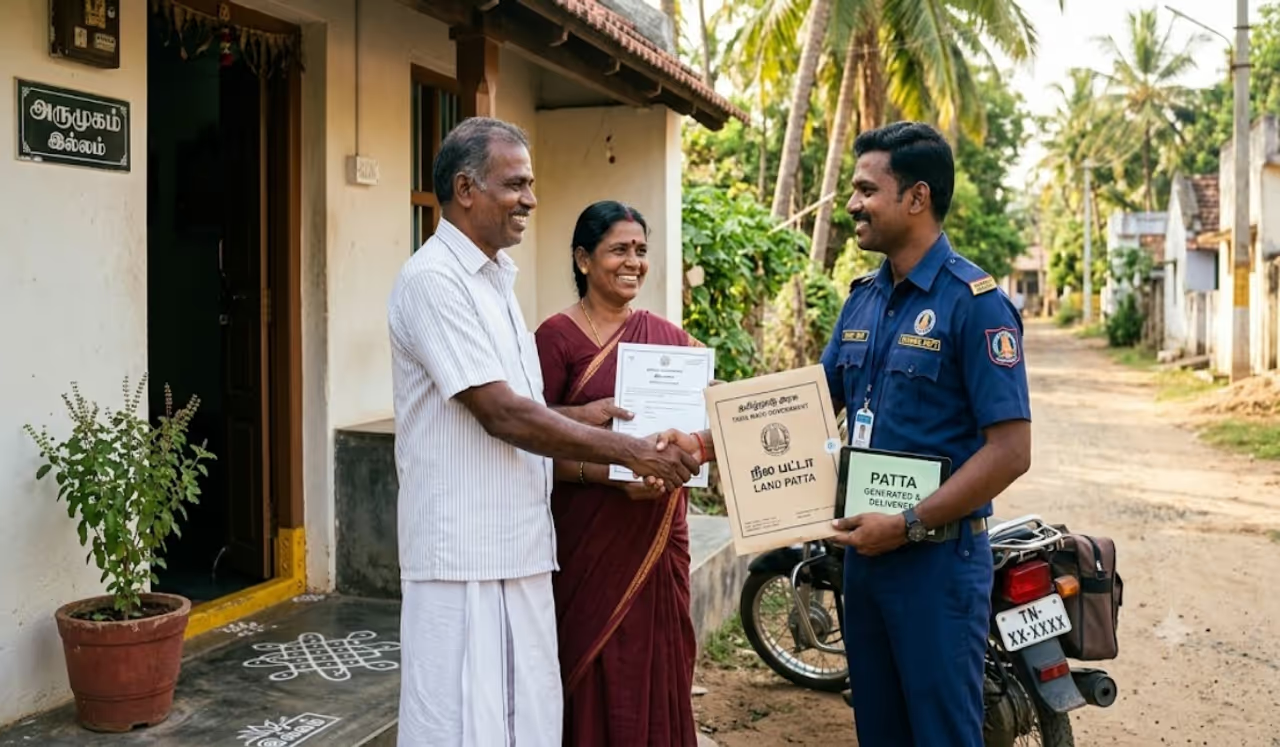
Vijay Govt: நிலம் வாங்கப் போறவங்களுக்கு ஜாக்பாட்! இனி பட்டா தேடி வரும்! தமிழக அரசு குட்நியூஸ்!

Vijay Govt: நிலம் வாங்கப் போறவங்களுக்கு ஜாக்பாட்! இனி பட்டா தேடி வரும்! தமிழக அரசு குட்நியூஸ்! Vijay Govt: நிலம் வாங்கப் போறவங்களுக்கு தமிழக...