Tuesday, February 5, 2019

CBI can question Kolkata police chief Rajeev Kumar, can’t arrest him, orders Supreme Court; Mamata says victory 

West Bengal chief minister Mamata Banerjee said the court verdict is a “moral victory”. “Rajeev Kumar never said I will not be available. They (CBI) came to arrest. The court said no arrest,” Mamata said. india Updated: Feb 05, 2019 13:07 IST

Bhadra Sinha
New Delhi, HT Correspondent

Kolkata police commissioner Rajeev Kumar with Mamata Banerjee during the police award ceremony at the dharna site in Esplanade, Kolkata, on Monday.


 (Photo by Arijit Sen/Hindustan Times)(Arijit Sen/HT Photo)

The Supreme Court on Tuesday ordered Kolkata police commissioner Rajeev Kumar to cooperate with the CBI in the Saradha chit fund case. The court though made it clear that no coercive steps, including arrest, can be taken against him.

“We direct the chief secretary of the state and the DGP to file their replies on or before February 18,” a bench led by Chief Justice of India Ranjan Gogoi said on Tuesday. (Follow live updates here)

Also watch: SC tells Kolkata’s top cop to cooperate, Mamata calls decision ‘moral victory’

West Bengal chief minister Mamata Banerjee, who is sitting on a dharna against CBI’s attempts to question Rajeev Kumar, said the court verdict is a “moral victory”. “Rajeev Kumar never said I will not be available. They (CBI) came to arrest. The court said no arrest,” she said. The Mamata Banerjee government has been involved in showdown with the Centre after the CBI came to the Kolkata police chief’s doors on Sunday night to question him.

The Supreme Court said Kumar should appear at a neutral place—Shillong. The court said it may seek personal presence of the police officers after it considers the response files by the chief secretary and DGP. If presence is required then they would be intimated by February 19.

Attorney General KK Venugopal, who appeared for the CBI, said the unprecedented events in West Bengal showed there was complete breakdown of the constitutional machinery.

The CBI moved the court seeking directions to Rajeev Kumar to cooperate with the investigation in the Saradha chit fund case. The CBI had raised suspicions that the Kolkata top cop was destroying evidence in the chit fund case.

On Sunday night, a CBI team was detained by Kolkata police in an unprecedented chain of events that also witnessed chief minister Mamata Banerjee rushing to Kumar’s residence. The CBI officers were taken to Shakespeare Sarani police station and released later under instruction from Mamata Banerjee.

HC quashes GO mandating 50% minorities in minority institutions

TNN | Jan 31, 2019, 06.29 AM IST


CHENNAI: The Madras high court on Wednesday quashed a government order that said minority educational institutions should admit not less than 50% of students belonging to the community concerned every year to retain the status.

The order dated April 5, 2018, had brought in the additional guideline for grant of minority status to educational institutions.

Allowing the plea moved by the Institute of the Franciscan Missionaries of Mary, Justice T Raja said the state government did not have the power to pass such orders under the National Commission for Minority Educational Institutions Act, 2004.

The petitioner had argued that the government order suffered from executive malafide as it sought indirectly to deny minority status to educational institutions established and administered by minority communities by imposing a burdensome and impractical condition, modifying the principles that have stood the test of time.

In the absence of any complaint from a minority community that its students had been denied admission in an institution run by it, there was no basis for the government order, the petitioner said.

‘Common rule won’t work as TN has 6.1% Christians’

There cannot be a common rule throughout the state to admit a minimum of 50% minority students in such institutions as a condition for minority status, while the Christian population was only 6.1% in the state, the petitioner said.

The Supreme Court has time and again held that the minority institutions gain minority character because they were established and administered by the minority community and not because of the number of minority students admitted therein. If the minority status was linked to the ratio of admission of minority students it will be fluctuating in minority character/status, each year. There will never be a certainty in the nature of the institution. That was not the intention of the founding fathers of the Constitution and therefore, the judgment of the apex court cannot be misinterpreted by the executive authorities, the petitioner argued.
Madras HC quashes Tamil Nadu govt order forcing minority institutions to admit 50% students from community, says state has no such power

India Press Trust of India Jan 31, 2019 00:01:37 IST
 
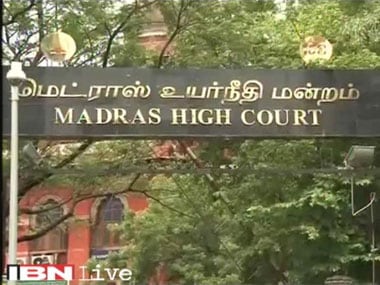
Chennai: The Madras High Court Wednesday quashed a government order mandating minority educational institutions to admit not less than 50 percent of students belonging to the community every year to retain their minority status. 


File image of Madras High Court. News 18

The state government does not have the power to pass such order in connection with minority status of educational institutions under the National Commission for Minority Educational Institutions Act, Justice T Raja held.

He was allowing a petition by the Institute of the Franciscan Missionaries of Mary seeking to quash last year's 5 April government order.

The petitioner contended that the government order imposed a burdensome and impractical condition, modifying the principles that have stood the test of time.

It suffered from executive mala-fide to indirectly deprive the minority status to the educational institutions established and administered by the minority community, the petitioner submitted.

There cannot be a common rule throughout the state to admit a minimum of 50 per cent minority students in the state, as the condition precedent for minority status, while the Christian population was only 6.1 percent in the demography of the state, it was contended.

Postgraduate medicos in a fix 
Shyama Rajagopal 
 
KOCHI, January 22, 2019 08:07 IST


Ernakulam medical college yet to get MCI recognition for some PG courses

Two batches of postgraduate doctors passed out from Government Medical College, Ernakulam, are finding it difficult to register with the Travancore Cochin Medical Council owing to lack of recognition of PG courses offered by the college.

A student from one of the PG departments of the college has approached the High Court alleging failure of the government in complying with the Medical Council of India (MCI) directives on conducting medical courses. Without registering their PG degree with the Travancore Cochin Medical Council, the doctors cannot practice or pursue further studies in the State.

A total of 11 students in five disciplines are taken in every year in the medical college for the PG courses that began in 2014. The first and the second batches of students had taken the final examinations in 2017 and 2018, but they continue to work with their graduate degrees. While a few from the first batch have joined the Health Services as graduate doctors, those in the second batch are executing the one-year bond with the government after passing out.

The MCI had pointed out various lacunae in each of the five disciplines of Medicine, Psychiatry, Paediatrics, Pathology and Microbiology at the time of the final examination held for the courses. The government had given an undertaking about providing required facilities at the college on the basis of which the examinations were held. However, it had filed no compliance report after the MCI inspected the college during the PG examinations in the disciplines last year.

Lack of MRI scanning machine, absence of superspecialty disciplines, lack of adequate faculty and other staff were cited by the MCI inspectors for denying recognition for the courses.
Compliance letter

Speaking to The Hindu, Director of Medical Education Ramla Beevi said that with the cardiology department functioning in full swing and the nephrology department having a dialysis wing now, the government could now send a report to the MCI. The government’s intent on setting up superspecialty departments was also evident since the work on building a superspecialty block had begun, she pointed out.

A compliance letter would be sent in a couple of months before fixing the examinations schedule for the next PG batch, she said.
KMC shuts door on RTI; doctors, activists worried

TNN | Jan 6, 2019, 08.05 AM IST


B

ENGALURU: The Karnataka Medical Council (KMC) has announced that it does not fall under the purview of the Right To Information Act, 2005 and will not accept any queries under the law.
The council registrar has, in a notification, explained that an examination of the audited financial statements revealed the KMC had not obtained financial assistance of “considerable quantum” and hence it is not a public authority, according to the RTI Act.

Upholding the KMC contention, the Karnataka Information Commission (KIC) too had earlier in October 2018 disposed of an appeal, saying the KMC is not a public authority. TOI has copies of the public notification issued by KMC and the KIC order exempting it from the purview of RTI.

The KMC stand has come as a shocker for the medical community, which is planning to appeal further.

Dr Manu Ayan, an emergency medicine specialist from Kerala, had filed an RTI, seeking information about the number of registered emergency medicine practitioners in Karnataka. “I was baffled when I saw the KMC’s response rejecting my application. It’s not so in any other state,” said Dr Manu.

“In a way, the medical council is stating that it’s not accountable to anyone and nobody can question it,” said Dr Sylvia Karpagam, a public health expert. “Who are they answerable to then? The state government diluted the Karnataka Private Medical Establishment (KPME) amendments, stating that the KMC exists. And now the KMC, which is neither accountable to patients, says it is not accountable to the public as it’s above RTI,” she said.

RTI activists too are aghast over the KIC order. “KIC’s interference is unwarranted. This is unacceptable,” said Vikram Simha, RTI activist from Kriya Katte. He pointed out that the KMC draws its powers from a law framed by the state.

Incidentally, the KMC is the state chapter of the Medical Council of India, which is covered under RTI.
Three docs sentenced to over two years in jail for medical negligence 

Ashok Kumar 

 
GURUGRAM, February 04, 2019 01:27 IST


In 2011, a teen had succumbed to injuries after no one in hospital attended to him

A local court in Haryana’s Jhajjar has sentenced three doctors of a private hospital to imprisonment of two years and six months each in a case pertaining to the death of a teenager in Bahadurgarh eight years ago for medical negligence.

Each of the accused has been sentenced to a two-year jail term for causing death due to negligence and two terms of three months each on charges of act endangering life, and breach of contract to attend on helpless person, but the sentences will run concurrently.

Rahul, a resident of Chhotu Ram Nagar in Bahadurgarh, was going to attend a computer class on January 21, 2011. He was walking along a railway track, when he fell on the stones due to the air pressure created by a fast-approaching train and sustained serious head injuries. He was rushed to Jeevan Jyoti Hospital where he was allegedly not attended to for hours and ultimately he succumbed to the injuries.
Gross negligence

In a 19-page judgment, holding doctors Deepak Sharma, Ritesh Kumar and Manish Pal responsible for the death of the Class X student, Judicial Magistrate (First Class) Vivek Kumar relied on the inquiry report of the medical board constituted under the chairmanship of N.K. Mundra, the then Deputy Civil Surgeon.

Saying that the prosecution had successfully proved the guilt of the accused beyond “shadow of reasonable doubt”, the court noted that Rahul had suffered skull fracture and multiple rib fractures, and a CT scan was was necessary for further medical aid.

The medical board found that no such tests were conducted on the injured since these facilities were not available at the hospital.

Quoting the medical board’s report, the court said: “This patient should have been referred to higher institute after the initial management.”

The court noted: “The accused did not exercise due care and caution as they could have transferred Rahul to the trauma centre at a government hospital, Bahadurgarh... but the accused were indifferent to the patient’s safety and thus committed gross negligence.”

The court also rejected the contention of the defence regarding a five-month delay in registration of the FIR, saying that it was not “tenable” in the present case. “This court is practical enough to understand that in a country like ours, it is quite difficult for a common man to get an FIR registered against a hospital for committing an act of gross negligence as the police are also reluctant to register the FIR,” the order stated.

The court, however, said the prosecution had failed to prove the charge of criminal conspiracy against the accused.

Medical dialogues Feb 2019

Read more at Education Medical Dialogues: Fate of GMC Ernakulam MD Students hangs in Balance as State Medical Council refuses to recognise their degrees 

https://education.medicaldialogues.in/fate-of-gmc-ernakulam-md-students-hang-in-balance-as-state-medical-council-refuses-to-recognise-their-degrees/

NEWS TODAY 24.05.2026