Tuesday, October 1, 2019

31 புதிய மருத்துவ கல்லூரிகளில் தமிழகத்துக்கு 6!

Updated : அக் 01, 2019 00:13 | Added : அக் 01, 2019 00:04

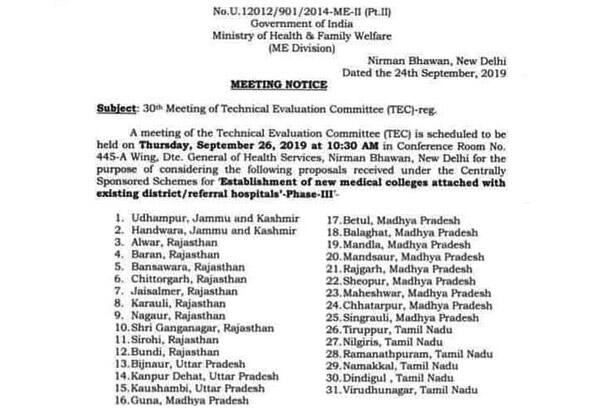
புதுடில்லி: நாடு முழுவதிலும் புதிதாக துவங்க இருக்கும் 31 புதிய அரசு மருத்துவ கல்லூரிகளில் தமிழ்நாட்டிற்கு 6 கல்லூரிகள் ஒதுக்கப்பட்டுள்ளன.

இதுகுறித்து சுகாதார மற்றும் குடும்ப நல அமைச்சகம் வெளியிட்டுள்ள அறிக்கையில், டில்லியில் செப்.,26ல் நடந்த தொழில்நுட்ப மதிப்பீட்டுக் குழு கூட்டம் நடந்தது; கூட்டத்தில் நாடு முழுவதும் புதிதாக துவங்க உள்ள 31 மருத்துவ கல்லூரிகளின் பட்டியல் முடிவு செய்யப்பட்டது என தெரிவிக்கப்பட்டுள்ளது. இதில் தமிழகத்திற்கு மட்டும், 6 கல்லூரிகள் ஒதுக்கப்பட்டுள்ளன.

அதிகபட்சமாக ராஜஸ்தான் மற்றும் ம.பி., மாநிலத்தில் தலா 10 கல்லூரிகள் அமைய உள்ளன. தமிழகத்தில் 6, காஷ்மீரில் 2, உ.பி.,யில் 3 என மொத்தம் 31 புதிய மருத்துவ கல்லூரிகள் திறக்கப்படும் என அறிக்கையில் குறிப்பிடப்பட்டுள்ளது.


எங்கெங்கு:

தமிழகத்தில் திருப்பூர், நீலகிரி, ராமநாதபுரம், நாமக்கல், திண்டுக்கல் மற்றும் விருதுநகர் மாவட்டங்களில் புதிய மருத்துவ கல்லூரிகள் அமைய உள்ளன.

முதுமை காலத்தில் பெற்றோரை தவிக்கவிட்டால் 6 மாதம் சிறை

Updated : அக் 01, 2019 06:38 | Added : அக் 01, 2019 06:28 

புதுடில்லி: முதுமை காலத்தில் பெற்றோரை கைவிடும் பிள்ளைகளுக்கு, 6 மாதம் சிறைதண்டனை விதிக்கும் வகையில் மத்திய அரசு சட்டதிருத்தம் கொண்டு வர உள்ளது.


குழந்தைகளாக இருக்கும் போது தங்களை கஷ்டப்பட்டு ஆளாக்கிய பெற்றோர்களை வயதான காலத்தில் காக்க வேண்டிய கடமை ஒவ்வொரு பிள்ளைக்கும் இருக்கிறது. ஆனால் நன்றியுணர்வும் மனசாட்சியும் இல்லாத ஒரு சிலர் தங்கள் பெற்றோர்களை வயதான காலத்தில் தவிக்க விட்டு விடுகின்றனர்.

ஆயிரம் கனவுகளுடன் வளர்த்த பிள்ளைகள் கைவிடும் போது தாங்க முடியாத மனஉளைச்சலுக்கும் வேதனைக்கும் பெற்றோர் ஆளாகின்றனர். ஒரு சிலர் தவறான முடிவுகளை எடுத்து விடுகின்றனர்

இந்நிலையில் இது தொடர்பாக நடவடிக்கை எடுக்க பிரதமர் அலுவலகம் முடிவு செய்து சமூக நலம் மற்றும் அதிகாரம் வழங்கல் துறை அமைச்சகத்துக்கு அறிவுறுத்தியது. அதன்படி நடைமுறைக்குட்பட்ட, பெற்றோர் மற்றும் மூத்த குடிமக்கள் பராமரிப்பு நலச்சட்டம் 2007 ல் திருத்தம் கொண்டுவருவதற்கான சட்டவரைவை தயாரித்துள்ளது.

தற்போது நடைமுறையில் உள்ள சட்டத்தின்படி வயதான பெற்றோர்களை கவனிக்காமல் தவிக்க விடும் பிள்ளைகளுக்கு 3 மாதம் சிறை தண்டனை கிடைக்கும்.


இந்த தண்டனை காலத்தை 3 மாதத்திலிருந்து 6 மாத காலமாக அதிகரிக்க புதிய வரைவில் வழிவகை செய்யப்பட்டுள்ளது. தற்போது மகன்கள், மகள்கள், பேரக்குழந்தைகள் மட்டுமே சட்டவரம்புக்குள் வரும் நிலையில் புதிய சட்டவரைவின்படி, தத்து குழந்தைகள், மருமகன்கள், மருமகள்கள், பேரக்குழந்தைகள் ஆகியோரும் சட்ட வரம்புக்குள் வர வழிவகை செய்யப்பட்டுள்ளது.

தற்போதைய சட்டத்தின் படி பெற்றோருக்கு பராமரிப்பு தொகையாக ரூ 10,000 வரை வழங்கலாம். இந்த வரம்பும் நீக்கப்பட்டு பிள்ளைகள் அதிகம் சம்பாதிக்கும் பட்சத்தில் பெற்றோருக்கு கூடுதல் தொகையை பராமரிப்பு செலவுக்கு தரவும் சட்டத்தில் திருத்தம் ஏற்பாடு செய்யப்பட்டுள்ளது.
Workplace Not Darkplace

Employers should eliminate the stigma around discussing mental health at work

Jeffrey Pfeffer & M Muneer  -1.10.2019

Last year, an email sent by an employee to her colleagues went viral in social media. She just wrote she needed a break to focus on her mental health. The reason it went viral was her CEO’s reply: “I just wanted to personally thank you for sending emails like this… You are an example to us all.”

But such a response is all too often the exception. More frequently, depression and stress are ignored or stigmatised, not treated as the real illnesses – threats to physical and psychological health and productivity – that they are.

Mental health problems and associated costs are a worldwide issue. But a 2017 WHO report finds that 18% of global depression cases emanate from India. About 57 million people! A 2016 survey of 200,000 professionals in India found that 46% reported suffering extreme stress as a consequence of their work. An Assocham study shows 43% of private sector employees in India are afflicted with mental health issues at work. Adjusted for population size, India ranks first in the incidence of mental disorders, and low- and middle-income countries tend to have the highest incidence.

The cost burden of mental problems is enormous. Depression shows much comorbidity with other diseases, and research indicates that depression leads to other health problems including cardiovascular disease and diabetes. A systematic review of studies of workrelated stress estimated costs to be as high as $1 trillion per year, with the majority of the expense coming from lost productivity, not direct health costs. We believe that learning and talking about mental health issues at work is a necessary first step to improving mental health in the workplace, and by extension, curbing the enormous costs they create.

Typical symptoms of depression amongst working professionals include mood-swings, anxiety, agitation and apathy; insomnia; difficulty in waking up in the morning; lethargy and drowsiness, lack of interest in daily affairs; over-eating, or conversely, loss of appetite, unexplained aches and pains in the body; and increased consumption of alcohol, tobacco.

As clinical depression has risen by around 50% in the last eight years, there has been an increase in other ailments including obesity, diabetes, hypertension and cardiac disorders. Major depression increases absenteeism, ‘presenteeism’ (reduced productivity) and has direct medical costs.

Employers should build cultures of physical and mental health in their workplaces through management practices that promote wellbeing. In order to get to a place where managers and employees understand the implications of mental health at work, enterprises should stop treating it as something distinct (and less important) than other forms of illness. They should provide comprehensive mental health coverage as part of their medical benefits, all while working to reduce the stigma.

Yet, in India, till a few months ago, mental illness has always been in the list of exclusions of health insurance policies. The Indian Mental Healthcare Act came into effect only in 2017, which prompted Irda to mandate insurers to offer this as part of the normal health policy in 2018. In contrast, the US had passed a mental health parity law mandating equal medical coverage for mental and physical illness way back in 2008, but big differences in coverage and access remain. One study found that behavioural care was between “4-6 times more likely to be out-of-network than medical or surgical care”, and insurers paid primary care providers 20% more for the same types of care than they paid addiction or mental health specialists.

An important first step is reducing the stigma associated with admitting any sort of mental distress. One board member said that he would vote out a CEO if he admitted to mental illness. An article about depression in the technology industry noted that admitting to depression could harm company perception and would put funding at risk. A second step entails recognising mental problems as “real” diseases like cancer or heart disease. Neuroimaging studies show changes in the physiology of the brain diagnosed with depression.

Ultimately, the best way companies can eliminate the stigma around mental health at work is to just start talking about it. EY, for example, launched a programme called We Care with the goal of educating employees about mental health issues and encouraging them to seek help. The programme is also centred on support for colleagues who may be struggling with it. Many companies are proactively tying up with an external partner to offer Employee Assistance Programmes. Some organisations are training managers regularly to spot symptoms and offer assistance early. And once the lines of communication are open, HR departments can (and should) consider offering benefits that provide more accessible mental healthcare.

Indian organisations can lead on this front by encouraging employees to get trained regularly, giving them frequent breaks, having stress buster sessions, urging them to break large assignments into smaller ones, and ensuring proper work-life balance. That’s probably easier said than done!

Mental illness is enormously costly, yet research advances make the effective treatment of disorders such as anxiety and depression much more possible. Recent research in psychology identified six specific neuro-imaged forms of depression. When treatment was matched to the specific manifestation of the disease – precision medicine applied to mental health – the effectiveness of treatment was substantially enhanced.

For reasons both economic and humane, employers should work to destigmatise mental disorders, increase insurance coverage of treatments and ensure that care uses the best, most recent available evidence.

Jeffrey Pfeffer is a professor at Stanford Graduate School of Business, M Muneer is co-founder of Medici Institute Foundation


They should provide comprehensive mental health coverage as part of their medical benefits. Stop treating it as something distinct (and less important) than other forms of illness
UP’s Munnabhai who performed ‘thousands of surgeries’ arrested

Was Working At A Local Hosp As Surgeon For Past 10 Years


Sandeep.Rai@timesgroup.com

Meerut:01.10.2019

Munnabhai MBBS met Ranchoddas Shyamaldas Chanchad of 3 Idiots in UP’s Deoband when police on Monday arrested one Om Pal for fraudulently working at a local CHC as surgeon for the past 10 years by impersonating Dr Rajesh R, who was the real degree holder from Mysore. He was also running a nursing home at the town in Saharanpur district.

According to Saharanpur SP (rural) Vidyasagar Mishra, Om Pal, 50, claimed that he had conducted thousands of ‘operations’ during his free run. He was appointed on contract in the CHC by forging MBBS degree of a Mysore University’s alumnus. His true identity was revealed when he went to police to lodge a complaint after getting an extortion call.

Mishra says that Om Pal worked in early 2000s as a paramedic at the air force base hospital in Mangalore and still gets pension. “A doctor named Rajesh R was working with him in Mangalore. Before Dr Rajesh R moved abroad, Om Pal got his MBBS degree ‘cloned’ after fixing his own photograph.”

He used this fake degree to get himself registered as a medical practitioner in UP. “On the basis of this degree, he not only got a surgeon’s job at Deoband CHC, but also get himself several certificates and diplomas for surgery — two of them from the US,” the SP (rural) said.

On papers he was Dr Rajesh R, but in prescriptions and hoardings he used ‘Dr Rajesh Sharma’, so that the unusual name doesn’t arouse any suspicion at a small place like Deoband, SP Mishra said. His dream run, however, came to an end when he himself went to seek police’s help after getting an extortion call.

The caller was trying to blackmail him by demanding ₹40 lakh for remaining quiet about Om Pal’s real identity. “But, Om Pal — who was a well-known figure in Deoband — was so confident about his infallibility that he refused to budge and informed police,” says a cop who was part of the probe.

“Interestingly, an inquiry regarding his degrees was conducted by the health department a couple of months ago, but since he showed certificate of his registration with the Medical Council of Karnataka and UP, it was assumed that his credentials were genuine,” Mishra says.

However, when our investigation team probing the extortion case went to Bengaluru to ascertain the authenticity of his medical degree and registration with the council, his real identity came out,” he says, adding “The registration number he claimed was his own belonged to one Rajesh R who was registered with Karnataka Medical Council and had obtained his degree from a medical college in Mysore in 2001. Om Pal even held a certificate of Diplomate of the National Board (DNB) in General Surgery whose registration number was not found in UP Medical Council though claimed in the certificate.”

Om Pal alias Dr Rajesh Sharma was arrested on Monday morning.


FREE RUN: Saharanpur policemen with fake surgeon Om Pal who was working as a doctor for a decade and also running a private nursing home

According to Saharanpur SP (rural) Vidyasagar Mishra , Om Pal’s true identity was revealed when he went to police to lodge a complaint after getting an extortion call
Govt identifies land for medical college in Ooty

Shantha.Thiagarajan@timesgroup.com

Udhagamandalam:01.10.2019

The Nilgiris district administration has submitted a detailed report on the existing government headquarters hospital in Ooty and availability of land to set up a new medical college in the district at the Technical Evaluation Committee (TEC) meeting held last Thursday in New Delhi.

The TEC met to consider proposals received under centrally sponsored schemes for establishment of new medical colleges under phase III.

The centrally sponsored scheme works with a ratio of 60:40 — the Centre bearing 60% of the total cost and the state paying the remainder.

As per the norms of Medical Council of India (MCI), at least 20 acres should be available for a medical college to come up, with a minimum capacity of 300 beds for inpatients. While the existing government hospital in Ooty has about 7.61 acres of land, the district administration has identified a plot of 13.61 acres at Indu Nagar in Ooty.

The district administration has been trying to get nod to set up a medical college in the Nilgiris for the past two years.

Last June, a meeting was held by the directorate of health services in Chennai, at which Nilgiris district has been identified as one of six districts for submission of proposal for a centrally sponsored medical college. The other districts were Dindigul, Tirupur, Ramanathapuram, Namakkal and Virudhunagar.

The Nilgiris district is home to about 7.35 lakh people (2011 census) and despite being a major tourist destination lacks a multi-specialty hospital. The nearest multi-specialty hospitals are in Coimbatore, 85km from Ooty, with a travel time of three to four hours.

Dr H Ravi Kumar, joint director of Ooty Government Headquarters Hospital told TOI, “A proposal for a medical college in Ooty has already been sent to the state government. The same has been forwarded to the state finance commission and the Central finance commission. A plot in Indu Nagar of 13.61 acres has been identified by the district administration. With these, the norms of MCI (Medical Council of India) are satisfied.”

The Ooty GH does not have special medical facilities and to treat emergency patients within the “golden hour” a medical college in the hill town is a must, said Dr H Ravi Kumar, joint director of Ooty GH
Brindavan Exp turns 55, but charm long lost

TIMES NEWS NETWORK 01.10.2019

If there is one thing old timers and regular end-to-end travellers of the Chennai-Bengaluru Brindavan Express would love to bring back, it would be its lost glory. What began as a service for end-to-end passengers, especially tourists, on October 1, 1964, they feel, has lost it sheen and purpose and only fond memories remain.

Named after Brindavan Gardens in Mysuru (then Mysore), it provided perfect connectivity till Karnataka capital Bengaluru (Bangalore), the gateway for nearly 30 places of tourist interest in that state.

Initially, a steam locomotive hauled eight conventional coaches and took 7.30 hours to Bangalore. In April 1966, a diesel van replaced the steam engine, reducing the running time to 5.30 hours. With halts at Katpadi, Jolarpettai and Bangalore Cantonment, it was the fastest broad gauge (BG) train.

The tremendous response affected bus services between the two cities. It was a favourite for regulars to Bangalore for its punctuality, cleanliness and for allowing only reserved passengers.

It had a completely vestibule rake and a highlight was the food in the pantry car (it was once ranked among the top five in the railways) served in the coaches. It also had a counter for those who preferred going there.

Over time, it began losing its charm with the running time changed to six hours, several halts introduced, and punctuality hardly adhered to. In 2014, the railways discarded the three AC chair car coaches, following the introduction of the Double Decker AC train and a few years later, it removed the pantry car. Recently, the timings were revised with a delay of 15 minutes, before, thanks to the efforts of rail users in Bengaluru, the previous schedule was restored.

Ashok Kumar Verma, divisional railway manager, Bengaluru railway division doesn’t agree its popularity has dipped after introduction of the double-decker train. “We are happy the service continuous to be popular among passengers and are working hard to ensure punctuality of the train,” he said.

(Inputs from Christin Mathew Philip)

Pandian Express: Keeping time & pace for 50 years

Looking Back At The Journey Of The Flagship Train of Madurai Division
Francis.T@timesgroup.com  01.10.2019

Undisputed King of Southern Railway or Honeymoon Express — sobriquets of the Pandian Express, the flagship train of Madurai railway division, are a testimony of the passion and emotional bonding passengers have towards the train that completes 50 years of its journey between the temple city of Madurai and the state capital Chennai on Tuesday.

Inaugurated on October 1, 1969, Pandian Express — named after the Pandya Kingdom, the first train in Indian Railways to be named after a kingdom — marked the beginning of a new chapter in the history of Southern Railway, as the need for a faster overnight connectivity between the two cities was fulfilled by the Madurai division. Led by twin steam locomotives, to haul an 18-coach rake, the train announced its departure from the Madurai Junction with the symbolic steam whistle and thick smoke amid cheers from several hundreds gathered to see it off.

D Paul David Sam, the second fireman during the inaugural run recalls the frenzy around the maiden journey, “Several people came to the railway station to see the new train with two engines. The platform was filled with people and wore a festive look. It used to be a tough job considering the smoke and ash coming from the engines. Even the wooden coaches were filled with smoke, but the passengers cherished the smell and ash. By the time we reached Trichy, our clothes would get dirty.”

It was for this debut that the Integral Coach Factory (ICF), for first time in the history of metre gauge (MG), manufactured new rakes for the purpose with a unique bottle green livery with two vermilion bands above and below the windows. During its initial days it had two first class, eight sleeper, one mail van, five unreserved and two SLR coaches. “The rakes had much bigger fans with shutter windows, all newly-introduced features. Since the coach capacity was too high, Southern Railway operated the train with double steam locomotives from Madurai to Villupuram and from thereon, with a single electric locomotive,” says Arun Pandian, a railfan.

With a maximum speed of 75kmph, the train 117/118, used to be the fastest in the MG traction, covering 495km in 11 hours and 10 minutes. For the newly-married heading to Kodaikanal, the Pandian Express used to be the go-to train due to its timings and fewer halts, with many travelling in the comforts of first class. And thus train earned the nickname ‘Honeymoon Express’.

For Maduraiites taking the train was like a homecoming. “Pandianla varen (I’m coming by Pandian),” is one way of bringing joy to Maduraiites. “From the days of cushionless seats to now, lots of memories are associated with the train. My family’s first outing on this train was in the first class coupe. It was a joyride for everyone. On other occasions, dinner with family on board the train was a routine amid peals of laughter and the nonstop chatter,” recalls Mariappan, a resident of Madurai. The train was known for its punctuality, so much so that it was preferred by the likes of M G Ramachandran and M Karunanidhi, says Arun Pandian.

In 1975, the train gave way to steam engines and a diesel locomotive was used. In 1985, two three-tier AC, one first AC and one second AC coaches were added to the rake, thus making it the first MG train to run with all existing classes of Indian Railways. The MG era of Pandian Express came to an end in March 1998 due to gauge conversion and it was during the summer that the new broad gauge era began with the same timings. From October 1, 2002 it was converted into a superfast express and the running time was reduced to nine hours. Gradually, more coaches were added due to increased demand on the Madras-Madurai section. Considering the demand, railways converted the rakes to Linke Hofmann Busch and at present, it takes 7 hours and 50 minutes to reach Madurai, while the return journey takes while it takes 8 hours and 10 minutes.

As Pandian Express completes 50 years, passengers hope its legacy of punctuality will be etched in the annals of Indian railway history.


SC orders all-India audit of pvt & deemed universities Focus On Structural Opacity & Examining Role Of Regulatory Bodies

SC orders all-India audit of pvt & deemed universities Focus On Structural Opacity & Examining Role Of Regulatory Bodies   Manash.Go...