Wednesday, October 7, 2026

Pressure to perform weighs on medical students, 77% of those surveyed stressed

Pressure to perform weighs on medical students, 77% of those surveyed stressed 

Anuja.Jaiswal@timesofindia.com 07.10.2026

New Delhi: The pressure to perform, fear of poor marks and the worry about not being able to answer teachers weigh heavily on the minds of medical students, 77% of whom have shown moderate to high stress in a New Delhi study. The study comes amid growing regulatory focus on student well-being. 

In Aug, the National Medical Commission (NMC) directed medical colleges to comply with Supreme Court directions on reporting student suicides and unnatural deaths and maintain updated institutional records. Published in the Indian Heart Journal, the study assessed 406 MBBS students across all four years at a govt medical college in New Delhi. 


Of them, 54.43% reported moderate stress and 22.66% high stress. The research involved teams from GB Pant Institute of Postgraduate Medical Education and Research, Maulana Azad Medical College and IIIT-Delhi. “What was revealing was that more than three-fourths of the students had moderate-to-high stress. Asking a student whether they are stressed is not enough. We need to systematically assess stress and build strategies into medical education to help students deal with it,” said Dr Mohit Gupta, lead author of the study. 

He added that a more inclusive, practical and balanced curriculum, with scope for recreation, could help reduce academic stress. The pressure to do well was the biggest source of stress. Students also reported worrying about not being able to answer teachers’ questions, poor marks and the vast coursework. Many said they felt their efforts were not recognised or that they were not good enough. The findings also echo recommendations of NMC’s national task force on mental health and well-being of medical students, which called for accessible counselling, crisis intervention, mental-health services and greater institutional support. 

“We need to make our students intellectually strong, but we also need to make them emotionally stable. Our education system cannot focus only on academic achievement. We also need to create an environment where students can seek help, manage stress and remain emotionally resilient,” Gupta said. 

Second-year students had the highest proportion of high stress, at 30.11%, though researchers said this could reflect differences between batches. Overall, heart-rate variability (HRV) did not differ significantly between students with mild, moderate and high stress. Final-year students had 29.1% lower RMSSD, an HRV measure, than second-year students after adjustment, but the pattern was inconsistent across years and does not show progressive changes in cardiac autonomic function. 

The researchers said regular monitoring of student stress and structured institutional support are needed, particularly around academic and teaching-learning pressures. They also called for longer-term studies to understand how stress and cardiac autonomic measures change during medical education. The study was conducted between May and Nov 2025 among students aged 18-25 years. As a single-centre, cross-sectional study, it cannot establish causation or represent all medical students in India.

Tuesday, October 6, 2026

Employee faked sick leave for a Coorg trip, then manager sent the viral reel with five awkward words


Employee faked sick leave for a Coorg trip, then manager sent the viral reel with five awkward words

etimes.in | Oct 1, 2026, 11.06 AM IST


A sick day can sometimes become the most complicated day off, especially when social media decides to join the story.

A Reddit user on r/antiLinkedIn shared how a planned Friday trip to Coorg turned into an awkward workplace episode. The employee claimed to have stomach flu while actually heading out for a holiday. The plan might have worked, except a holiday reel accidentally put the employee in the frame.

The sick leave excuse had one small problemAccording to the Reddit post, the employee took Friday off to travel to Coorg and told the manager that they had stomach flu.

There was no mention of the trip to the workplace. Instead, the employee went to a homestay and apparently ended up appearing in the background of a video featuring people dancing.

The unexpected part came later. The video reportedly took off on Instagram and crossed 13,000 likes.

That made a private holiday much less private.

Monday brought an awkward messageWhen the employee returned to work on Monday, the situation apparently became clear.

The Reddit user said their skip-level manager sent them the reel and wrote: “Hope your stomach is better.”

It was a short message, but the meaning was difficult to miss.

The employee said they were still employed after the incident, but claimed that their subsequent WFH requests were no longer being approved because the manager had lost trust in them.

The internet found the story painfully familiarThe post quickly attracted amused reactions from other Reddit users. Some laughed at the timing, while others pointed out the obvious risk of using a false excuse when social media can expose plans unexpectedly.
One commenter summed up the lesson bluntly: “Lies are short lived.”

Another joked about deleting Instagram altogether.

The original poster also appeared surprised by how quickly the story travelled, replying that they had not expected the reel to go viral.

A holiday can stay private, but a viral reel cannotThe interesting part of this story is not really the Coorg trip. Taking a day off is normal. The trouble came from giving a reason that did not match what happened.

A holiday photo shared with friends can remain buried in someone's feed. A reel that suddenly reaches thousands of people is a different matter.

And once a workplace connection sees it, explaining the coincidence can become harder than simply asking for a day off.

Social media has changed the old workplace ruleEarlier, an excuse given to a manager usually stayed between a few people. Today, a single tagged post can travel far beyond its original audience.

This Reddit story is a humorous example, not evidence that every workplace handles leave or WFH in the same way. Still, it captures an increasingly familiar workplace reality: online posts can sometimes reveal more than their creators intended

Disclaimer: This article is based on a Reddit post and comments shared by users. The claims and workplace circumstances described in the post have not been independently verified.

NEWS TODAY 06.10.2026


EXCLUSIVE: NMC not in favour of ‘one nation, one stipend’ for medical interns, but states can fix amount


EXCLUSIVE: NMC not in favour of ‘one nation, one stipend’ for medical interns, but states can fix amount

Proposal pending with NMC seeks to examine stipend parity, non-payment for UG MBBS interns across govt and private medical colleges.


05 October, 2026 08:30 am IST


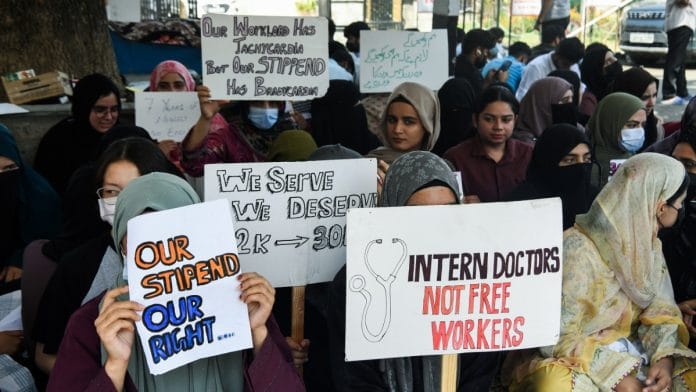
Intern doctors hold placards during a protest to demand an increase in their monthly internship stipend, at GMC Srinagar on 8 September, 2026 | ANI

New Delhi: There cannot be a fixed pan India stipend amount for medical interns, but states can explore fixing a stipend amount, made uniformly applicable to all medical colleges in that state, a senior National Medical Commission (NMC) official told ThePrint, adding that the state policy will be subject to interpretation of the statutes and various judgments passed by the courts from time to time.

The proposal, pending with the NMC since December 2025, seeks to examine stipend parity and non-payment of stipends for undergraduate MBBS interns across government and private medical colleges.

Separately, resident doctors’ bodies and medical care activists have demanded a uniform minimum stipend across states and institutions under the broader “One Nation, One Stipend” campaign.

On the demand for nationwide stipend parity, the NMC official said, “One stipend cannot be given across the country. That is difficult because smaller states, whose financial allocations are lower, cannot give such a big stipend. The stipend amount has to be decided by the respective states only and it is exclusively within their regulatory domain.”

The NMC recognises the disparity in stipend payments to medical interns, the official said, adding, “The broader principle should be that no intern should be left without stipend, including foreign medical graduates (FMGs) undergoing compulsory internships in India.”

The comments come after the Ministry of Health & Family Welfare wrote to the NMC on 6 November 2025 and sent a reminder in December, asking it to examine the issue of stipend parity and reported non-payment of stipends to some FMGs. Concerns were also raised over large differences in payments between government and private medical colleges.

At present, the NMC’s Compulsory Rotating Medical Internship (CRMI) Regulations, 2021 say medical interns should be paid a stipend “as fixed by the appropriate authority applicable to the institution/University or State”.

Simply put, this means the NMC rules do not set one fixed amount for every medical intern. The amount can be decided by the state or the authority applicable to the medical college. However, the NMC official said the commission has issued clear-cut instructions that there cannot be any disparity in the stipend paid by an institution to an FMG and an Indian medical graduate (IMG).

The issue took on another layer of complication after the NMC’s Postgraduate Medical Education Regulations, 2023 included a provision saying junior residents (JRs) should receive a stipend on par with junior residents in a state government or central government medical institution in the state or Union Territory where their college is located. This meant that a junior resident in a private medical college would be entitled to the same stipend as a junior resident in a state-run medical college in the same state or Union Territory.

In February 2026, the NMC’s Undergraduate Medical Education Board (UGMEB) said any change to the 2021 regulations would require a statutory process and consultation with the concerned authorities. The issue has remained unresolved even as medical interns in several states have protested over low and varied stipends.

In Jammu and Kashmir, for instance, MBBS and BDS interns began an indefinite protest on 31 August, seeking that their stipend be hiked to Rs 30,000 from Rs 12,300. In Madhya Pradesh, medical interns demanded an increase from Rs 14,337 to Rs 30,000. The state subsequently raised the stipend to Rs 21,500.

Uttar Pradesh doubled the monthly stipend for MBBS and BDS interns in government medical colleges from Rs 12,000 to Rs 25,000, while Bihar increased it from Rs 20,000 to Rs 27,000. Uttarakhand also raised its stipend to Rs 25,000.

Apart from states paying different amounts, some interns have also complained of non-payment or much lower amounts than the applicable state rate.

NMC data for 2025 showed that 60 of 555 medical colleges had not paid stipends, while several others reported payments of less than Rs 5,000 a month.

The Supreme Court has also been examining the issue of unpaid stipends. In an October 2025 order, the court questioned the NMC over delays in taking action against colleges that had not complied with its directions on stipend information, observing that the regulator appeared to be “dragging its feet”.

The issue has also come up in cases involving FMGs, or doctors who obtained their medical degrees outside India and have to complete a compulsory internship in India to obtain registration to practise. In February 2026, the Supreme Court directed authorities to pay pending stipends to a group of FMGs who had completed their internships at Aligarh Muslim University, holding that similarly placed FMGs could not be treated differently from those who had received stipends.

The senior NMC official told ThePrint that only recently a monetary penalty was imposed on eight institutions by the Under-Graduate Medical Education Board (UGMEB) for failing to furnish stipend-related information. The Commission would be taking strict action against institutes that do not follow the applicable stipend rules, the official said.

Adding, “We are going to be more vigilant and more strict. We will be taking disciplinary action against institutes that violate the stipend rules, because there is a clear-cut direction from the Hon’ble Supreme Court. The penalty will not only be financial. If an institute does not comply, its accreditation may also be affected.”

(Edited by Amrtansh Arora)

https://theprint.in/health/exclusive-nmc-not-in-favour-of-one-nation-one-stipend-for-medical-interns-but-states-can-fix-amount/3061763/

K’taka OKs auto approval of period leave for govt staff

K’taka OKs auto approval of period leave for govt staff

Niranjan.Kaggere@timesofindia.com  06.10.2026

Bengaluru: Women govt employees across Karnataka will no longer need to justify their need for menstrual leave with their sanctioning authority, as the state govt Monday ordered automatic approval of all such leave applications through the Kartyavya app. 

In a move aimed at ensuring menstrual leave remains an entitlement rather than a matter of discretion, the latest directive from the Praja Seva department has made the leave sanctioning process virtually automatic, eliminating the need for human intervention. Officials have been instructed to ensure that employees apply for menstrual leave only through the Kartyavya app.


App-authorised leave can’t be reversed Continued from page 1 

The Kartyavya app is an AI-powered mobile attendance registration platform. Once a menstrual leave application is authorised through the app, no sanctioning authority can withhold, question or reverse the decision. The decision follows recent reports that women employees were facing hurdles in availing the leave, with applications allegedly being held up and some sanctioning officers even questioning the need for such leave.

The state govt has now made it clear that such discretion cannot be exercised once the prescribed conditions are met. The circular issued by Praja Seva department said state govt had already extended a day’s menstrual leave every month to women govt employees. The benefit was specifically introduced to do away with the need for a medical certificate. “An application that fulfils the prescribed conditions should be sanctioned promptly, and the sanctioning authority has no discretion to reject it,” the circular further clarified.

NEWS TODAY 09.10.2026