Wednesday, February 6, 2019

PG holders apply for sanitary workers’ job

Sivakumar.B@timesgroup.com

Chennai:05.02.2019

Tamil Nadu is a highly urbanized and industrialized state, but it may not be creating adequate job opportunities for its educated youth. Sample this, of the 4,607 people who responded to the advertisement put out by the Tamil Nadu assembly secretariat to fill up 14 posts of sweepers and sanitary workers recently, there are scores of graduates, post-graduates, diploma holders and professional degree holders.

The profile of the applicants shows that they belong to all sections of society, caste and geographical regions. They are from rural, semi-urban and urban areas. Some are from Chennai city too. The secretariat has rejected 677 applications as the applicants did not comply with the age criteria. High demand for government jobs could be the primary reason for highly educated youth applying for such jobs, feel economists.

“First of all, we are surprised to see so many people applying for the post of sweepers and sanitary workers. Presence of professional degree holders among them is more intriguing,” said a senior official in the assembly secretariat. All the applicants had approached for the job through the employment exchange. “The salary is ₹17,000 per month. Some could have been attracted by the pay package. Only after the Lok Sabha polls will we finalise the selection,” said the official.

A vast majority of applicants, out of the 3,930 received, have studied only up to 10th or 12th standard. Many have not passsed 10th standard. Sasi, (name changed) a Chennaibased graduate, has applied for the job. “I am employed in a private company and I get ₹7,000 plus a travel allowance of ₹2,000 every month. But I heard the salary for a sanitary worker in government is more than double of what I get now. So I did not think twice to apply for the post,” he said.

Labour economist M Vijayabaskar said a large number of engineers and other graduates are jobless in Tamil Nadu. “We may be an industrialized state, but companies are shifting from labour-intensive production to machine-centric production. The number of job aspirants is much more than the job opportunities available in the state,” he said.

Government job has become more attractive after the implementation of the new pay commission recommendations. Moreover, it entails pension. “When the government invited applications for temporary teachers’ post during the strike of government employees and teachers, in a single day itself about 3 lakh people submitted applications. They also knew that it is not a permanent job. It reflects the level of unemployment in Tamil Nadu,” said Tamil Nadu Government Employees’ Association general secretary M Anbarasu.

High educational qualification does not stop them from applying for lower level jobs.

“All they want is a secured job with a good salary. They are not bothered much about the nature of work,” said Anbarasu.

REVIEW ALLOTMENT

HC seeks report on free land given to colleges

Sureshkumar.K@timesgroup.com

Chennai: 05.02.2019

Cracking the whip on educational institutions sitting on vast tracts of land granted for free by governments over the years, the Madras high court on Tuesday questioned the logic behind authorities evicting poor encroachers from small pieces of lands, while allotting hundreds of acres to even profitmaking educational institutions across the state.

Rejecting the plea made by Vellore Institute of Technology (VIT) to order the state government to allot 41.92 acres of land at Katpadi for the institute, Justice S M Subramaniam directed the state to review its earlier order allotting 98.8 acres to the institute and to review possible violations of conditions by the institute imposed by the government at the time of allotment.

Expanding the scope of the order to cover all institutions in the state, the court asked the authorities to review allotments made in favour of individuals and institutions to check if there were violations of revenue board standing orders, conditions and government orders.

“If any irregularities or illegalities are identified in respect of those assignments/allotments of government lands, water bodies and water resources, suitable action must be initiated to cancel all such illegal or irregular assignments and restore the public property in favour of the government and utilize the same for the welfare of the public,” Justice Subramaniam said.

The court also directed the government to issue suitable circulars/instructions to all district collectors in this regard to verify and review all assignments already granted in favour of private individuals and institutions, and submit a report to the government.

‘Plot must be safeguarded for welfare scheme’

Justice Subramaniam said, “When the state is actively initiating steps to evict those who encroach upon government lands measuring one or two cents for their livelihood, on what basis, the state is justified in assigning or allotting huge extent of land to commercial institutions either free of cost or by collecting a meagre amount?”

It was VIT which had moved the court against rejection of its plea to allot 41.9 acres of poromboke land lying adjacent to its campus at Katpadi. The government rejected the proposal saying the land had been allotted for the state sports development authority for construction of a multi-purpose sports complex.

Justice Subramaniam, upholding the rejection order, ordered that if necessary the plot should be fenced and safeguarded for public welfare scheme “by constructing a multipurpose sports stadium through without any undue delay.”

“VIT is a private institution and it had already been assigned a land by the government of Tamil Nadu to an extent of 98.8 acres from and out of the said assignment land. VIT is making profits by running the institution. The government rejected VIT’s claim for further assignment of 41.92 acres on the ground that it was a profit-making institution and so can purchase patta lands for the development of their institution,” observed Justice Subramaniam.

Justice Subramaniam, upholding the rejection order, said if necessary the plot should be fenced and safeguarded for public welfare scheme “by constructing a multipurpose sports stadium through without any undue delay”

Tuesday, February 5, 2019

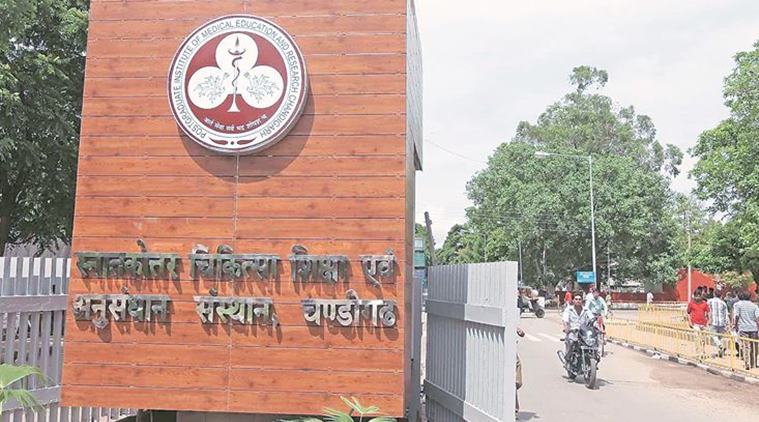
PGIMER agrees to doctors’ demands, fixes convocation in every October 

The resident doctors had launched a signature campaign to boycott the convocation. Jagat Ram, director, PGIMER also issued letter to the Association of Resident Doctors in which he regretted the inconvenience caused to the recipients of degrees and their families.

Written by Yasir Ahmed | Chandigarh | Published: February 5, 2019 8:43:39 am


The 35th convocation, which was scheduled on February 4, was rescheduled owing to Union Health Minister JP Nadda’s busy schedule.

The standoff between the Post Graduate Institute of Medical Education and Research (PGIMER) administration and resident doctors came to an end on Monday with the director of the institute agreeing to the demands and issuing a written apology. It was also decided that the convocation will be held in October every year.

The 35th convocation, which was scheduled on February 4, was rescheduled owing to Union Health Minister JP Nadda’s busy schedule. The resident doctors then launched a signature campaign to boycott the convocation. Jagat Ram, director, Post Graduate Institute of Medical Education and Research (PGIMER) on Monday issued letter to the Association of Resident Doctors in which he regretted the inconvenience caused to the recipients of degrees and their families.

The letter said, “Doctors are the symbol of nobility, humanity and empathy. It is hoped that these basic qualities would be kept in mind for all times to come and it is expected that all of us together will keep the PGI flag flying high.”

In his letter, the director also mentioned that the matter was deliberated in detail with senior functionaries, committees and stakeholders. “From next year, the convocation of PGI will be held in October every year,” he said. He also said degrees will be sent by courier to the resident doctors who would not be able to reschedule their visit to PGI.

President of the Association of Resident Doctors (ARD), Dr Uttam Thakur, asked for a written apology for the inconvenience to each of the resident doctors on mail by the administration. The doctors also demanded sending degrees by post, free of cost. The third demand was that a month be fixed for the convocation and a fall back option for chief guest.

The convocation will be held on February 9 from 11.30 am.

UGC-appointed panel suggests encrypted barcodes over roll numbers 

A University Grants Commission (UGC)-appointed panel has preferred the introduction of encrypted barcodes over roll numbers to curb malpractices in examinations and on-demand examination facility to help students. education 


Updated: Feb 05, 2019 08:16 IST


Amandeep Shukla
Hindustan Times, New Delhi


A University Grants Commission (UGC)-appointed panel has preferred the introduction of encrypted barcodes over roll numbers to curb malpractices in examinations and on-demand examination facility to help students. (Bloomberg)

A University Grants Commission (UGC)-appointed panel has preferred the introduction of encrypted barcodes over roll numbers to curb malpractices in examinations and on-demand examination facility to help students.

The nine-member panel, set up to make suggestions for an overhaul of the examination system in the country’s higher education institutes, is also of the view that a model should be created for undergraduate, post-graduate, MPhil and PhD courses that will enable continuous internal evaluation and external tests.

The committee headed by MM Salunkhe, a former vice-chancellor of the Central University of Rajasthan, also thinks that the process of making question papers needs drastic reforms, and it is for facilitating actual learning instead of rote learning.

The report was submitted to UGC on January 29. The council is largely in agreement with the suggestions, a UGC member said.

The panel of eminent educationists emphasised that a learning outcome-based framework should be the priority. Exams in the present system, however, are often reduced to testing memory skills alone, the panel felt.

Models for courses from undergraduate to PhDs should be worked out to balance continuous internal assessment and external assessment. For instance, institutions can give 30% weightage to internal assessment and 70% assessment to external examination, the panel said. In exceptional institutions, this ratio can even be 60:40.

To curb malpractices, the panel has suggested the use of encrypted barcodes. It also observed that a major source of cheating was help from outside the exam hall. If candidates are not permitted to leave the exam centre in the first 90 minutes, and if they are not allowed to take question papers outside, this problem can be nipped in the bud, the panel said.

It held that question papers should be transmitted to the centres through the internet just before the commencement of the exam.

A national board may be established to conduct examinations “on-demand”, the report said. “The panel has made several recommendations, including on-demand exams. Under this system, a student can choose whether s/he is ready to take the test for the semester s/he is studying in...,” said the commission member.
Both Mamata Banerjee and Modi govt see moral win in Supreme Court order 

Mamata Banerjee described the Supreme Court ruling on CBI versus Kolkata police commissioner case as “a moral victory” after which Ravi Shankar Prasad called it “a great moral victory for the CBI”. 


 india Updated: Feb 05, 2019 12:49 IST

HT Correspondent
Hindustan Times, New Delhi


Kolkata police commissioner Rajeev Kumar with West Bengal Chief Minister Mamata Banerjee during West Bengal and Kolkata Police award ceremony at Esplanade in Kolkata on Monday. (Photo by Arijit Sen/Hindustan Times)(Arijit Sen/HT Photo)

Soon after West Bengal Chief Minister Mamata Banerjee claimed “moral victory” following the Supreme Court ruling that the Central Bureau of Investigation (CBI) can question Kolkata police commissioner Rajeev Kumar but not arrest the Bengal top cop, the Bharatiya Janata Party (BJP) interpreted the apex court order to its own advantage. Union Law Minister and senior BJP leader Ravi Shankar Prasad said the Supreme Court order was “a great moral victory for the CBI”.

“This order was given by the Supreme Court to investigate the conspiracy angle and also money laundering angle. This investigation must be done in a fair manner. Let’s not politicise it. This is a great moral victory for the CBI,” the Union law minister said.

Ravi Shankar Prasad further accused Mamata Banerjee and “other political parties” of maintaining a “silence” even as lakhs of small investors were cheated” in the chit fund scams in West Bengal. Follow live updates here

Prasad said, “Today we have to ask larger questions on behalf of the party (BJP). Lakhs of small investors were cheated and looted of their money. Is it not our moral obligation to push for an investigation? Why is Mamata ji silent on this? Why are the other political parties silent on this?”

The law minister’s comments followed Banerjee’s claim that the Supreme Court order vindicated her sit-in protest in support of the police officers of West Bengal. Banerjee said, “Rajeev Kumar never said he will not be available. He said we want to meet at a mutual place, if you want to ask for any clarification, you can come and we can sit.”

“But what they (CBI) started doing? They wanted to arrest him. They went to his house, on a secret operation, on Sunday, without any notice. That court said ‘no arrest’. We are so obliged. It will strengthen the morale of the officers,” Banerjee said in Kolkata, where her protest entered third day on Tuesday.

Earlier in the day, the Supreme Court directed Rajeev Kumar to “faithfully” cooperate with the CBI and appear before the central agency, which is probing cases related to the Saradha chit fund scam. A Supreme Court bench headed by Chief Justice of India (CJI) Ranjan Gogoi fixed Meghalaya capital Shillong as the venue for meeting of CBI officials and Koltaka top cop Rajeev Kumar.

The CBI had told the Supreme Court that it had apprehension that Rajeev Kumar, who header a special investigation team in the case earlier, may tamper with evidence related to the chit fund scam. The matter will come up for hearing next in the Supreme Court on February 20.

Banerjee began her sit-in after a CBI team reached Kolkata on Sunday to question Rajeev Kumar in connection with Sharada and Rose Valley chit fund scams in West Bengal. The CBI officials were allegedly detained at a police station in an unusual chain of events that also saw Banerjee rushing to Rajeev Kumar’s residence. The CBI officials were later released apparently under instructions from Banerjee.

The BJP has alleged that the leaders of ruling Trinamool Congress party were the beneficiaries of the chit fund scams in which crores of rupees were fraudulently collected from small investors. Banerjee has said it was her government, after coming to power for the first time in 2011, which probed the chit fund scams and arrested Saradha chairman Sudipta Sen. She said Rs 250-300 crore was returned to the duped depositors due to action taken by her government.
CBI can question Kolkata police chief Rajeev Kumar, can’t arrest him, orders Supreme Court; Mamata says victory 

West Bengal chief minister Mamata Banerjee said the court verdict is a “moral victory”. “Rajeev Kumar never said I will not be available. They (CBI) came to arrest. The court said no arrest,” Mamata said. india Updated: Feb 05, 2019 13:07 IST

Bhadra Sinha
New Delhi, HT Correspondent

Kolkata police commissioner Rajeev Kumar with Mamata Banerjee during the police award ceremony at the dharna site in Esplanade, Kolkata, on Monday.


 (Photo by Arijit Sen/Hindustan Times)(Arijit Sen/HT Photo)

The Supreme Court on Tuesday ordered Kolkata police commissioner Rajeev Kumar to cooperate with the CBI in the Saradha chit fund case. The court though made it clear that no coercive steps, including arrest, can be taken against him.

“We direct the chief secretary of the state and the DGP to file their replies on or before February 18,” a bench led by Chief Justice of India Ranjan Gogoi said on Tuesday. (Follow live updates here)

Also watch: SC tells Kolkata’s top cop to cooperate, Mamata calls decision ‘moral victory’

West Bengal chief minister Mamata Banerjee, who is sitting on a dharna against CBI’s attempts to question Rajeev Kumar, said the court verdict is a “moral victory”. “Rajeev Kumar never said I will not be available. They (CBI) came to arrest. The court said no arrest,” she said. The Mamata Banerjee government has been involved in showdown with the Centre after the CBI came to the Kolkata police chief’s doors on Sunday night to question him.

The Supreme Court said Kumar should appear at a neutral place—Shillong. The court said it may seek personal presence of the police officers after it considers the response files by the chief secretary and DGP. If presence is required then they would be intimated by February 19.

Attorney General KK Venugopal, who appeared for the CBI, said the unprecedented events in West Bengal showed there was complete breakdown of the constitutional machinery.

The CBI moved the court seeking directions to Rajeev Kumar to cooperate with the investigation in the Saradha chit fund case. The CBI had raised suspicions that the Kolkata top cop was destroying evidence in the chit fund case.

On Sunday night, a CBI team was detained by Kolkata police in an unprecedented chain of events that also witnessed chief minister Mamata Banerjee rushing to Kumar’s residence. The CBI officers were taken to Shakespeare Sarani police station and released later under instruction from Mamata Banerjee.
HC quashes GO mandating 50% minorities in minority institutions

TNN | Jan 31, 2019, 06.29 AM IST


CHENNAI: The Madras high court on Wednesday quashed a government order that said minority educational institutions should admit not less than 50% of students belonging to the community concerned every year to retain the status.

The order dated April 5, 2018, had brought in the additional guideline for grant of minority status to educational institutions.

Allowing the plea moved by the Institute of the Franciscan Missionaries of Mary, Justice T Raja said the state government did not have the power to pass such orders under the National Commission for Minority Educational Institutions Act, 2004.

The petitioner had argued that the government order suffered from executive malafide as it sought indirectly to deny minority status to educational institutions established and administered by minority communities by imposing a burdensome and impractical condition, modifying the principles that have stood the test of time.

In the absence of any complaint from a minority community that its students had been denied admission in an institution run by it, there was no basis for the government order, the petitioner said.

‘Common rule won’t work as TN has 6.1% Christians’

There cannot be a common rule throughout the state to admit a minimum of 50% minority students in such institutions as a condition for minority status, while the Christian population was only 6.1% in the state, the petitioner said.

The Supreme Court has time and again held that the minority institutions gain minority character because they were established and administered by the minority community and not because of the number of minority students admitted therein. If the minority status was linked to the ratio of admission of minority students it will be fluctuating in minority character/status, each year. There will never be a certainty in the nature of the institution. That was not the intention of the founding fathers of the Constitution and therefore, the judgment of the apex court cannot be misinterpreted by the executive authorities, the petitioner argued.

NEWS TODAY 11.06.2026