Huge influx of devotees raises risk of stampede on Tiruvannamalai girivalam path in TN
Temple visitors recall multiple near-stampede incidents during holidays over past 3 years.
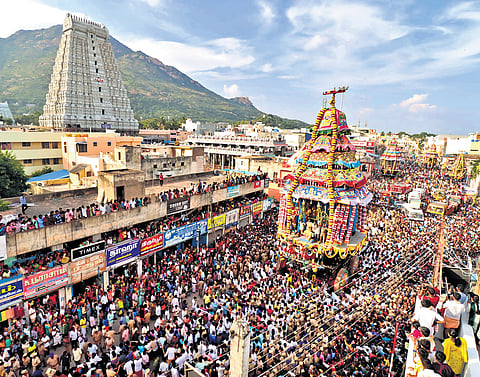
Thousands of devotees from across the country take part in ‘girivalam’ ritual held at the Arunachaleswarar temple in Tiruvannamalai.(File photo)
B Anbuselvan
Updated on:
06 Oct 2025, 8:03 am
CHENNAI: Once a quiet town in northern Tamil Nadu, Tiruvannamalai has now become a potential hotspot for stampedes owing to the steady influx of devotees, particularly from Andhra Pradesh and Telangana. With every inch of space occupied with devotees, the girivalam (pilgrimage walk) path, the Arunachaleswarar temple and Tiruvannamalai railway station are showing signs of becoming potential disaster zones. The temple which witnessed large gatherings only during Karthigai Deepam and the girivalam days until 2021, is now receiving massive crowds on weekends and extended holidays as well.
Regular visitors who spoke to TNIE recalled witnessing multiple minor stampedes on the girivalam path over the past three years, frequently leading to people fainting from dehydration and prolonged walking, particularly when Pournami falls on weekends or public holidays. Also, with the shortage of bus and train services to Tirupati and Chennai, Tiruvannamalai railway station becomes completely packed, and passengers encounter near-stampede situations every Pournami.
“It took nearly 11 hours to complete the 14-km girivalam in April 2024 when the crowd was estimated at around 25 lakh people. In at least four stretches, I found myself trapped in stampede-like situations as ambulances tried to make their way through the dense crowd to reach people who had fainted,” recalled Siva Bharathi, 43, a resident of Chennai. “After that, I no longer took my kids to Tiruvannamalai,” added Bharathi.
Officials from the district administration have remained tight-lipped about it, noting that it is up to the state government to take a policy decision on implementing crowd management measures at temple sites. “The chief minister announced that a standard operating procedure (SOP) would be framed for public events. It remains to be seen if the temple events during festival or non-festival days also will be covered,” said an official.
A temple official said, “Devotees can now offer worship in front of the Annamalaiyar sanctum from three rows at a time, instead of the previous two. This has significantly helped to reduce congestion. Drinking water facilities have also been increased,” said an official.
Tiruvannamalai town is accessible by nine major roads, with vehicles arriving primarily from Chennai, Vellore, Chengam, Bengaluru, Tiruchy, and other regions. In view of the growing crowds, the district administration has established temporary bus shelters at 25 locations on the outskirts of the town. Additionally, police have erected watchtowers along the girivalam path to monitor the movement of devotees and ensure safety.
The girivalam route narrows drastically — from 40 feet to about 20 feet soon after the temple — posing a stampede risk, said locals. “When devotees from three directions converge in front of the main Rajagopuram of the temple, a massive crowd builds up at the temple entrance. As they begin the girivalam, the stretch that narrows to 20 feet for nearly 300 metres becomes a potential disaster zone,” recalled S Sridhar, a devotee and resident of Tiruvannamalai.
According to MV Narasimman, a resident and activist from Tiruvannamalai, the influx of devotees is partly attributed to the influence of well-known Telugu spiritual orator Chaganti Koteswara Rao and YouTube channels emphasising that Arunachaleswarar serves as the Kuladeivam (family deity) for numerous Telugu families. “For Telugu devotees, Tiruvannamalai has become a must-visit pilgrimage spot, often combined with a visit to Tirupati,” Narasimman explained.
He further alleged that the recent gang rape of a woman by two police constables who intercepted a vehicle at a check-post serves as a stark reminder that the administration lacks a clear plan for crowd management.
S Naresh from Sannadhi street said, “Approximately, during the pournami girivalam, around 40% of the participants are devotees from Tamil Nadu, while nearly 60% are Telugu-speaking pilgrims. On regular weekends, Telugu-speaking visitors make up almost 95% of the crowd.”
A railway official acknowledged the overcrowding of trains and said the issue will be looked into.


No comments:
Post a Comment